
Field notes
Dairy cow field notes from the Cowdemy atlas — rumen, udder, hoof, transition, and barn. Newest first, with the sheet each note belongs to.
45 notes · newest first in each area
Rumen
Fermentation, fiber, and starch load
- Chop length is not peNDFChop length is a harvester setting; peNDF is the fiber structure that actually reaches the rumen after moisture, processing, mixing, and sorting.Rumen · Physically effective fiber · 3 min

- Refusals read the peNDF storyShake fresh TMR and the refusal pile with the same particle separator — divergence shows whether formulated peNDF actually reached the cow.Rumen · Physically effective fiber · 3 min

- Sorting steals the peNDFA correctly mixed TMR can still fail when cows pick fines and leave long forage — the consumed ration loses peNDF even though the ticket looked right.Rumen · Physically effective fiber · 3 min

- Water is a fiber plasticizerForage dry matter changes how the TMR mixes and how the particle box reads — even when chop length matches a drier day.Rumen · Physically effective fiber · 3 min

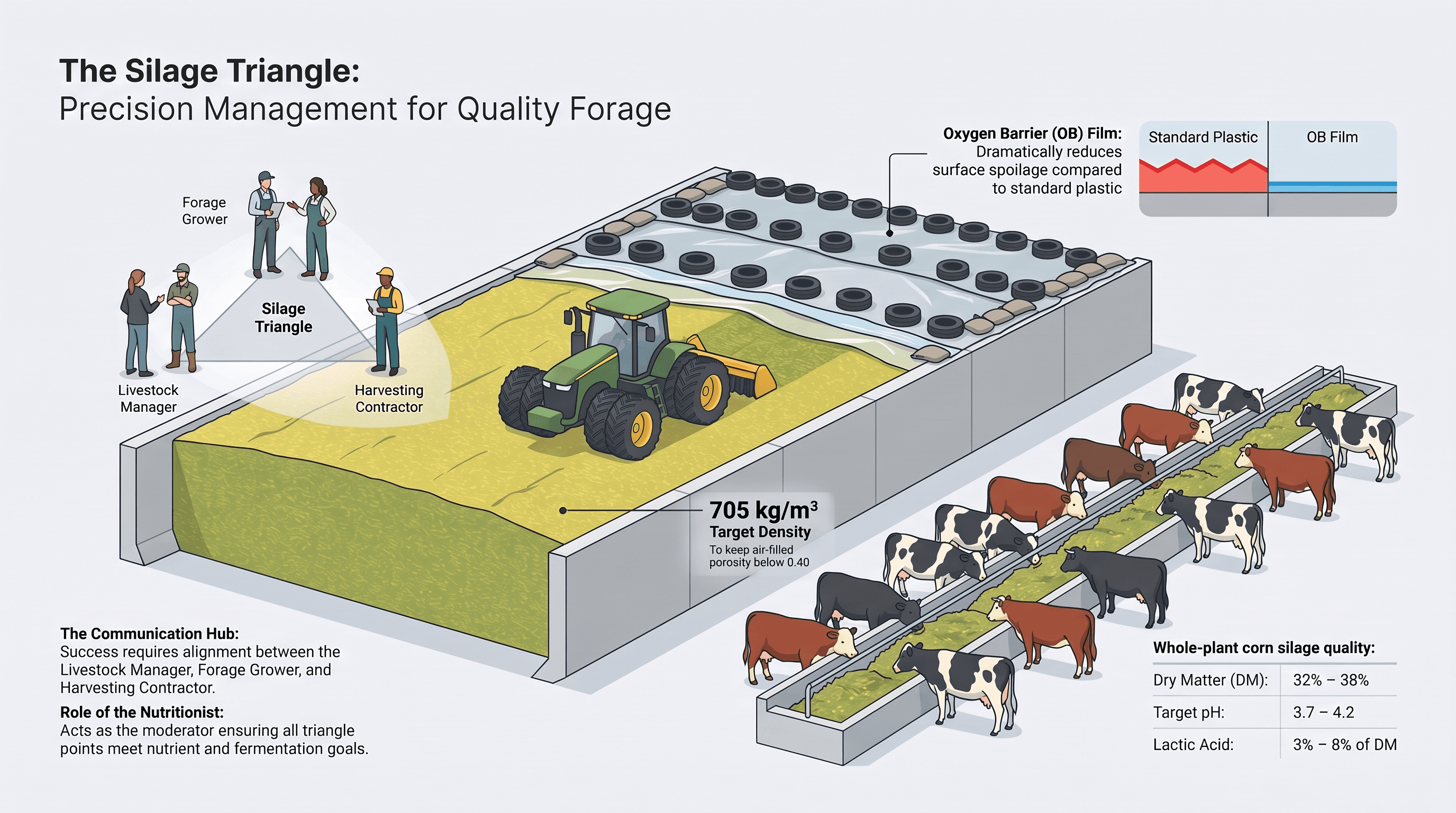
- Air at the face spoils the packDense packing and oxygen-barrier cover lock fermentation in. A ragged, slow face lets air back in and burns dry matter at the bunk.Rumen · Inside the rumen · 3 min
- Milk fat depression starts in the rumenHigh starch and unsaturated fat with weak effective fiber can shift biohydrogenation toward trans-10 intermediates that suppress mammary fat synthesis.Rumen · Starch load & SARA · 3 min

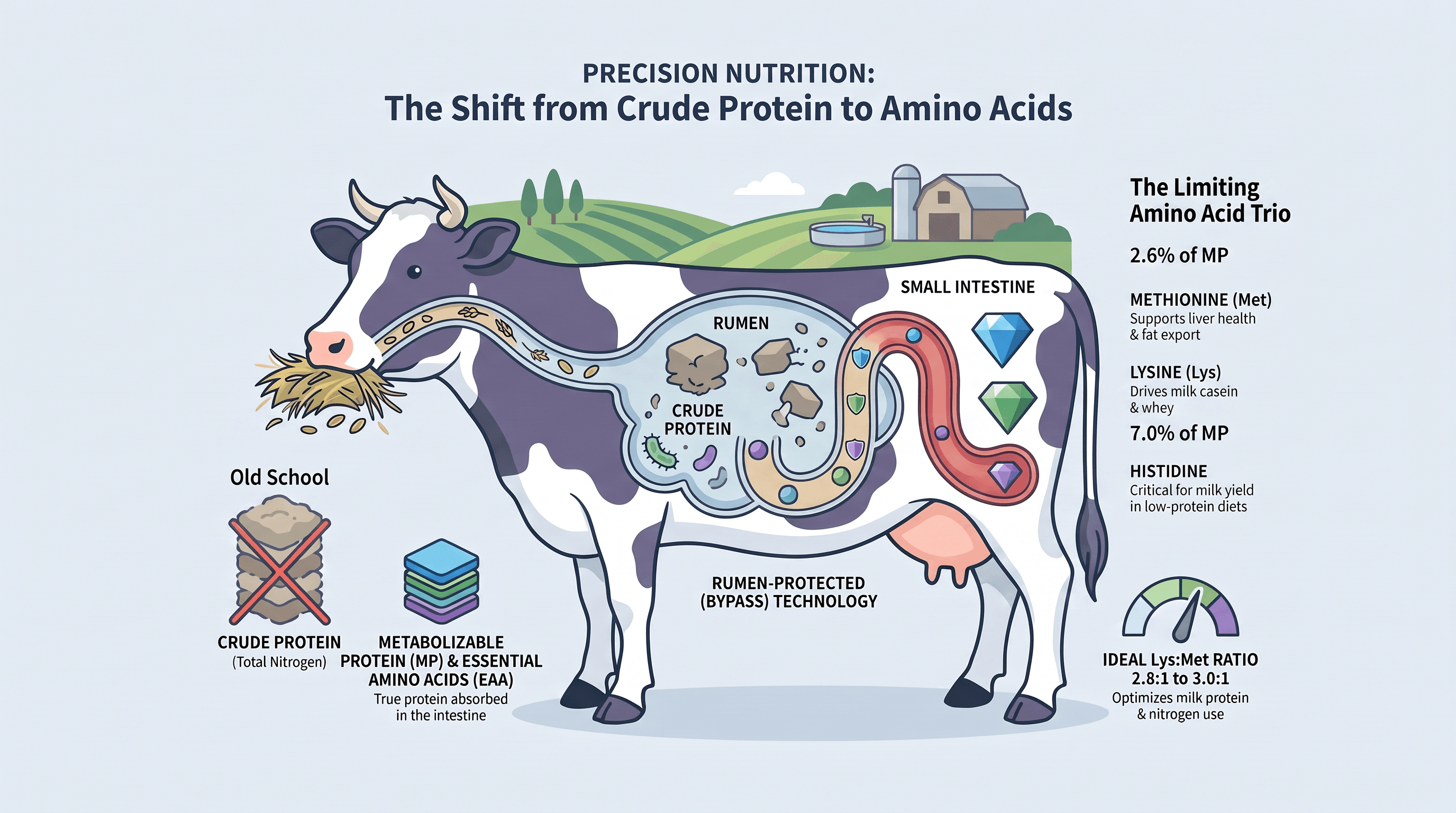
- MP is not crude proteinCrude protein counts nitrogen. Metabolizable protein asks what amino acids actually reach the cow after the rumen.Rumen · Inside the rumen · 3 min
- Read manure before you rewrite the ticketThe alley is a daily report card on the ration the cow actually ate and fermented — consistency, fiber, and grain tell you before the mixer does.Rumen · Inside the rumen · 3 min

- Saliva is the free bufferBagged bicarbonate has a line item. Saliva is the free, manageable buffer you earn with chewing — not the larger proton sink than SCFA absorption.Rumen · Inside the rumen · 3 min

- The mixer and push-up are part of the rationScales, mix time, and bunk push-ups decide whether the printed recipe is what the cow actually eats — empty bunks and drifted loads rewrite the ration.Rumen · Physically effective fiber · 3 min

- The sensor is a barn alarm, not a diagnosisRumination and activity collars flag deviations from a cow’s own baseline — useful alarms that still need the cow, bunk, and stall before you act.Rumen · Inside the rumen · 3 min

- Overmixing Steals the MatYour ration might look perfect on paper, but if the mixer grinds your forage too fine, you lose the physically effective fiber required to build a healthy rumen mat.Rumen · Physically effective fiber · 3 min

- Cud chewing is the cheapest rumen sensorRumination is how the cow rebuilds particle size and pumps saliva bicarbonate into the vat. If she stops, the buffer stops.Rumen · Inside the rumen · 3 min

- Empty bunks are starch eventsCows that wait, then eat fast, drop pH even when the printed diet never changed.Rumen · Starch load & SARA · 3 min

- Reading milk fat as a rumen alarmA falling fat test is often the first cheap signal that fermentation has shifted, not that the cow forgot how to make fat.Rumen · Inside the rumen · 3 min

- Milk fat first, then manureSARA rarely announces itself with a down cow. The tank and the alley move while the parlor still looks busy.Rumen · Starch load & SARA · 3 min

- Particle size holds the fiber matIf the TMR is too fine, the forage raft thins — less trapping, less re-chewing, less bicarbonate-rich saliva.Rumen · Inside the rumen · 3 min

- SARA is not grain overloadAcute acidosis is an emergency. SARA is a chronic, almost-normal herd that is quietly losing fat, fiber digestion, and later hoof integrity.Rumen · Starch load & SARA · 3 min

- Shake the bunk, not the memoryThe particle box is only honest if the sample is the diet the cow can reach.Rumen · Physically effective fiber · 3 min

- The top sieve is not the goalLong stems look like fiber and often become refusals.Rumen · Physically effective fiber · 3 min

Udder
Mammary anatomy and mastitis pathways
- Milk meters are early alarms — not diagnosesInline fat, protein, and SCC signals can flag rumen or udder trouble early — useful alarms that still need the bunk and the teat before you act.Udder · Mastitis pathways · 3 min

- The stall bed is half the teat environmentBetween milkings the teat lives on the stall bed. Wet, dirty bedding is a continuous environmental bacterial dose.Udder · Mastitis pathways · 3 min

- Milking is a transmission machineContagious mastitis hops cow-to-cow on liners, hands, and towels — the parlor is the transit system to the teat canal.Udder · Mastitis pathways · 3 min

- Name the reservoir firstMastitis control starts with the reservoir: milking-time spread and bedding exposure need different checks, and culture plus records should guide the next move.Udder · Mastitis pathways · 3 min

- The teat end is the gateA compromised teat sphincter undermines even effective post-milking disinfection; managing hyperkeratosis begins with machine function and milking routine.Udder · Inside the udder · 3 min

Hoof
Claw map, lesions, recognition, and risk
- Camera scores are screening — not diagnosesComputer-vision gait scores can prioritize cows and track herd trends — useful screening when camera setup is honest, never a veterinary diagnosis on their own.Hoof · From lameness to lesion · 3 min

- Hoof records are herd trends — not diagnosesStandardized digital trim records and lesion codes can show infectious vs claw-horn patterns over time — useful herd trends when read with BCS, energy balance, and standing time, not a cow-side diagnosis.Hoof · From lameness to lesion · 3 min

- Standing time is the doseProlonged standing load can bruise the corium and surface weeks later as a claw-horn lesion.Hoof · Why hoof lesions develop · 3 min

- The new parlor added two hours of standingThroughput rose. Thin soles followed the extra hold time.Hoof · Why hoof lesions develop · 4 min

- Name horn or skin before you sprayDigital dermatitis and a sole ulcer fail entirely different tissues. One protocol cannot fix both.Hoof · From lameness to lesion · 3 min

Transition
The ±3-week window around calving
- Dry period is recovery timeA controlled dry period plus close-up bunk access is mammary recovery time — not an empty parking lot before calving.Transition · The transition cow · 3 min

- The DCAD sweet spotPrepartum DCAD is a calcium-readiness tool — moderate negative targets help; extremes buy little calcium and more acid load.Transition · The transition cow · 3 min

- When the fresh cow’s energy gap widensAfter calving, milk demand rises faster than intake — the gap is where ketone risk lives.Transition · The transition cow · 3 min

- The fresh pen was stocked at 120%Calving went well; in the fresh pen, 96 cows competed for 80 headlocks, and first-lactation cows paid in lost bunk access and intake.Transition · The transition cow · 4 min

- Intake before the next additiveTransition-cow intake is the first ration to protect: a heating TMR lowers the nutrients she can actually consume.Transition · The transition cow · 3 min

Barn
Heat, stocking, water, and cow flow
- A rising fetch list is a time-budget failureRobots succeed when cows choose the box and still get 12–14 hours lying. A climbing fetch list means the barn is stealing that time.Barn · Stocking & cow flow · 3 min

- Build the stall around the riseHigh-producing cows need 12–14 hours lying. A stall that blocks the rise charges that time back as standing, collisions, and lesions.Barn · Stocking & cow flow · 3 min

- Stocking density is a time budgetOverstocking steals lying and eating time — manage stalls, bunk, and flow, not headcount alone.Barn · Stocking & cow flow · 3 min

- THI and air speed stage the coolingBarn THI alone can miss the cow's microclimate — pair temperature-humidity with cow-level air speed so fans, misters, and soakers stage against what she actually feels.Barn · Heat stress · 3 min

- Water space is a ration ingredientLinear water space and refill rate behave like ration ingredients — if subordinate cows wait, intake and milk are already slipping.Barn · Heat stress · 3 min

- Water is the third letter in S-A-WShade and air get the budget meetings. On a muggy afternoon, the queue at the trough is often the first place heat load becomes visible.Barn · Heat stress · 3 min

- They closed a crossover to add stallsHeadcount math ignores behavioral biology: walling off a crossover crippled cow flow and penalized subordinate cows.Barn · Stocking & cow flow · 3 min

- Walk the dry yard at two o’clockThe milk barn can look cooled while the next lactation pants in a still pocket.Barn · Heat stress · 3 min

- Hidden stocking is lockup plus holdThe stall sheet said 100%. The cows stood from breakfast through the second parlor turn.Barn · Stocking & cow flow · 3 min

- The holding pen was the hottest roomParlor fans were fine. The packed pen before the gate was still.Barn · Heat stress · 4 min
