
Overmixing Steals the Mat
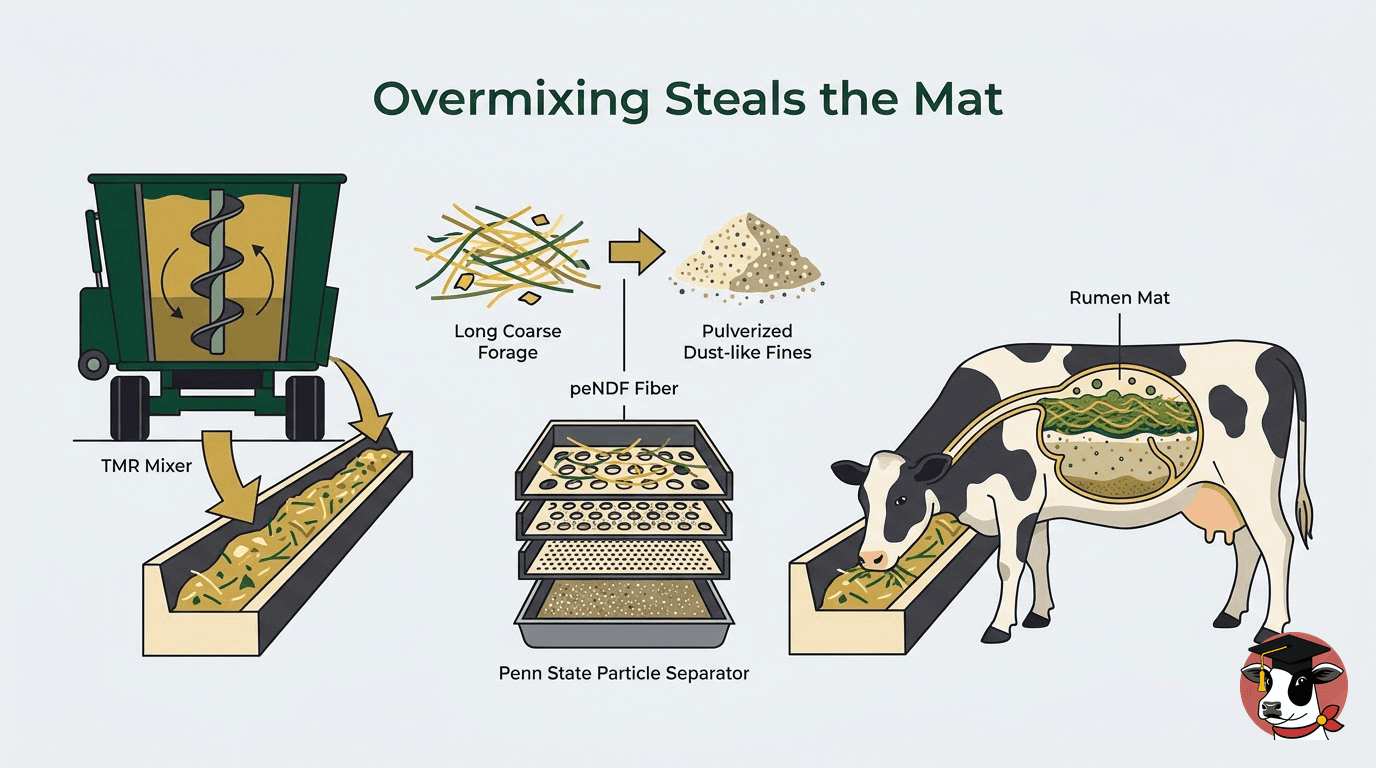
Your ration might look perfect on paper, but if the mixer grinds your forage too fine, you lose the physically effective fiber required to build a healthy rumen mat.
3 min read · 2026-09-08
In this note
- 30–40%
- 50–60%
- three to five minutes
- 8–19 mm
- >19 mm
You walk the feed bunk just after morning delivery. The ration looks like a perfectly uniform blend — smooth, well-incorporated, and completely free of the long, coarse hay stalks that cows occasionally toss over their shoulders. To the human eye, it looks like a win. But two weeks later, milk fat is slipping, manure consistency is erratic, and the barn is suspiciously quiet when the cows are resting.
Your ration software says you are feeding exactly the right amount of neutral detergent fiber (NDF). But the cows are telling you that they do not have enough physically effective fiber (peNDF). What happened between the printout and the bunk? You overmixed the TMR, and you stole the rumen mat.
Nutritionists assume forage structure survives the mixer; that structure drives chewing, saliva buffer, and the floating fiber mat. When mixing times stretch — waiting on the loader, chores between ingredients, winter dry-outs — the mixer becomes a grinder. Aggressive vertical knives and soft forages (BMR corn silage, wet haylage) break down fast. Chemical NDF can match the recipe while peNDF fails, leading to faster passage, lower pH, SARA risk, and butterfat drop.
Check in the barn
Barn checks: run a Penn State Particle Separator on delivered TMR. If the top (>19 mm) and second (8–19 mm) sieves look stripped and the bottom pan (<4 mm) climbs toward or past about 30–40% while upper sieves are thin, over-processing is likely. Penn State’s TMR guide targets blend, not chop — about three to five minutes after the last ingredient for many vertical mixers. Two hours after feeding, roughly 50–60% of resting cows should be chewing cud; a quiet barn often means lost scratch factor.
To correct: load hay early and fragile silages later so they are not pulverized while you wait on the next ingredient. Dull knives force longer mix times that destroy the rest of the ration. Sister notes on this universe cover shaking the bunk you delivered and why the top sieve is not the goal — this note is what happens when the wagon erases length after the sheet was printed.
Sources
- Penn State Particle Separator — Penn State Extension
- Total Mixed Rations for Dairy Cows — Penn State Extension