
The top sieve is not the goal
Long stems look like fiber and often become refusals.
3 min read · 2026-09-07
In this note
- 2–8%
- 19 mm
- 8 mm
- 4 mm
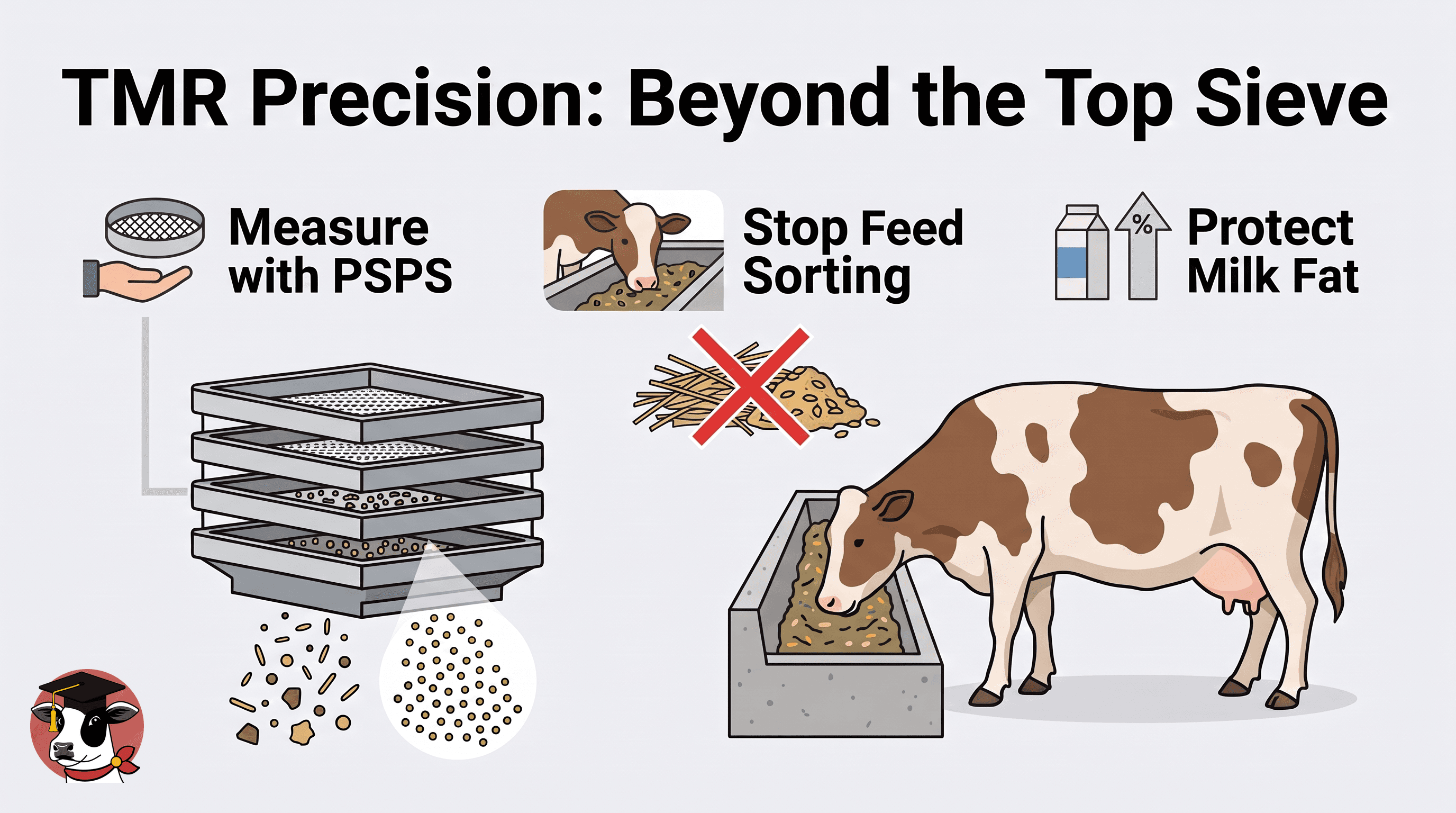
The Penn State Particle Separator top sieve catches the longest stems. On a high-producing TMR, that 19 mm fraction is meant to stay small — typically about 2–8%.
Broomstick stems look like fiber on the clipboard and get sorted out of the bunk.
Most of the peNDF mass that supports chewing lives on the 8 mm and 4 mm sieves together — particles long enough to help hold a mat without inviting refusals.
The 4 mm screen is the peNDF cutoff used to estimate physically effective fiber; it is not the main scratch layer by itself.
The 2013 update that added the 4 mm sieve changed how peNDF is estimated on farm; the companion guideline is an eatable-length TMR — enough length to chew, not so much that cows refuse it.
If the top sieve runs high and the refusals are stem-heavy, you built a sorting diet, not a safer rumen.
Sources
- Penn State Particle Separator — Penn State Extension
- Methods Used to Measure Forage and Ration Particle Size — Penn State Extension