
The Pen Average Hides the Cows That Lose
A pen average weights every cow equally, so a small group that is doing badly can disappear inside a number that looks acceptable.
Knowledge level in this topic: Intermediate. Barn-side working knowledge in this topic: checks, pairing, and what to do next.
3 min read · 2026-10-05
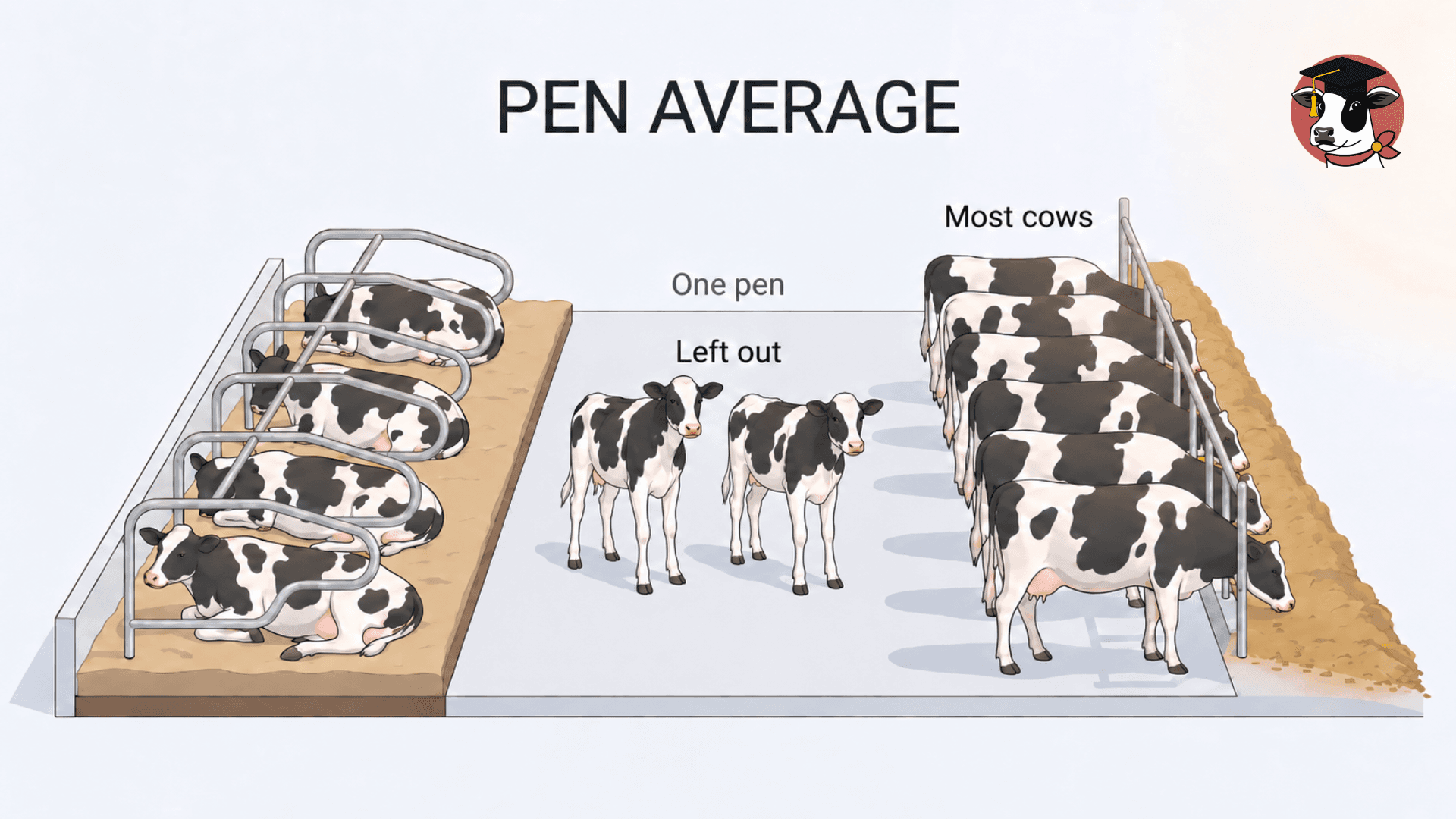
A pen report comes back with one number, and the number looks acceptable. That figure is an average for the cows in the pen, so it describes the cow who is, on average, in that pen, not every cow's day.
An average weights every cow equally, so the larger group decides the number. A pen is rarely one group: parity, stage of lactation, health status and social rank can split the experience of the same stalls, bunk and water. The measure can be hours lying, time at the bunk, milk or a lameness score. Stalls, bunk and time fail separately, and a single stocking percentage is not the cow's experience.
Illustration only, with invented values (not targets, norms or measured farm findings). A pen contains 80 mature cows averaging 12 hours lying per day and 20 first-lactation cows averaging 8 hours. The pen average is (80 x 12 + 20 x 8)/100 = 11.2 hours. Reporting only 11.2 conceals the group difference: the average sits close to the larger mature group while the smaller group is far below it. Lying time differs among cows and systems; these invented hours are not a design goal or a pass mark.
Cows in one pen do not share one experience of feed, water and stalls. In controlled trials with lactating Holstein cows, animals ranked lower in the social hierarchy were displaced more often at a crowded feed bunk, and feeding activity rose with more feeding space, especially for subordinate cows. Those trials were short and do not support a lifetime claim. Unequal access can also come from the route, as when a closed crossover left subordinate cows standing in the alley, and from the fresh group, where in one herd older cows displaced first-lactation animals. First-lactation cows are one example of a smaller group that may lose, not a proven rule from those trials.
A split by group shows that a difference exists, not why. The next step is to investigate access, disease, time away and measurement quality, not to diagnose from hours alone. Watch peak demand right after feed delivery, after milking and at lock-up release, and see who waits, who is displaced and who eats late. Water is a second resource where the same cows can lose: if subordinate animals leave without drinking, observe who drinks, without treating trough length as settled science.
Ask for any pen number split by group, with a cow count for each group, and report the numerator and denominator. A 20-cow group is one in five cows in a 100-cow pen. Do not choose only the easy-to-see cows. A Journal of Dairy Science review of lying time notes that cow factors such as age influence the hours, that a valid single daily threshold is hard to set, and that context is needed before reading welfare from the number alone.
Check in the barn
What to check: Is this pen number split by parity or lactation stage, with a count for each group? Which cows are waiting, displaced or eating late at peak demand, and which resource (feed, water, stall or route) are they waiting for? Are lameness, illness or time away from the pen part of the difference? Is the measure the same for both groups? Leave diagnosis, treatment, welfare and ration decisions to the herd veterinarian and the herd's welfare, behavior and nutrition advisers.
Educational only: not a diagnosis, prescription, or facility design. Defer clinical, welfare and ration decisions to the herd veterinarian and the herd's advisers.
Keep reading
View the networkNext
Stocking density is a time budget
Overstocking steals lying and eating time. Manage stalls, bunk, and flow, not headcount alone.
Knowledge level in this topic: Intermediate. Barn-side working knowledge in this topic: checks, pairing, and what to do next.Sister note · 3 min
Home plate: Barn · Stocking & cow flow · Resource-based stocking
- Resource-based stockingNot one percentagePlaced here
- Build the stall around the riseLying time is the budget a stall protects. A stall that blocks the rise charges that time back as standing, collisions, and lesions.Sister note
- They closed a crossover to add stallsHeadcount math ignores behavioral biology: walling off a crossover crippled cow flow and penalized subordinate cows.Sister note
- The transition cowClose-up through early fresh: intake lags milk, calcium must adapt, the uterus involutes, and space is part of the protocol.Bridge → Transition
Mark size is the kind. Color is the atlas area.
- Sheet
- Focus
- Field note
- Transition
- Barn
Sources
- Stocking density and feed barrier design affect the feeding and social behavior of dairy cattle — Journal of Dairy Science (2006)
- Effect of feeding space on the inter-cow distance, aggression, and feeding behavior of free-stall housed lactating dairy cows — Journal of Dairy Science (2004)
- Invited review: Lying time and the welfare of dairy cows — Journal of Dairy Science (2021)
- Invited review: Freedom from thirst: Do dairy cows and calves have sufficient access to drinking water? — Journal of Dairy Science (2021)
- Stocking Density — The Dairyland Initiative, University of Wisconsin-Madison