
Footbath Design: Length, Depth, Cow Passes, and Cleanliness
A footbath only works if every cow gets enough clean contact — length, depth, and how often the bath is refreshed decide whether heels are treated or just splashed with dirty solution.
3 min read · 2026-09-17
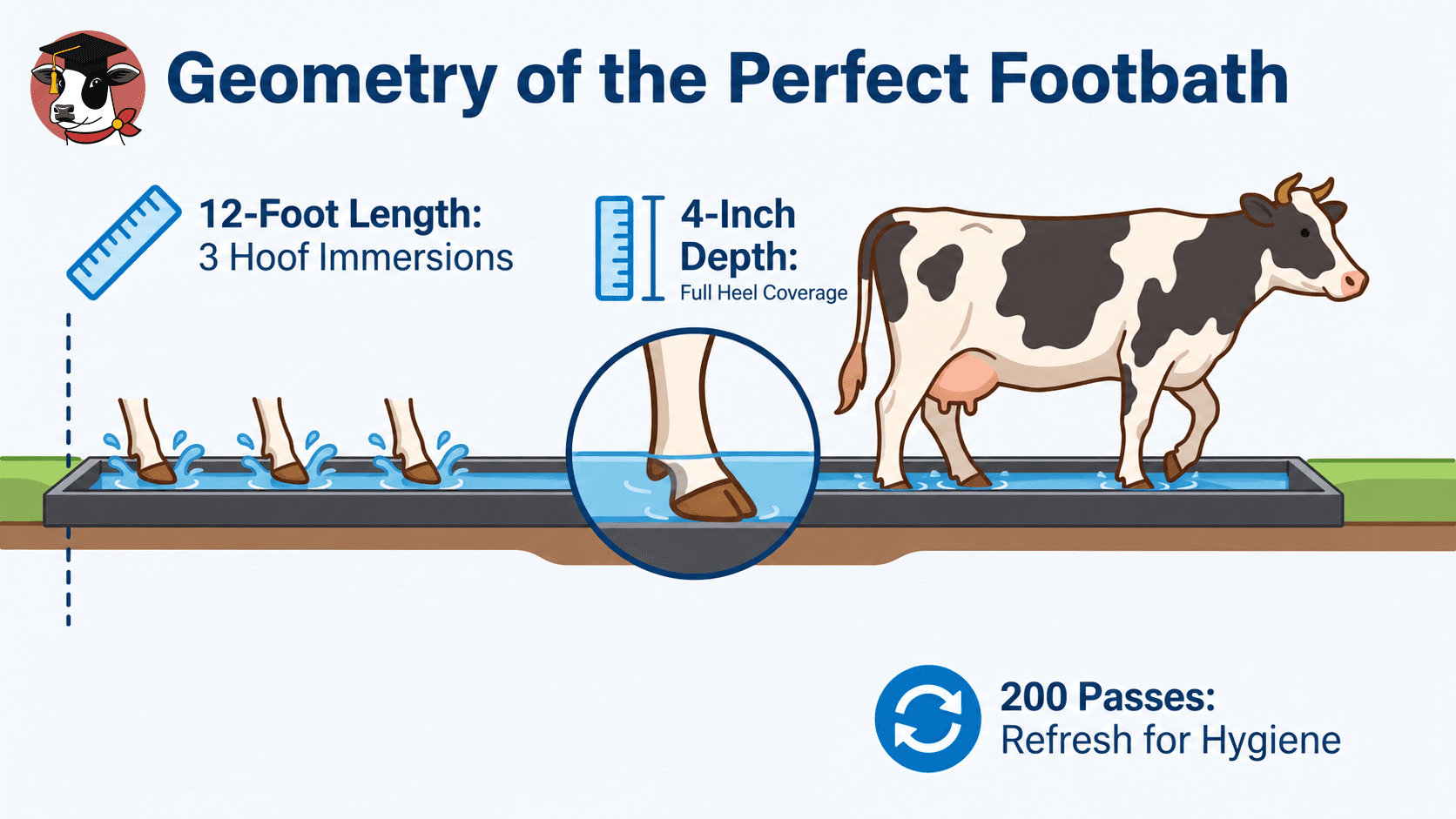
The product in the bath cannot prevent digital dermatitis if it never reaches the heel bulbs and interdigital skin. Geometry and hygiene decide contact. Pair this with the companion note on footbaths as prevention, not treatment — here the question is whether the lane is built and run so every rear foot is immersed cleanly, not only whether the chemistry is right.
Traditional short baths (often about 6 ft / 1.8 m) commonly give one rear foot a single dunk while the other may see two. Behavioral work used by the UW Dairyland Initiative shows the chance of at least two immersions per rear hoof rises sharply with length — about 96% at 10 ft (3.1 m) — and a 12 ft (3.7 m) bath pushes more feet toward three immersions. Longer contact lanes improve infectious-hoof control regardless of which antibacterial is used, because transfer to the skin is the bottleneck.
Narrow the base (about 20–24 in / 51–61 cm) with sloped side walls so volume stays similar to old short, wide baths (Dairyland's 12 × 24 in example at ~3.5 in fill holds roughly 52 gal / 197 L). Enclosed tunnel sides help cow flow; include a hinged drop panel so a downed cow can be rescued.
Target solution depth is about 3.5–4 in (8–10 cm) so heel bulbs and the interdigital cleft are covered. A ~10 in (25 cm) step-in helps cows shorten stride (more placements in the bath) and retains fluid against splash-out. Low curbs lose depth early; later cows then get a shallow splash that never reaches the heel. Place the bath on a level platform — a long bath on a parlor-return slope cannot hold uniform depth. Provide a bypass for non-bath days so cows are not forced through a dry, manure-filled basin.
Organic matter and microbial load rise with passes and defecations; volume also falls from drag-out (often roughly half after ~200 passes in field studies). Refresh guidance commonly lands around 150–200+ cow passes, but remaining depth is the non-negotiable check — dump or top off with correctly mixed solution before the floor shows through the heels. Alley scraping and cleaner feet stretch a bath; caked limbs shorten it. Extension guidance advises against pre-wash water baths that load manure into the treatment solution and add wastewater.
Check in the barn
What to check: Watch 10–20 cows: do both rear feet get at least two immersions? Is fill still ≥ ~3.5 in after the first 150 passes — or are late cows only splashing? Can the herd bypass an empty or dirty basin on off days? Is there a working side drop panel on an enclosed tunnel? When the bath looks like brown slurry, do you lower the pass limit or scrape alleys harder — or just keep dumping the same volume?
Keep reading
View the networkNext
Footbaths: Prevention, Not Treatment
A footbath is a herd prevention tool for digital dermatitis pressure — not a cure for an active painful lesion waiting in the chute. Concentration, cow passes, and cleanliness decide whether the bath reduces new cases or just paints dirty heels.
Sister note · 3 min
Home plate: Hoof · From lameness to lesion · Classify the lesion
- Classify the lesionHorn or skinPlaced here
- Digital Dermatitis in Heifers: Prevention Before First LactationHeifers that meet endemic digital dermatitis before first calving pay for it in early lactation — prevention in the rearing pen beats chasing first-lactation ulcers after they hit the parlor.Sister note
- Digital Dermatitis Staging: M0 to M4.1M-stages (M0–M4.1) turn “hairy heel wart” into a herd language for active vs chronic lesions — staging drives treatment urgency, footbath strategy, and whether chronic cows are seeding the pen.Same focus
Mark size is the kind. Color is the atlas area.
- Focus
- Field note
- Hoof
Sources
- Footbath Design — The Dairyland Initiative (UW–Madison)
- The Ideal Footbath — University of Wisconsin–Madison Extension
- Current recommendations for footbath solutions renewal rates in dairy cattle: the need for adaptation? — Relun A, et al., Animal (2019);13(9):2099–2105
- A survey of foot disinfection practices for control of bovine digital dermatitis: Evaluating solution depth, footbath hygiene, and the potential of footbaths as infection reservoirs for Treponema species — Arango-Sabogal JC, et al., Journal of Dairy Science (2024)