
Milking is a transmission machine
Contagious mastitis hops cow-to-cow on liners, hands, and towels — the parlor is the transit system to the teat canal.
3 min read · 2026-09-08
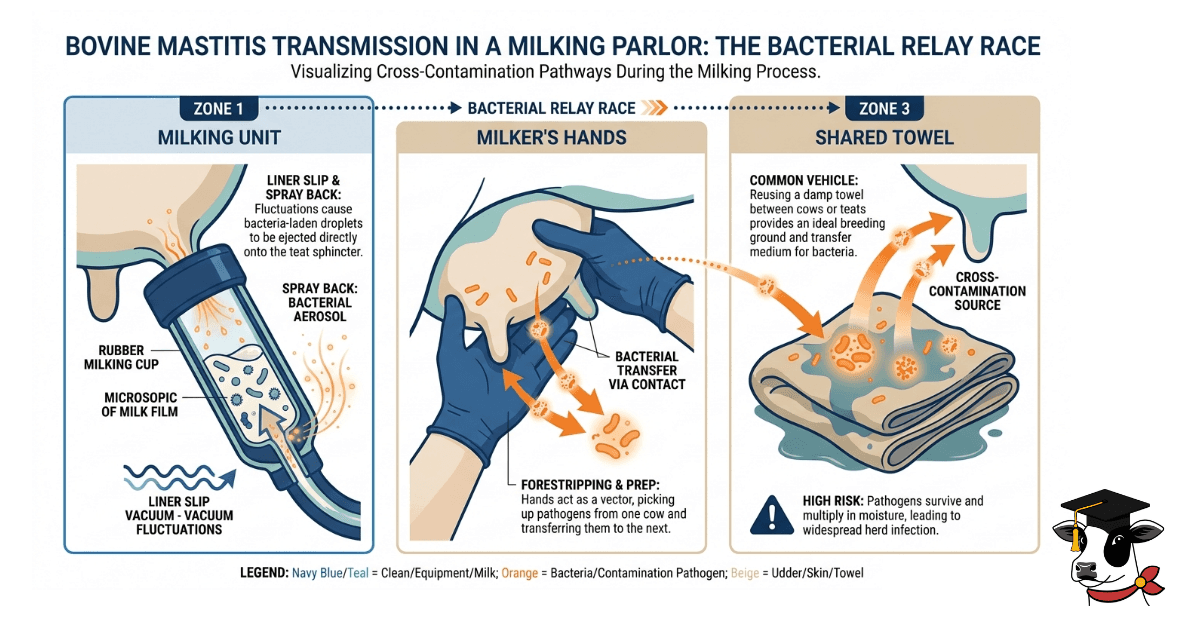
If the teat end is the gate, the milking parlor is the high-speed transit system delivering invaders directly to the doorstep. Contagious mastitis pathogens — most notably Staphylococcus aureus and Streptococcus agalactiae — rely almost entirely on the mechanical routine of milking to hop from an infected reservoir cow to a healthy herdmate.
Without strict protocol, the milking routine acts as a highly efficient bacterial relay race. Merck lists adult lactating cows as the main reservoir for contagious organisms. The unit, the milker, and shared cloth are fomites — not decoration on a checklist.
The milking unit carries milk film in liners between cows. Liner slip, vacuum fluctuations, and reverse jets can push contaminated film into the streak canal of the next teat. NMC’s recommended program still ranks proper milking-machine function in the first tier of control.
The milker’s hands are a forestripping vector. Even gloved hands need a sanitizing rinse between cows if you are stripping onto a strip cup or palpating quarters. One set of gloves touching an infected quarter and then the next cow is a direct transfer line.
The shared towel is the fastest herd spread. One towel on many cows, or the same towel dragged across all four quarters, turns a single reservoir into a barn-wide problem in a shift. Towels are not shortcuts when contagious pathogens are in the tank culture picture.
Breaking the chain is mechanical, not mystical: one towel per cow, post-milking germicidal teat dip on every teat, and milk known reservoir cows last — or cluster-flush between high-risk animals if your veterinarian approves the protocol. Sister notes on this universe cover naming the reservoir first and why the teat end is the gate. This note is the parlor floor where those ideas become shift habits. Educational only — treatment and dry-cow choices stay with the herd veterinarian.
Sources
- Mastitis in Cattle — Merck Veterinary Manual
- Recommended Mastitis Control Program — National Mastitis Council