
The Rumen Chamber
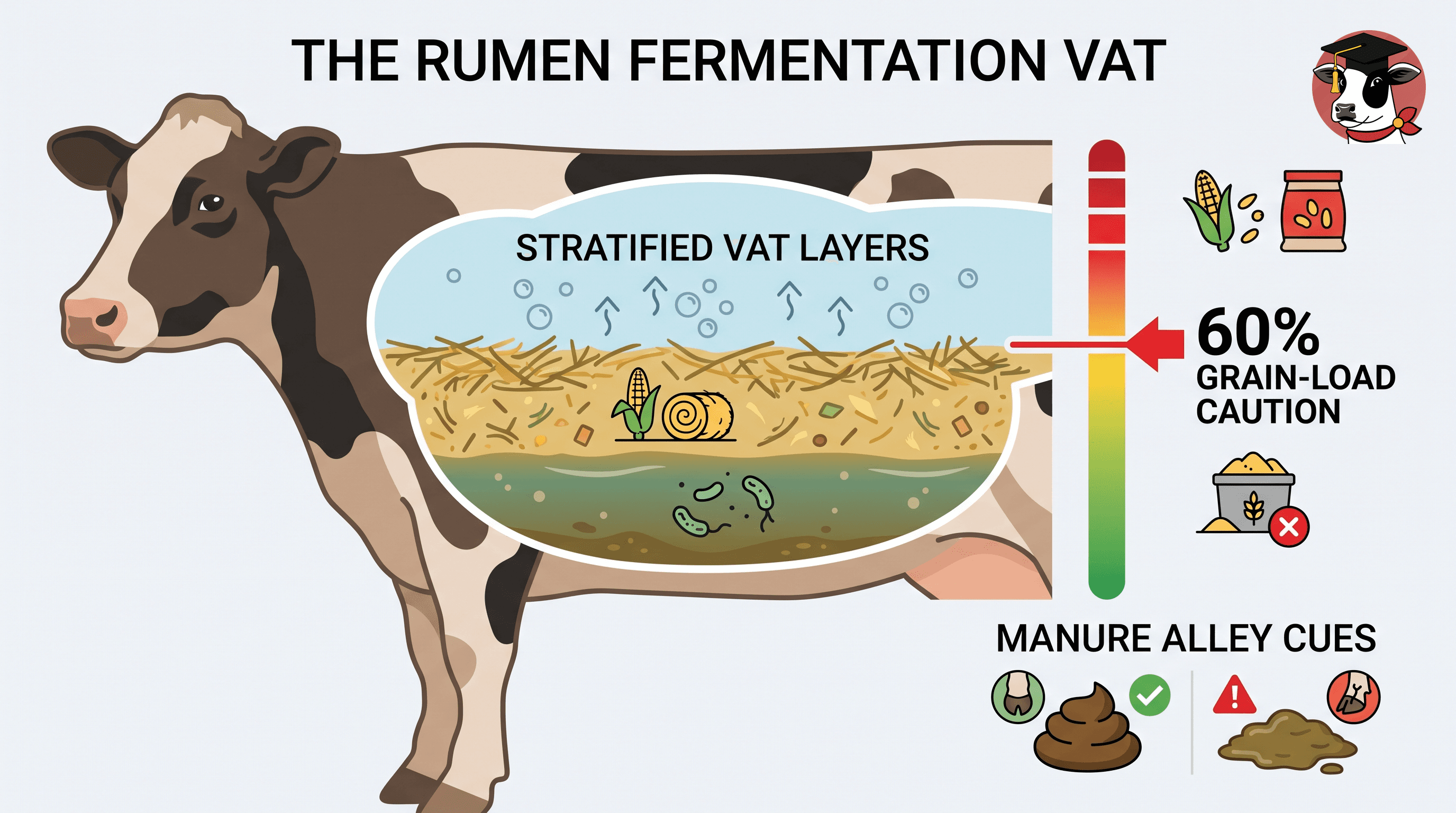
The rumen is a fluid-filled fermentation vat: carbs often 60–70% of dietary DM; past ~60% concentrate of DMI is a cautionary overload threshold, not a universal law.
Knowledge level in this topic: Intermediate. Barn-side working knowledge in this topic: checks, pairing, and what to do next.
3 min read · 2026-09-21
In this note
- 60–70%
- 60%
A mature dairy rumen is a continuous-flow anaerobic fermentation vat, not a simple feed bag. Gas caps the top. A buoyant fiber mat floats above a denser fluid pool of microbes, water, and dissolved acids. Carbohydrates often dominate dietary dry matter, so this note frames the chamber as a stratified reactor and a grain-load risk, not a full tour of SARA taxonomy, peNDF, four-compartment anatomy, cud and saliva depth, or clinical laminitis. Those live in companion notes.
The chamber holds tens of gallons of digesta that stratify by density. Primary contractions mix and move material roughly every 30 seconds. When the mat thins or acid pools in the fluid phase, the reactor is unstable; fermentation outruns the cow's buffering and absorption capacity.
Carbohydrates often make up 60–70% of dietary DM. Past about 60% concentrate of DMI is a cautionary overload threshold, not a universal law. Processing speeds starch fermentation, and a push beyond that band can drop rumen pH, raise endotoxin load, and weeks later show up as hoof discomfort. Read manure before the hoof trimmer does.
Barn-walk cues: manure color, consistency, content, and pen-to-pen variation are the daily report card. After a grain change, are there porridge piles? Whole kernels or forage pieces longer than about half an inch? Mucin casts? Wild within-pen divergence? Hoof discomfort weeks after a high-starch push belongs on a nutrition-and-vet review, not a guess in the alley.
Keep reading
View the networkNext
The Four Compartments
Ruminants run specialized pre-gastric fermentation: four compartments, but field management lives or dies on rumen health (fiber → usable energy).
Knowledge level in this topic: Basic. First-pass in this topic — useful even if you already know another area well.Sister note · 3 min
Home plate: Rumen · Inside the rumen · The rumen chamber
- The rumen chamberThe vatPlaced here
- Read manure before you rewrite the ticketThe alley is a daily report card on the ration the cow actually ate and fermented: consistency, fiber, and grain tell you before the mixer does.Same sheet
- The sensor is a barn alarm, not a diagnosisRumination and activity collars flag deviations from a cow’s own baseline — useful alarms that still need the cow, bunk, and stall before you act.Same sheet
Mark size is the kind. Color is the atlas area.
- Focus
- Field note
- Rumen
Sources
- The ruminant digestive system — University of Minnesota Extension
- Carbohydrate nutrition for lactating dairy cattle — Penn State Extension
- Using manure evaluation to enhance dairy cattle nutrition — Penn State Extension
- On-farm tools to evaluate feeding programs — University of Minnesota Extension
- Feeding to minimize acidosis and laminitis in dairy cows — Shaver RD, University of Wisconsin Extension
- Bovine acidosis: implications on laminitis — Nocek JE, Journal of Dairy Science (1997)
- Disorders of acid-base balance promote rumen lipopolysaccharide biosynthesis in dairy cows by modulating the microbiome — Hou G, et al., Front Microbiol (2024)
- Integrating subacute ruminal acidosis, lipopolysaccharide, and trained immunity: a comprehensive review — Hou G, et al., Int J Biol Sci (2025)