
Nitrogen Efficiency Is Milk N Over Feed N
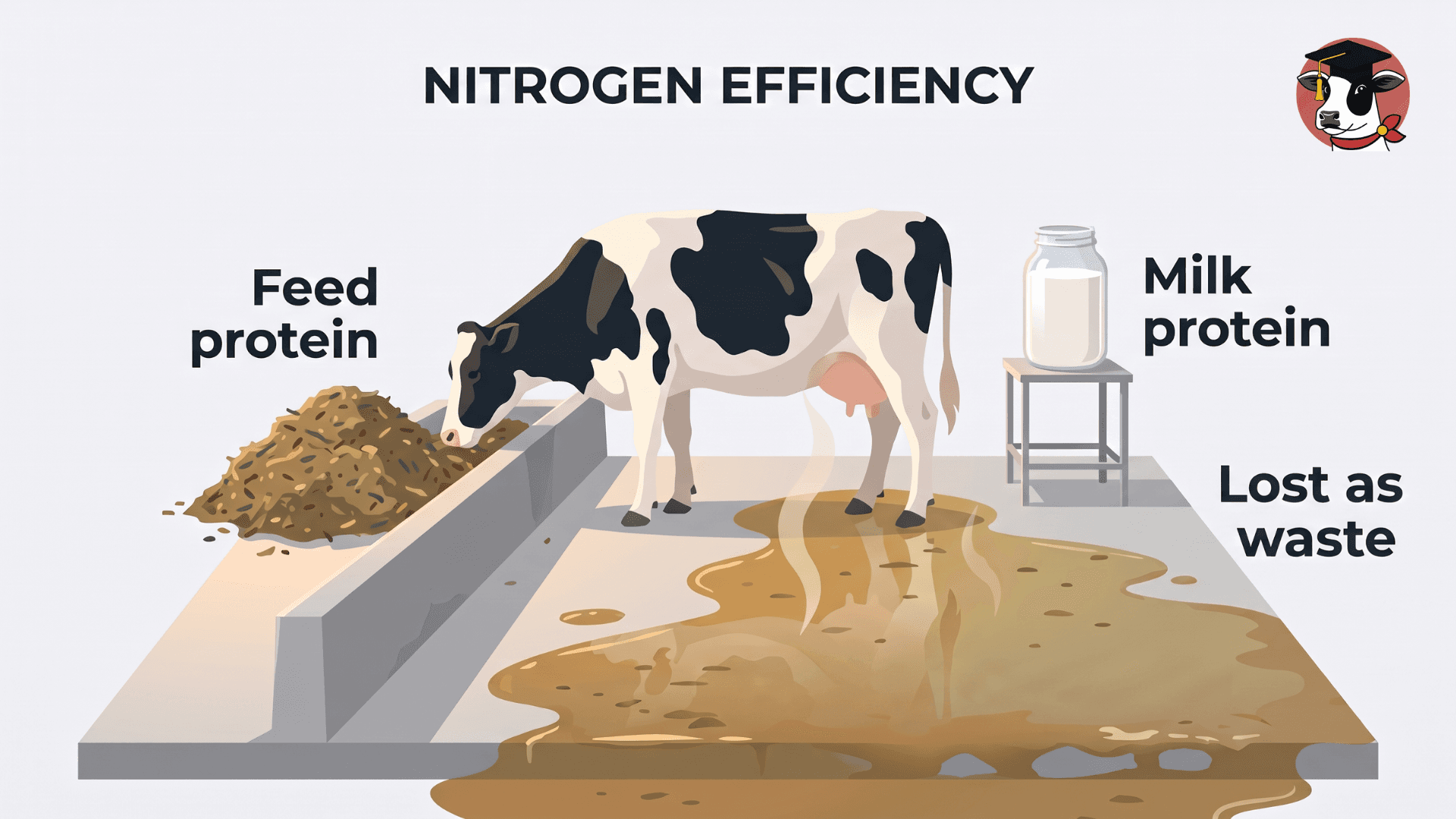
Only about a quarter to a third of the nitrogen a lactating cow eats leaves in milk. The rest goes out in urine and manure. Protein fed beyond what the cow can use mostly adds urinary nitrogen, which costs money and adds to ammonia loss.
Knowledge level in this topic: Advanced. Mechanism and stacked risk in this topic — assumes the first-pass frame.
3 min read · 2026-10-03
In this note
- 15.1 to 18.4%
- 17.5 to 15%
- 23 to 35%
- 45 to 41%
- 25 to 50%
Nitrogen use efficiency, also called milk nitrogen efficiency, is the nitrogen secreted in milk divided by the nitrogen the cow eats. In lactating herds it usually falls between a quarter and a third. In one trial that fed 15.1, 16.7 and 18.4% crude protein, milk nitrogen was 31% of intake at the lowest level and 25% at the highest. More than 30% is considered a good herd benchmark. Even when diets are formulated to meet protein requirements, roughly three quarters of the nitrogen eaten can still leave in urine and feces.
Surplus protein leaves mostly in urine. In that same trial, raising crude protein from 15.1 to 18.4% lifted urinary nitrogen from 23 to 35% of intake, while fecal nitrogen slipped from 45 to 41%. The path starts in the rumen. When microbes cannot capture all the ammonia released from degraded protein (see microbes and fermentation), the extra crosses the rumen wall, the liver turns it into urea, and the urea leaves in urine and milk. On the barn floor, urinary urea becomes ammonium and then ammonia gas. Mass-balance estimates put ammonia losses at 25 to 50% of the nitrogen cattle excrete in manure, so less urinary nitrogen means less ammonia lost.
Urea nitrogen in milk closely tracks urea nitrogen in blood, so milk urea nitrogen (MUN) is a cheap, non-invasive read on how much surplus the herd is processing. Penn State Extension gives 8 to 12 mg/dL as the target for rations balanced for protein and fermentable carbohydrate, typically near 16% crude protein, and notes that some groups use 10 to 14. It cites an estimate of about a 2 mg/dL rise in MUN for each percentage point of crude protein between 15 and 18.5%. Values above 12 to 14 suggest more urinary nitrogen and room to improve. Published ranges disagree at the edges, and one model set targets of 10 to 16 mg/dL by milk yield, so use the range your nutritionist works from.
MUN responds to more than protein. It usually peaks three to five hours after feeding, tends to run higher in summer, in herds milked three times a day, and in Jerseys than Holsteins, and can differ between laboratories because of machine standards and sampling. Compare samples taken at consistent times. A model that predicts nitrogen excretion from MUN needed a mean of at least 10 cows, so lean on group averages rather than one cow. A low MUN is not automatically good: values below 8 to 10 mg/dL can mean too little protein for the rumen, and even an 8 can come with weak milk nitrogen efficiency when production is below benchmark.
Trials that lower crude protein while keeping metabolizable protein close to requirements have often held milk yield. In a red clover and grass silage trial, cutting crude protein from 17.5 to 15% did not change performance, urinary nitrogen fell by about 60 g a day, and efficiency rose from 28.6 to about 34%. In another, a 15% crude protein diet with rumen-protected lysine and methionine matched the milk yield of a 16.4% diet and lowered MUN, although cows ate less and the model still rated metabolizable protein short. Not every trial agrees. In the first trial above, intake and fat yield were also lower at 15.1%. In one, milk protein yield fell on a 15% diet, and amino acid supplements did not always prevent it. At 14.5%, adding methionine, lysine and histidine gave no benefit, because most essential amino acids stayed limiting. A diet about 15% below metabolizable protein requirements cut intake and milk until rumen-protected amino acids were added. So about 15% crude protein has worked when metabolizable protein and amino acids were managed, and going lower needs closer watching of intake and milk protein.
Check in the barn
What to check: Follow the MUN trend on the regular milk report, and ask what changed when it moves by more than 2 to 3 points, such as a new corn silage crop or a wetter, higher-protein haylage. Compare the crude protein of the formulated ration with what the cows actually receive, since mixing errors, dry matter errors and sorting at the bunk can pull the fed ration away from the plan. Ask the nutritionist what each protein source costs per unit of metabolizable protein, because cheaper crude protein is not always cheaper usable protein.
Educational only — not a diagnosis, prescription, or ration formula. Defer clinical and ration decisions to the herd veterinarian and nutritionist.
Keep reading
View the networkNext
What Leaves the Rumen
Liquid and solid digesta leave the rumen on different clocks. Fast fluid outflow harvests microbial protein, while fiber particles leave only after they shrink and sink.
Knowledge level in this topic: Intermediate. Barn-side working knowledge in this topic: checks, pairing, and what to do next.Sister note · 3 min
Home plate: Rumen · Inside the rumen · What leaves the rumen
- What leaves the rumenDownstreamPlaced here
- MP is not crude proteinCrude protein counts nitrogen. Metabolizable protein asks what amino acids actually reach the cow after the rumen.Sister note
- Reading milk fat as a rumen alarmA falling fat test is often the first cheap signal that fermentation has shifted, not that the cow forgot how to make fat.Sister note
- The ±3-week windowThe windowBridge → Transition
Mark size is the kind. Color is the atlas area.
- Focus
- Field note
- Rumen
- Transition
Sources
- Effects of varying dietary protein and energy levels on the production of lactating dairy cows — Broderick GA, J Dairy Sci (2003)
- A meta-analysis of the effects of dietary protein concentration and degradability on milk protein yield and milk N efficiency in dairy cows — Huhtanen P, Hristov AN, J Dairy Sci (2009)
- Using milk urea nitrogen to predict nitrogen excretion and utilization efficiency in lactating dairy cows — Jonker JS, Kohn RA, Erdman RA, J Dairy Sci (1998)
- Review: Ammonia emissions from dairy farms and beef feedlots — Hristov AN, Hanigan M, Cole A, Todd R, McAllister TA, Ndegwa PM, Rotz A, Can J Anim Sci (2011)
- Effects of reduced dietary protein and supplemental rumen-protected essential amino acids on the nitrogen efficiency of dairy cows — Arriola Apelo SI, Bell AL, Estes K, Ropelewski J, de Veth MJ, Hanigan MD, J Dairy Sci (2014)
- Rumen-protected lysine, methionine, and histidine increase milk protein yield in dairy cows fed a metabolizable protein-deficient diet — Lee C, Hristov AN, Cassidy TW, Heyler KS, Lapierre H, Varga GA, de Veth MJ, Patton RA, Parys C, J Dairy Sci (2012)
- Effect of supplementing rumen-protected methionine, lysine, and histidine to low-protein diets on the performance and nitrogen balance of dairy cows — Van den Bossche T, Goossens K, Ampe B, Haesaert G, De Sutter J, De Boever JL, Vandaele L, J Dairy Sci (2023)
- Reducing dietary protein and supplementation with starch or rumen-protected methionine and its effect on performance and nitrogen efficiency in dairy cows fed a red clover and grass silage-based diet — Chowdhury MR, Wilkinson RG, Sinclair LA, J Dairy Sci (2024)
- Effects of rumen-encapsulated methionine and lysine supplementation and low dietary protein on nitrogen efficiency and lactation performance of dairy cows — Seleem MS, Wu ZH, Xing CQ, Zhang Y, Hanigan MD, Bu DP, J Dairy Sci (2024)
- Interpretation of Milk Urea Nitrogen (MUN) Values — Penn State Extension
- Dairy Sense: Pairing Milk Urea Nitrogen (MUN) with Milk N Efficiency — Ishler VA, Penn State Extension (2023)