
uNDF240 Sets the Fill Limit
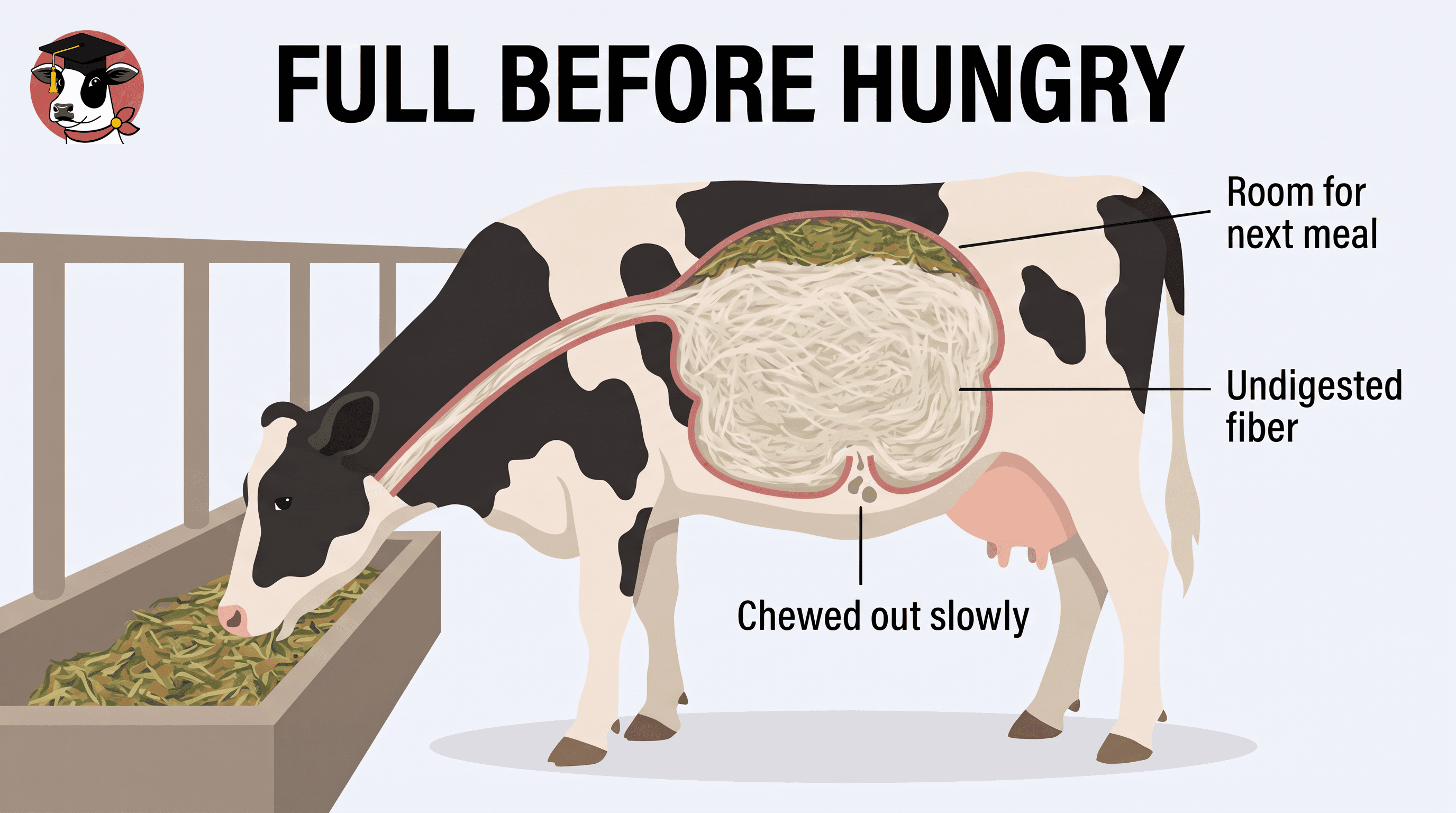
NDF tells you how much cell wall a forage carries. uNDF240 estimates how much of it the rumen cannot digest, and that fraction takes up space until it is chewed small enough to leave. In high-producing cows, it can cap how much they eat.
Knowledge level in this topic: Intermediate. Barn-side working knowledge in this topic: checks, pairing, and what to do next.
5 min read · 2026-09-25
In this note
- 0.30 to 0.40%
- 10 to 11%
- 7 to 11%
- 11.5%
- 8.9%
A forage report prints NDF as one number, but the rumen treats it as at least two. Part of the cell wall ferments, and part never does. That second part, measured as uNDF240, can only leave by being chewed small and passed, and until then it occupies space. This note is about that fill. Particle size and peNDF are covered in particle size holds the fiber mat and chop length is not peNDF, the left-flank fill picture in the four compartments, and passage in what leaves the rumen.
NDF is the sum of potentially digestible NDF and undigested NDF. To measure the undigested part, the lab ferments a forage sample with rumen fluid for 240 hours in vitro, then reports the fiber left over as uNDF240. Research papers and many lab reports give it ash-corrected (uNDF240om), on the same aNDFom basis as NDF. Cotanch and colleagues draw a useful line here: uNDF is a lab measurement at a stated time point, while indigestible NDF (iNDF) is a theoretical pool that could only be reached with infinite time. The 240-hour end point is chosen because the residue changes little with more fermentation. Raffrenato, Nicholson and Van Amburgh describe forage NDF as three pools: a fast-digesting pool, a slow-digesting pool, and the undigested fraction. They note that earlier data show the undigested fraction is not a fixed coefficient; it varies with plant maturity and growing conditions. That helps explain why two corn silages with similar NDF can behave differently at the bunk.
In his 2000 review of intake regulation, Allen wrote that distension of the reticulo-rumen often limits dry matter intake in high-producing cows and in cows fed high-forage diets. The Cornell, Miner and Bologna fiber group treats the uNDF240 held in the rumen as a baseline of fill, although in their alfalfa hay study intake tracked how fast the digestible fiber fermented more than uNDF240 intake. Sugars, starch and digestible fiber ferment and disappear from the rumen. The undigested fraction does not. It stays until rumination breaks it down far enough to pass, so it builds up as rumen mass. The size of that mass is larger than daily intake suggests. In Miner Institute trials summarized by Cotanch and colleagues, the rumen held about 1.6 times the uNDF240 the cow ate in a day across four corn silage–based diets. On one of those diets, cows eating about 2.2 kg of uNDF240 a day carried about 3.5 kg of it in the rumen. The authors noted that the ratio still needs testing with other forages and stages of lactation. Too little can also be a problem. The Miner group links low-uNDF240 diets with a higher risk of subacute ruminal acidosis, which is why it pairs them with close attention to peNDF.
Reference points, not targets: Intake as % of body weight. In the trials Cotanch and colleagues summarized, cows consumed roughly 0.30 to 0.40% of body weight as uNDF240 per day, and the authors put the maximum near 0.40% for those corn silage and haycrop diets. In the same paper, Bologna cows fed finely chopped alfalfa hay reached 0.48%, so the ceiling depends on the forage. Particle size moves the ceiling. In a 2018 Miner study reported by Grant and colleagues, diets held 8.9% or 11.5% uNDF240 in ration DM, each fed with shorter or longer hay. The high-uNDF240 diet with long hay limited intake. Chopping the hay finer in that diet raised intake by 2.5 kg/day, and uNDF240 intake reached 0.45% of body weight. Dietary uNDF240 was changed by changing forage content, so the two were confounded, as the authors note. Ration level. For corn silage–based diets, Grant and colleagues suggest intake may fall when ration uNDF240 exceeds about 10 to 11% of DM, and that below about 7% the risk of acidosis may rise. These are ration values from one institute's research diets, not forage cut-offs. Corn silage. Penn State Extension gives 7 to 11% of DM as typical for corn silage uNDF240 and lists under 11% as its optimal range. Hybrids in the 2025 Pennsylvania (PDMP) corn silage trial averaged 9.9%. In one Miner study, brown midrib silage ran under 8% and conventional silage about 11%. A corn silage below about 10% beats that trial average, but it is not a pass mark, and values depend on the lab and method.
uNDF240 is a chemistry-and-fill number. peNDF is a physical-form-and-chewing number. Brown midrib silage can be low in uNDF240 and still supply adequate peNDF if it is chopped long enough. Finely chopped hay or straw can be high in uNDF240 but low in peNDF. NDFD30 tells you how much fiber ferments in 30 hours; uNDF240 tells you what is still left after 240 hours. The two matter most together when the ration is highly fermentable. In one Miner study where every diet was low in uNDF240 (about 7% of DM), even moderate rumen-fermentable starch (about 19% of DM) lowered milk fat. The authors advise against chopping low-uNDF240 forage too finely because cows still need physically effective fiber. The acid side of that story is in SARA is not grain overload, and starch access from the kernel is in kernel processing unlocks the starch.
Check in the barn
What to check: Read the right line. uNDF240om as % of DM, multiplied by dry matter intake, gives the kilograms the cow eats, which is the basis for intake as % of body weight. As % of NDF, it describes the fiber itself. Stay with one lab. The result comes from a fermentation with live rumen fluid, and Cotanch and colleagues note that different fermentation systems need different times to reach that end point (240 hours in vitro for the Cornell method, 288 hours for one in situ method). Compare samples from the same lab and method, not across labs. New-crop silage. When new-crop corn silage enters the ration, put its uNDF240 next to the old crop's. If it is higher, talk with the nutritionist before feeding it at the same inclusion. Then watch high-group intake and milk over the first week or two. A fill-limited group is likely to show it at the bunk first. Educational only—not a diagnosis, prescription, or treatment protocol. Defer clinical and ration decisions to the herd veterinarian and nutritionist.
Keep reading
View the networkNext
Chop length is not peNDF
Chop length is a harvester setting; peNDF is the fiber structure that actually reaches the rumen after moisture, processing, mixing, and sorting.
Knowledge level in this topic: Advanced. Mechanism and stacked risk in this topic — assumes the first-pass frame.Sister note · 3 min
Home plate: Rumen · Physically effective fiber · NDF vs physically effective fiber
- NDF vs physically effective fiberTwo different jobsPlaced here
- Refusals read the peNDF storyShake fresh TMR and the refusal pile with the same particle separator — divergence shows whether formulated peNDF actually reached the cow.Sister note
- Sorting steals the peNDFA correctly mixed TMR can still fail when cows pick fines and leave long forage — the consumed ration loses peNDF even though the ticket looked right.Same sheet
- Intake & the energy gapIntakeBridge → Transition
Mark size is the kind. Color is the atlas area.
- Focus
- Field note
- Rumen
- Transition
Sources
- Effects of diet on short-term regulation of feed intake by lactating dairy cattle — Allen MS, J Dairy Sci (2000)
- Applications of uNDF in ration modeling and formulation — Cotanch KW, Grant RJ, Van Amburgh ME, Zontini A, Fustini M, Palmonari A, Formigoni A, Proc Cornell Nutrition Conference for Feed Manufacturers (2014)
- Development of a mathematical model to predict pool sizes and rates of digestion of 2 pools of digestible neutral detergent fiber and an undigested neutral detergent fiber fraction within various forages — Raffrenato E, Nicholson CF, Van Amburgh ME, J Dairy Sci (2019)
- Relationships between fibre digestibility and particle size for lactating dairy cows — Grant R, Smith W, Miller M, WCDS Advances in Dairy Technology (2020)
- A Tale of Two Fibers: Physically Effective and Undegradable Neutral Detergent Fiber and Their Interaction with Starch — Grant R, Smith W, Miller M, Smith K, Tri-State Dairy Nutrition Conference / Miner Institute (2021)
- Key forage quality metrics for corn silage — Martins L, Guevara MF, Penn State Extension (updated 2026)