
A Pen Move Is a Social Event
Moving a cow puts her into a group with its own social order; for hours to days she may be displaced more and eat less, so plan how often, when, with whom and into how much space cows move.
Knowledge level in this topic: Intermediate. Barn-side working knowledge in this topic: checks, pairing, and what to do next.
3 min read · 2026-10-06
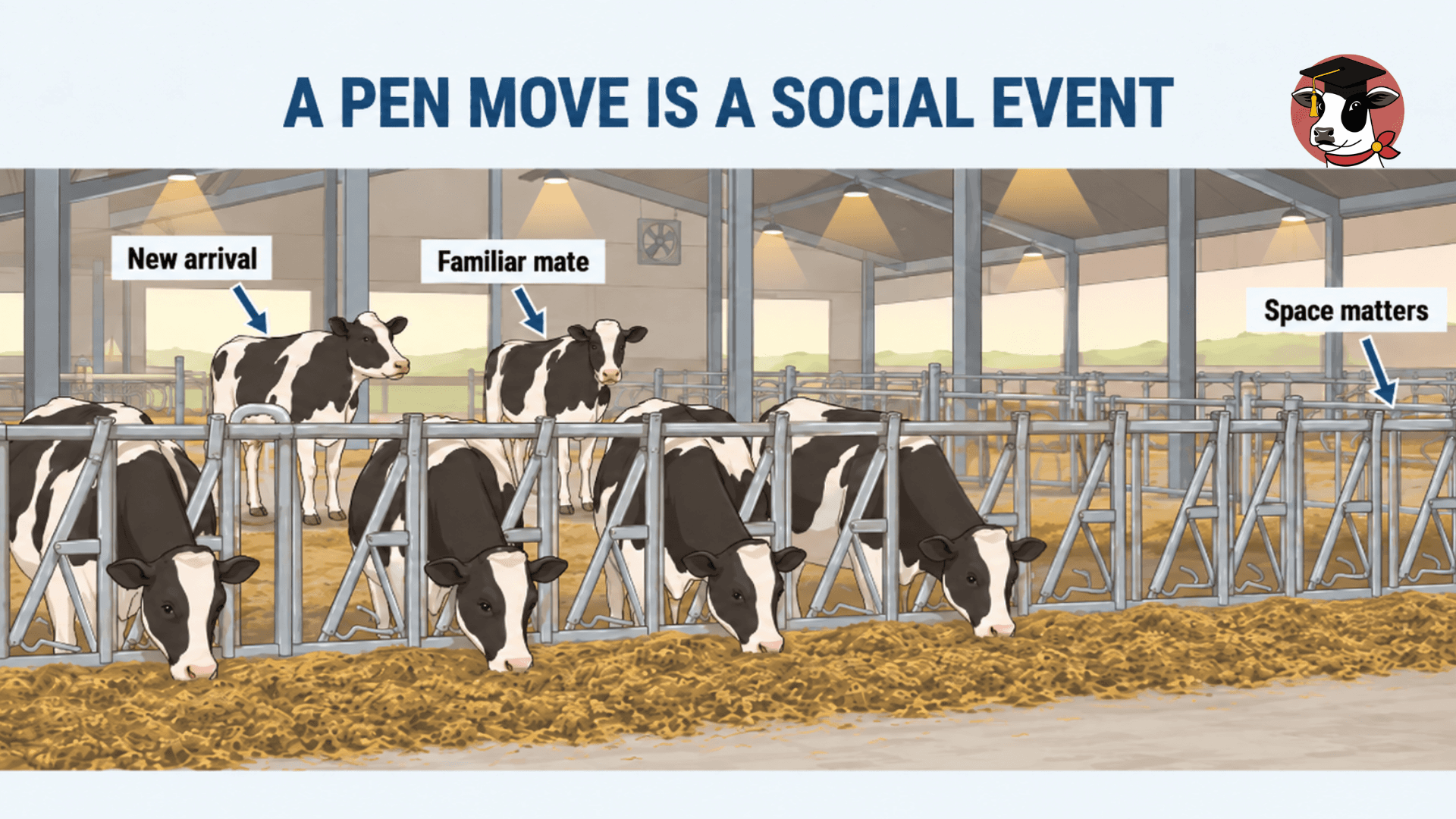
A cow leaves the fresh pen for the high group. On the work list it is a ten-minute job, but she walks into a group that already has its own social order.
That order shows up quickly at the feed bunk. In a Journal of Dairy Science study of 11 mid-lactation Holstein cows introduced one at a time into established groups, the newcomers were displaced at the feed bunk (pushed off their place by another cow) more than twice as often on the day of the move, and this declined over the following days. They also spent less time eating in the first hour, had fewer lying bouts that day and groomed other cows less. In small studies like this, most measured changes lasted hours to days.
The cow that moves tends to pay more than the residents. In one study of 48 prepartum Holstein cows, cows moved to a new pen ate less on the day of the move, while cows that stayed home and received newcomers showed no clear drop in intake; rumination fell in both groups. Some studies found larger effects in first-lactation cows, but others point in different directions, and a retrospective study of 1,130 crossbred cows on one farm found that effects depended on parity, stage of lactation and how many cows moved together. Treat first-lactation cows as a group to watch, not a rule, and report moved cows separately from residents.
Timing near calving needs care. Housing guidance from the Dairyland Initiative advises minimizing regrouping stress in the 2 to 7 days before calving, to avoid the risk of a sharp drop in dry matter intake, and notes that the impact is smaller on resident cows than on cows moved in. An intake dip near calving matters because the fresh cow's energy gap opens soon after. Regrouping also happens daily in the fresh pen, and even splitting a crowded fresh group into more space, which can be the right decision, is still a move to watch.
The levers are management choices. In a small experiment with four groups of Holstein cows regrouped weekly, bunk displacements fell and lying time rose when stocking density dropped at the move, so how much space the receiving pen has is one lever. In one study of two new groups of 14 cows, cows preferred familiar cows as grooming partners and feeding neighbors after regrouping, and a small group of familiar cows may buffer the move. Fewer, planned moves, not stacked on a ration change, a long lockup or a full pen, follow the same logic, though untested as a package.
Keep the evidence in proportion. Most regrouping studies are small and short. In one trial of 567 Jersey cows, adding new cows to the prepartum pen every week did not change disease, metabolic, reproductive or milk outcomes compared with keeping a stable group, under conditions of adequate feed bunk space. A move is a question about access, not, on its own, a proven cause of disease or shorter herd life.
Check in the barn
What to check: How many times has each cow changed pens this lactation, and are any moves planned for the days before calving? Are cows moved alone or with familiar pen mates? Is the receiving pen fuller than the one she left? On the move day and the days after, which moved cows are displaced or eat after the others, and does her lying or rumination dip against her own recent days (read lying hours with context)? Leave diagnosis, treatment, welfare and ration decisions to the herd veterinarian and the herd's welfare, behavior and nutrition advisers.
Educational only: not a diagnosis, prescription, or facility design. Defer clinical, welfare and ration decisions to the herd veterinarian and the herd's advisers.
Keep reading
View the networkNext
The fresh pen was stocked at 120%
Calving went well; in the fresh pen, 96 cows competed for 80 headlocks, and first-lactation cows paid in lost bunk access and intake.
Knowledge level in this topic: Intermediate. Barn-side working knowledge in this topic: checks, pairing, and what to do next.Sister note · 4 min
Home plate: Transition · The transition cow · Space, rest & social stress
- Space, rest & social stressHousingPlaced here
- The Pen Average Hides the Cows That LoseA pen average weights every cow equally, so a small group that is doing badly can disappear inside a number that looks acceptable.Sister note
- Lying Longer Is Not Always BetterAbout 12 hours of lying a day is a common design goal, but a long lying day can mean comfort or illness, and lying hours are not sleep.Sister note
- Stocking & cow flowStocking is stalls, bunk, lying, lockup, holding, and movement — not one percentage. Those resources fail separately.Bridge → Barn
Mark size is the kind. Color is the atlas area.
- Sheet
- Focus
- Field note
- Transition
- Barn
Sources
- Acute behavioral effects of regrouping dairy cows — Journal of Dairy Science (2008)
- Short-term effects of regrouping on behavior of prepartum dairy cows — Journal of Dairy Science (2011)
- Behavioural variability, physical activity, rumination time, and milk characteristics of dairy cattle in response to regrouping — Animal (2024)
- Impact of pen move events on rumination time, milk yield, and water intake in dairy cows — JDS Communications (2026)
- Transition Cow Housing — UW Dairyland Initiative
- Reduced stocking density mitigates the negative effects of regrouping in dairy cattle — Journal of Dairy Science (2014)
- Familiarity influences social networks in dairy cows after regrouping — Journal of Dairy Science (2021)
- Effects of weekly regrouping of prepartum dairy cows on metabolic, health, reproductive, and productive parameters — Journal of Dairy Science (2013)