
Microbes and Fermentation
Feed the microbes first: fiber + NFC → VFAs for energy; dietary N upgrades to microbial crude protein; biohydrogenation of PUFA is microbial survival, not an MFD deep dive.
Knowledge level in this topic: Intermediate. Barn-side working knowledge in this topic: checks, pairing, and what to do next.
3 min read · 2026-09-22
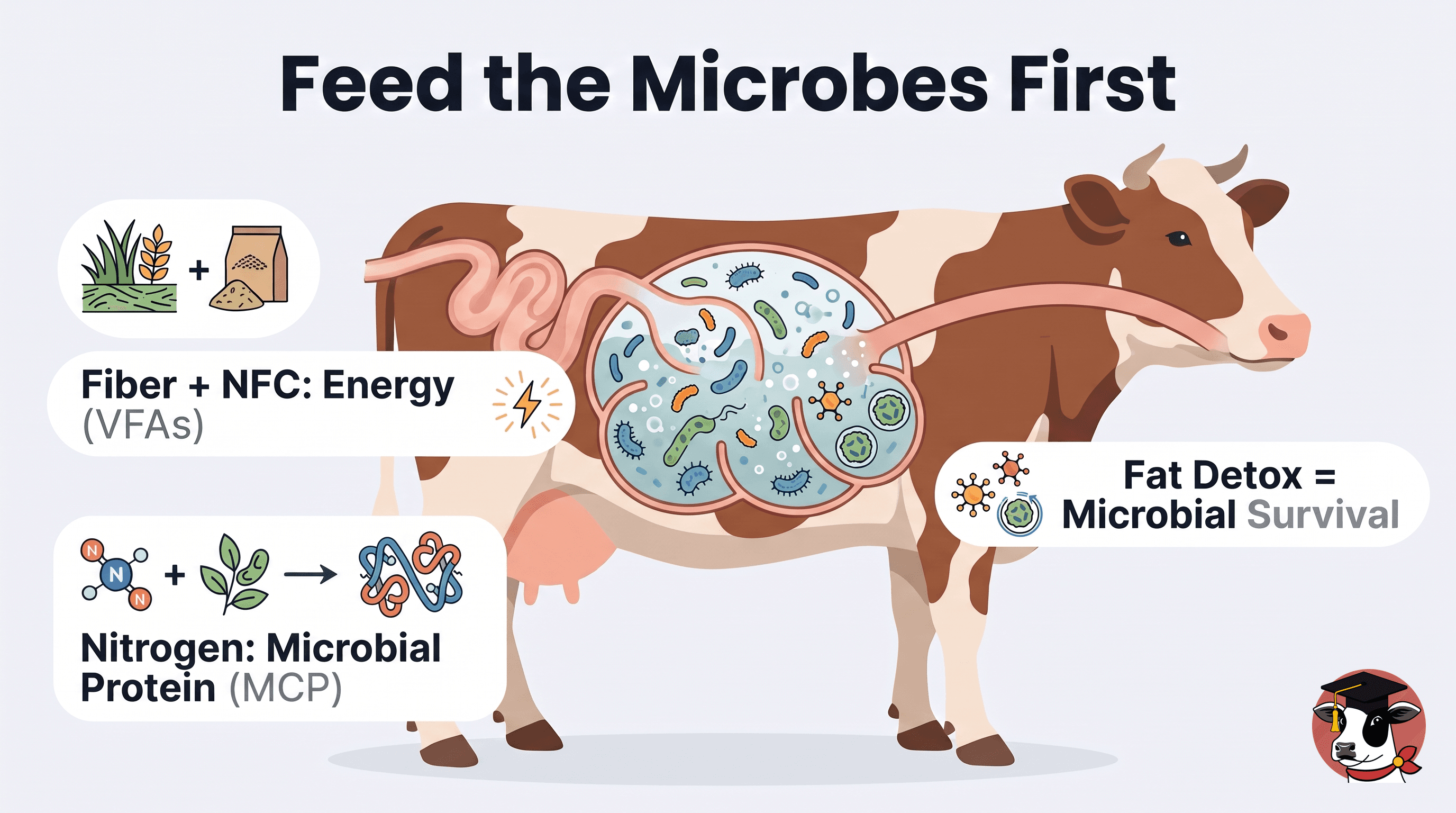
The dairy cow does not digest most of her ration alone. She hosts an obligate anaerobic fermentation vat: tens of gallons of digesta, kept warm and mixed, packed with bacteria, protozoa, and anaerobic fungi. Extension teaching puts it plainly: feed the microbes first. This note covers who lives in the vat, how fiber and non-fiber carbohydrates become usable energy, how dietary nitrogen is upgraded into microbial crude protein (MCP), and why biohydrogenation of polyunsaturated fatty acids is microbial survival chemistry. Leave MFD pathways, MP-vs-CP framing, SARA taxonomy, fiber-mat/peNDF craft, four-compartment anatomy, chamber grain-load detail, rumination/saliva depth, and VFA absorption mechanics to their companions.
Bacteria dominate numerically and drive primary fermentation. Solid-associated communities cling to feed particles and dismantle plant cell walls; liquid-associated planktonic bugs rapidly ferment soluble sugars and starch; a thinner epimural layer on the epithelium helps scavenge oxygen and recycle urea nitrogen. Cellulolytic guilds — including Fibrobacter succinogenes, Ruminococcus albus, and Ruminococcus flavefaciens — prefer a relatively neutral fluid and slow fiber work. Amylolytic guilds — including Streptococcus bovis and Ruminobacter amylophilus — multiply fast on NFC and can outpace buffering if starch floods the vat. Protozoa are far fewer by count but can hold a large share of microbial biomass; entodiniomorphids engulf starch granules, temporarily sequestering substrate from amylolytic bacteria and slowing a hard pH drop, while also preying on bacteria and recycling nitrogen. Anaerobic fungi are a smaller mass fraction, yet their rhizoids mechanically fracture lignified forage and open surface for cellulolytic bacteria that follow.
Mammalian enzymes cannot cleave structural plant beta-linkages. Microbes hydrolyze NDF and NFC to sugars, then, under anaerobic limits, stop short of full oxidation and excrete volatile fatty acids as their waste. Those VFAs are the cow's main absorbed energy currency: acetate leans toward peripheral tissues and milk-fat synthesis; propionate toward hepatic glucose and lactose support; butyrate heavily fuels the rumen epithelium itself. Cross-feeding matters: amylolytic and proteolytic activity releases branched-chain VFAs that cellulolytic species need as growth factors and membrane building blocks. When rapidly fermentable carbohydrate arrives without matched degradable nitrogen, microbes can spill excess ATP as heat — uncoupled fermentation that wastes dietary energy.
Rumen microbes convert feed nitrogen and recycled urea into their own cellular protein. Cellulolytic bacteria lean hard on ammonia; many amylolytic species prefer peptides and free amino acids for fast growth. When fermentable energy and available nitrogen stay synchronized, efficiency of microbial protein synthesis rises and more high-quality MCP washes to the abomasum and small intestine, commonly the majority of absorbable amino acids reaching the host. Surplus ammonia without ATP to capture it leaves as urea cost; surplus starch without nitrogen costs growth. Treat the nitrogen upgrade as a fermentation product of the vat, not the MP-vs-CP rationing lesson housed elsewhere.
Dietary lipids arrive as triglycerides, galactolipids, and phospholipids. After lipolysis, free polyunsaturated fatty acids — especially linoleic and alpha-linolenic acids — are acutely toxic to broad swaths of the microbiome, including key cellulolytic and butyrate-producing species: membrane disruption, leaked gradients, collapsed ATP pools, and stalled growth. Biohydrogenation is the bacterial detox: isomerize, then sequentially hydrogenate double bonds toward less toxic, more saturated end products (often toward stearic acid when the cascade completes). The saturated-fat profile of ruminant products is the biochemical aftereffect of that survival fight — not a milk-fat depression pathway deep dive. Protozoa lack the hydrogenation enzymes but can physically sequester unsaturated chloroplast lipids and deliver some protected PUFA downstream when they wash out.
Check in the barn
What to check: these cues are educational signposts about microbial balance — not a field diagnosis. After a starch or oilseed push, are cows sorting grain off long fiber — a classic setup for uncoupled fermentation and fiber-bug stress? At rest, are roughly half or more of cows chewing their cud (field teaching often cites 50–60% of resting cows)? In manure, are whole kernels common (NFC outrunning amylolytic capture or passage too fast)? Are long, identifiable forage pieces frequent (cellulolytic inhibition, hostile pH, or BCVFA/nitrogen shortfall)? Do mucin casts or bubbly manure show up beyond an occasional cow (hindgut fermentation when rumen capture failed)?
Educational only — not a diagnosis, prescription, or ration formula.
Keep reading
View the networkNext
The Four Compartments
Ruminants run specialized pre-gastric fermentation: four compartments, but field management lives or dies on rumen health (fiber → usable energy).
Knowledge level in this topic: Basic. First-pass in this topic — useful even if you already know another area well.Sister note · 3 min
Home plate: Rumen · Inside the rumen · Microbes & fermentation
- Microbes & fermentationThe workforcePlaced here
- Saliva is the free bufferBagged bicarbonate has a line item. Saliva is the free, manageable buffer you earn with chewing — not the larger proton sink than SCFA absorption.Sister note
- Reading milk fat as a rumen alarmA falling fat test is often the first cheap signal that fermentation has shifted, not that the cow forgot how to make fat.Sister note
- Lying timeStallsBridge → Barn
Mark size is the kind. Color is the atlas area.
- Focus
- Field note
- Rumen
- Barn
Sources
- From feed to milk: understanding rumen function — Penn State Extension
- The ruminant digestive system — University of Minnesota Extension
- Nitrogen metabolism in the rumen — Bach A, Calsamiglia S, Stern MD, J Dairy Sci (2005)
- Integration of ruminal metabolism in dairy cattle — Firkins JL, et al., J Dairy Sci (2006)
- The role of ciliate protozoa in the rumen — Newbold CJ, et al., Front Microbiol (2015)
- Lipid metabolism in the rumen — Jenkins TC, J Dairy Sci (1993)
- Toxicity of unsaturated fatty acids to the biohydrogenating ruminal bacterium, Butyrivibrio fibrisolvens — Maia MRG, et al., BMC Microbiol (2010)
- Lipid metabolism in the rumen: new insights on lipolysis and biohydrogenation with an emphasis on the role of endogenous plant factors — Buccioni A, et al., Anim Feed Sci Technol (2012)
- Rumen protozoa are rich in polyunsaturated fatty acids due to the ingestion of chloroplasts — Huws SA, et al., FEMS Microbiol Ecol (2009)
- Studies on the metabolic function of branched-chain volatile fatty acids, growth factors for ruminococci. I. Incorporation of isovalerate into leucine. — Allison MJ, Bryant MP, Doetsch RN, J Bacteriol (1962)