
VFAs and Absorption
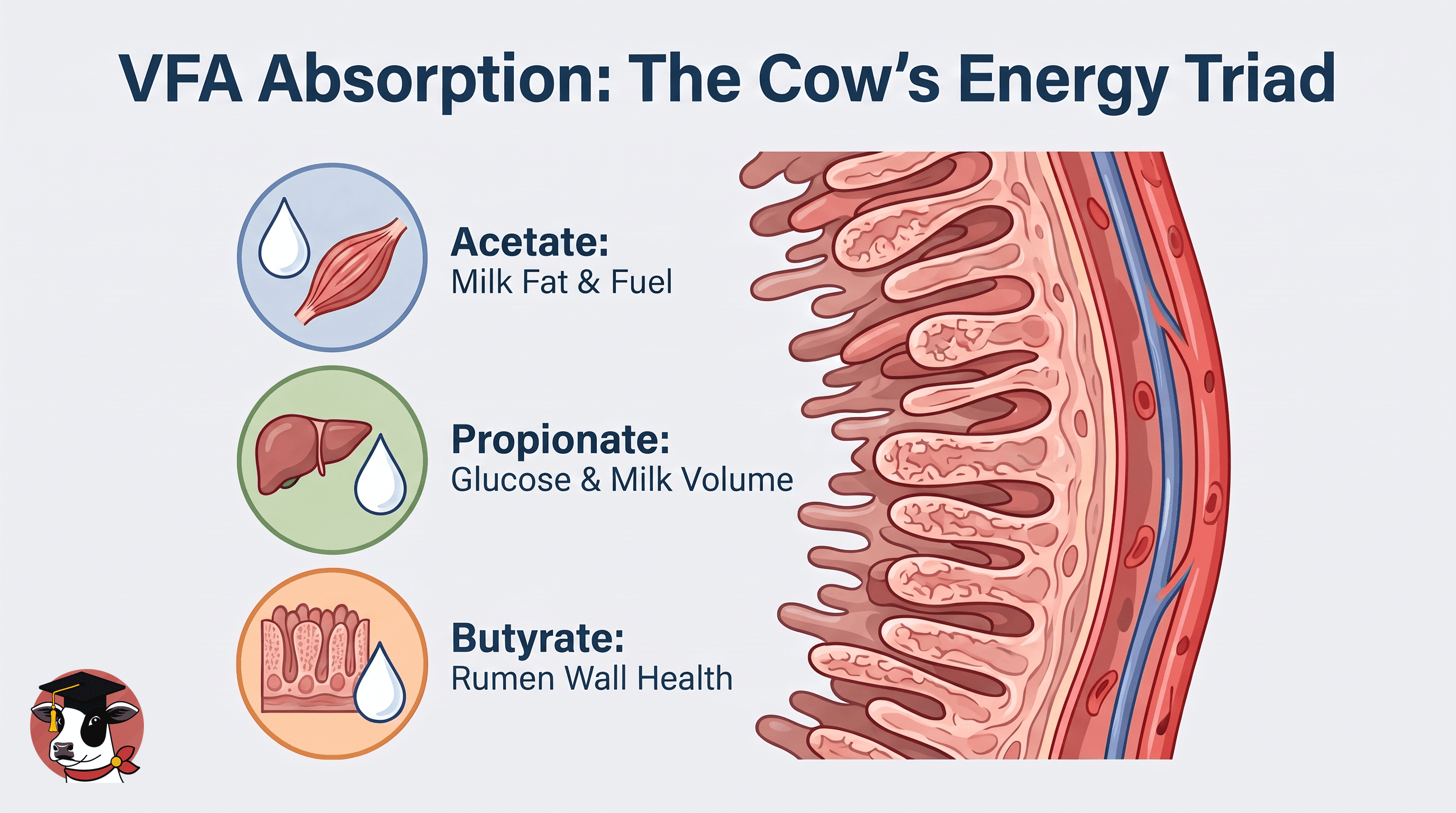
VFAs absorbed across the rumen wall supply most of the cow's metabolizable energy: acetate for milk fat and maintenance, propionate for glucose and lactose, butyrate for the wall itself.
Knowledge level in this topic: Intermediate. Barn-side working knowledge in this topic: checks, pairing, and what to do next.
3 min read · 2026-09-22
In this note
- 50–70%
- 60–80%
Microbial fermentation of fiber and non-fiber carbohydrate does not hand the cow sugar. It hands her volatile fatty acids, short-chain acids that cross the stratified squamous rumen wall into portal blood and cover a large share of metabolizable energy — classic reviews center near ~70%, while extension teaching spans roughly 50–70% up to ~80%. This note is about those fermentation end-products becoming host energy: the acetate–propionate–butyrate triad, how the wall absorbs them, and how they partition for milk and maintenance. Leave SARA taxonomy, milk-fat depression pathways, microbial ecology detail, fiber-mat craft, and rumination/saliva depth to their companions.
Acetate (C2) is usually the largest molar share, especially on forage-heavy diets. Cellulolytic and hemicellulolytic guilds release it from structural carbohydrate. Acetate largely bypasses hepatic extraction, oxidizes in peripheral tissues for maintenance, and supplies the primary carbon backbone for de novo milk-fat synthesis in the mammary gland. Propionate (C3) rises when starch and sugars ferment faster. Nearly all portal propionate is extracted by the liver and driven into gluconeogenesis. Because little dietary glucose survives the rumen intact, hepatic glucose from propionate is the main fuel for lactose — and lactose osmotically sets milk volume. Butyrate (C4) is typically the smallest of the three. Most of it never reaches portal blood as free butyrate: the epithelium oxidizes it for its own ATP and converts the bulk to ketone bodies (chiefly β-hydroxybutyrate). That local ketogenic sink keeps intracellular butyrate low, steepens the lumen-to-cell gradient, and feeds the absorptive surface that clears the other acids.
Molar proportions shift with diet: forage-leaning profiles often near ~70:20:10 acetate:propionate:butyrate; high-concentrate early-lactation profiles often closer to ~60:25:15, but the teaching point is role, not a fixed formula.
Papillae multiply surface area like a biological sponge. Their length and density are plastic: butyrate (and to a lesser extent propionate) signals epithelial hyperplasia so the sponge grows with fermentable load. At healthy rumen pH (~5.8–6.8), most VFAs exist as anions. A small undissociated fraction diffuses through lipid membranes — and as pH falls, more acid protonates, so passive clearance accelerates as a safety valve. The majority of anion flux uses carrier proteins (anion exchangers that trade VFA− for HCO3− into the lumen, Na+/H+ exchangers that defend intracellular pH, and basolateral monocarboxylate transporters that export VFAs and ketone bodies into capillary blood). Capillary flow sweeps absorbed acids away; higher local VFA concentrations themselves vasodilate the bed, accelerating clearance. Heat stress that diverts visceral blood flow can blunt that vacuum.
Portal blood delivers the triad to the liver. Propionate is almost fully extracted for glucose. Acetate largely passes through to muscle, heart, adipose, and the udder. Epithelial BHBA joins acetate as a four-carbon primer for de novo milk fat. Propionate flux to the liver also participates in short-term intake control: elevated portal propionate is linked to hypophagia (smaller meals), coupling intake to fermentation rate.
Check in the barn
What to check: these cues are educational signposts about fermentation and clearance — not a field diagnosis. At rest, are roughly 60–80% of lying cows chewing their cud? Chewing drives salivary bicarbonate that buys the wall time to absorb acids. Does the left paralumbar fossa look well filled rather than deeply hollow? Fill implies substrate for VFA production and a mat that retains particles long enough to ferment. In manure, are long forage pieces (>~0.5 in) or whole kernels common? Intact substrate that left the rumen is energy that never became absorbed VFAs. After a starch push, do resting cud rates fall while manure loosens? Production may be outrunning absorption and buffering.
Educational only — not a diagnosis, prescription, or ration formula.
Keep reading
View the networkNext
Saliva is the free buffer
Bagged bicarbonate has a line item. Saliva is the free, manageable buffer you earn with chewing — not the larger proton sink than SCFA absorption.
Knowledge level in this topic: Advanced. Mechanism and stacked risk in this topic — assumes the first-pass frame.Sister note · 3 min
Home plate: Rumen · Inside the rumen · VFAs & absorption
- VFAs & absorptionThe acids that become milkPlaced here
- Microbes and FermentationFeed the microbes first: fiber + NFC → VFAs for energy; dietary N upgrades to microbial crude protein; biohydrogenation of PUFA is microbial survival, not an MFD deep dive.Sister note
- Reading milk fat as a rumen alarmA falling fat test is often the first cheap signal that fermentation has shifted, not that the cow forgot how to make fat.Same focus
Mark size is the kind. Color is the atlas area.
- Focus
- Field note
- Rumen
Sources
- From feed to milk: understanding rumen function — Penn State Extension
- The ruminant digestive system — University of Minnesota Extension
- Energy contributions of volatile fatty acids from the gastrointestinal tract in various species — Bergman EN, Physiol Rev (1990)
- Effects of diet on short-term regulation of feed intake by lactating dairy cattle — Allen MS, J Dairy Sci (2000)
- Ruminant Nutrition Symposium: Role of fermentation acid absorption in the regulation of ruminal pH — Aschenbach JR, et al., J Anim Sci (2011)
- A model of ruminal volatile fatty acid absorption kinetics and rumen epithelial blood flow in lactating Holstein cows. — Storm AC, Kristensen NB, Hanigan MD, J Dairy Sci (2012)