
Amino Acids in the Transition Window
Around calving, a cow eats less just as her udder, liver and immune system pull hard on amino acids. In trials, extra methionine from about three weeks before calving has mostly raised milk protein afterward, while the health benefits are less certain.
Knowledge level in this topic: Advanced. Mechanism and stacked risk in this topic — assumes the first-pass frame.
3 min read · 2026-09-26
In this note
- 2.95 to 3.07%
- 6.5 to 7.2%
- 2.2 to 2.4%
- 30 to 50%
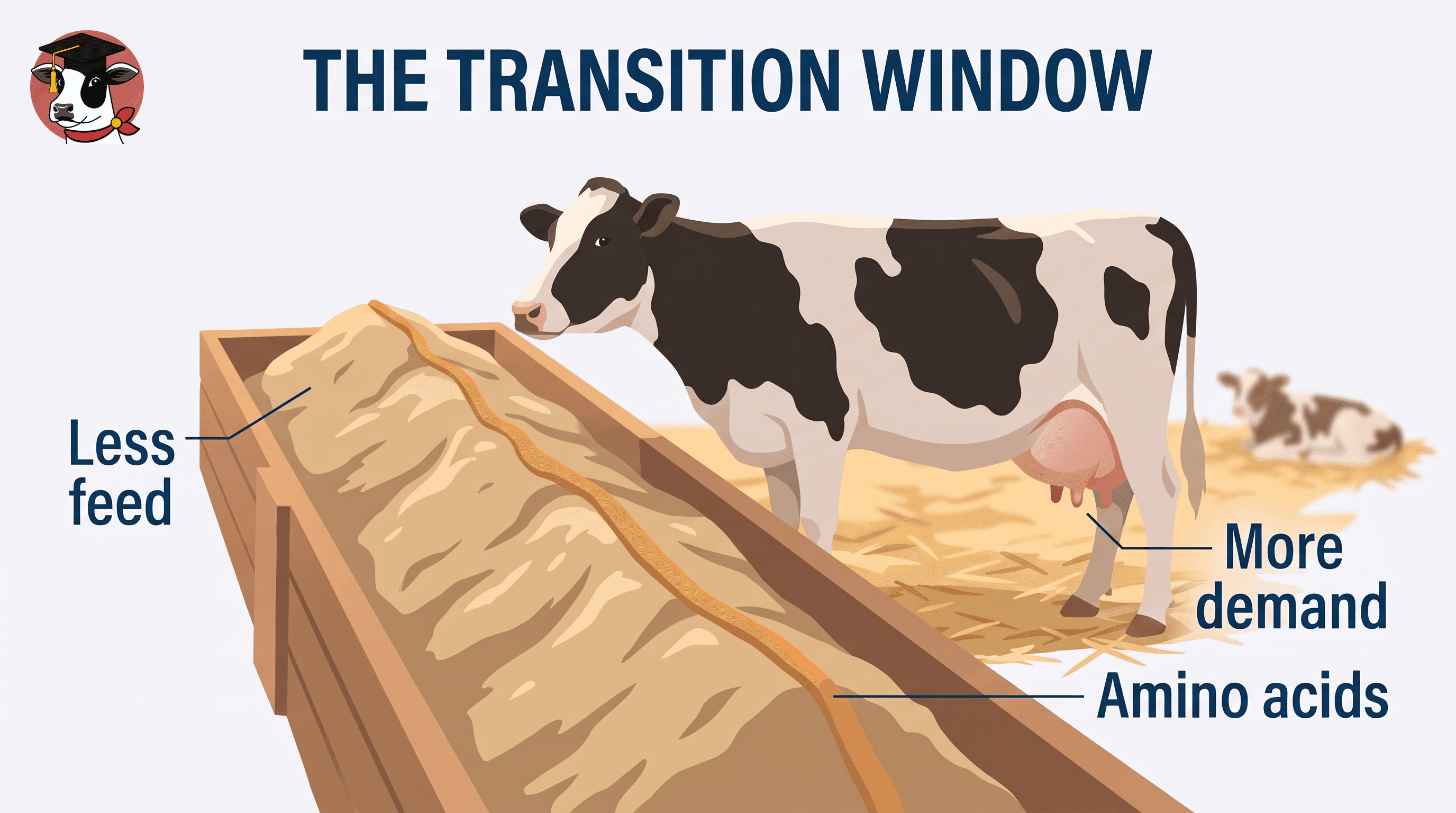
Late pregnancy raises a cow's needs for glucose and amino acids by roughly 30 to 50%. Within four days of calving, the udder's demand is several times what the pregnant uterus needed just before term, and even a cow with a good appetite cannot eat enough to cover it. For about the first two weeks she makes up much of the difference by breaking down body protein, mostly from muscle. A ration can look fine on crude protein and still leave her short of specific essential amino acids, because what counts is the supply that reaches the small intestine, as MP is not crude protein explains.
Many transition trials have tested rumen-protected methionine in diets that already had enough lysine. A 2024 meta-analysis pooled 21 publications with 40 comparisons in which feeding started, on average, about 19 days before calving and continued into lactation. Intake, body weight and body condition did not change before calving. After calving, supplemented cows ate more and made more milk, milk fat and milk protein. At 21 days in milk the estimated gains were about 1.4 kg of dry matter intake, 2.1 kg of milk and 92 g of milk true protein per day, and they shrank as lactation went on. Single trials that started three or four weeks before calving reported 3.4 to 4.1 kg more milk a day in the first month.
In the largest pen-level trial, with 470 cows in two university herds, methionine fed before and after calving did not change intake or milk yield averaged over 16 weeks, although milk protein rose from 2.95 to 3.07%. The product matters too: in the meta-analysis, the methionine analog HMTBa did not raise milk protein percentage, while the other sources did. The positive single trials fed commercial products to groups of 12 to 30 cows. Lysine has been studied less in this window. Across lactation, its responses tend to be smaller than those to methionine, and larger when methionine is already adequate.
Methionine also feeds methylation and antioxidant pathways, which is one reason it is studied for liver and immune function. In one trial, supplemented cows had lower markers of inflammation and oxidative stress, and their neutrophils, the front-line white blood cells, were more active against bacteria in lab tests. Those measurements came from 15 healthy cows per group. In another trial, neutrophil activity improved but liver fat did not change. Two small trials reported trends toward less ketosis, and one toward fewer retained placentas. In the 470-cow trial, methionine did not reduce most health disorders, and the meta-analysis found health outcomes too inconsistently reported to judge. Treat any health benefit as possible, not proven.
Guidance built on the older MP approach commonly put lysine at about 6.5 to 7.2% of MP and methionine at about 2.2 to 2.4%, close to three parts lysine to one part methionine. Several transition trials, and some university guidance for close-up and fresh cows, aim for about 2.6 to 2.9 parts lysine per part methionine, which means relatively more methionine. NASEM (2021) instead compares the supply of each essential amino acid with a target efficiency of use rather than a share of MP. The best amino acid profile for close-up and fresh cows is still unsettled, and published targets shift with the diet, the production level and the model used.
Check in the barn
What to check: Ask the nutritionist whether the close-up and fresh diets were each run through their model for MP, lysine and methionine, and which targets they used. If a rumen-protected product is in the ration, ask what evidence shows how much of it reaches the small intestine as usable methionine, because products differ. Track fresh-cow intake, since in several trials the extra milk came at least partly from higher intake after calving. Milk protein percent in the first weeks of lactation is a rough, late signal at best. Energy supply, breed and days in milk move it too, and a wide energy gap can pull it down whatever the amino acid balance. Any ration change stays with the nutritionist.
Educational only—not a diagnosis, prescription, or ration formula. Defer clinical and ration decisions to the herd veterinarian and nutritionist.
Keep reading
View the networkNext
When the fresh cow’s energy gap widens
After calving, milk demand rises faster than intake — the gap is where ketone risk lives.
Knowledge level in this topic: Intermediate. Barn-side working knowledge in this topic: checks, pairing, and what to do next.Sister note · 3 min
Home plate: Transition · The transition cow · The ±3-week window
- The ±3-week windowThe windowPlaced here
- Dry period is recovery timeA controlled dry period plus close-up bunk access is mammary recovery time — not an empty parking lot before calving.Same focus
- The DCAD sweet spotPrepartum DCAD is a calcium-readiness tool — moderate negative targets help; extremes buy little calcium and more acid load.Same sheet
- Inside the rumenA dairy cow is a microbial fermentation system. Open the vat: four compartments, a stratified rumen, chewing, acids, and what leaves downstream.Bridge → Rumen
Mark size is the kind. Color is the atlas area.
- Sheet
- Focus
- Field note
- Rumen
- Transition
Sources
- Regulation of organic nutrient metabolism during transition from late pregnancy to early lactation — Bell AW, J Anim Sci (1995)
- Protein nutrition in late pregnancy, maternal protein reserves and lactation performance in dairy cows — Bell AW, Burhans WS, Overton TR, Proc Nutr Soc (2000)
- Supplemental Smartamine M or MetaSmart during the transition period benefits postpartal cow performance and blood neutrophil function — Osorio JS, Ji P, Drackley JK, Luchini D, Loor JJ, J Dairy Sci (2013)
- Better postpartal performance in dairy cows supplemented with rumen-protected methionine compared with choline during the peripartal period — Zhou Z, Vailati-Riboni M, Trevisi E, Drackley JK, Luchini DN, Loor JJ, J Dairy Sci (2016)
- Ethyl-cellulose rumen-protected methionine enhances performance during the periparturient period and early lactation in Holstein dairy cows — Batistel F, Arroyo JM, Bellingeri A, Wang L, Saremi B, Parys C, Trevisi E, Cardoso FC, Loor JJ, J Dairy Sci (2017)
- Ethyl-cellulose rumen-protected methionine alleviates inflammation and oxidative stress and improves neutrophil function during the periparturient period and early lactation in Holstein dairy cows — Batistel F, Arroyo JM, Garces CIM, Trevisi E, Parys C, Ballou MA, Cardoso FC, Loor JJ, J Dairy Sci (2018)
- Effects of feeding rumen-protected methionine pre- and postpartum in multiparous Holstein cows: Lactation performance and plasma amino acid concentrations — Toledo MZ, Stangaferro ML, Gennari RS, Barletta RV, Perez MM, Wijma R, et al., J Dairy Sci (2021)
- Systematic review and meta-analysis of dairy cow responses to rumen-protected methionine supplementation before and after calving — Zanton GI, Toledo MZ, JDS Commun (2024)
- Effects of feeding rumen-protected methionine pre- and postpartum in multiparous Holstein cows: Health disorders and interactions with production and reproduction — Toledo MZ, Stangaferro ML, Caputo Oliveira R, Monteiro PLJ, Gennari RS, Luchini D, et al., J Dairy Sci (2023)
- Amino acid nutrition of dairy cows: invited review — Martins LF, Hristov AN, Anim Biosci (2026)
- Nutrient Requirements of Dairy Cattle: Seventh Revised Edition, 2001 — National Research Council (2001)
- Nutrient Requirements of Dairy Cattle, 8th revised edition — National Academies of Sciences, Engineering, and Medicine (2021)
- Ready, set, go! Points to consider when feeding rumen-protected amino acids and clay to dairy cows — Cardoso P, Dairy Focus, University of Illinois Urbana-Champaign (2020)