
The sensor is a barn alarm, not a diagnosis
Rumination and activity collars flag deviations from a cow’s own baseline — useful alarms that still need the cow, bunk, and stall before you act.
Knowledge level in this topic: Intermediate. Barn-side working knowledge in this topic: checks, pairing, and what to do next.
3 min read · 2026-09-09
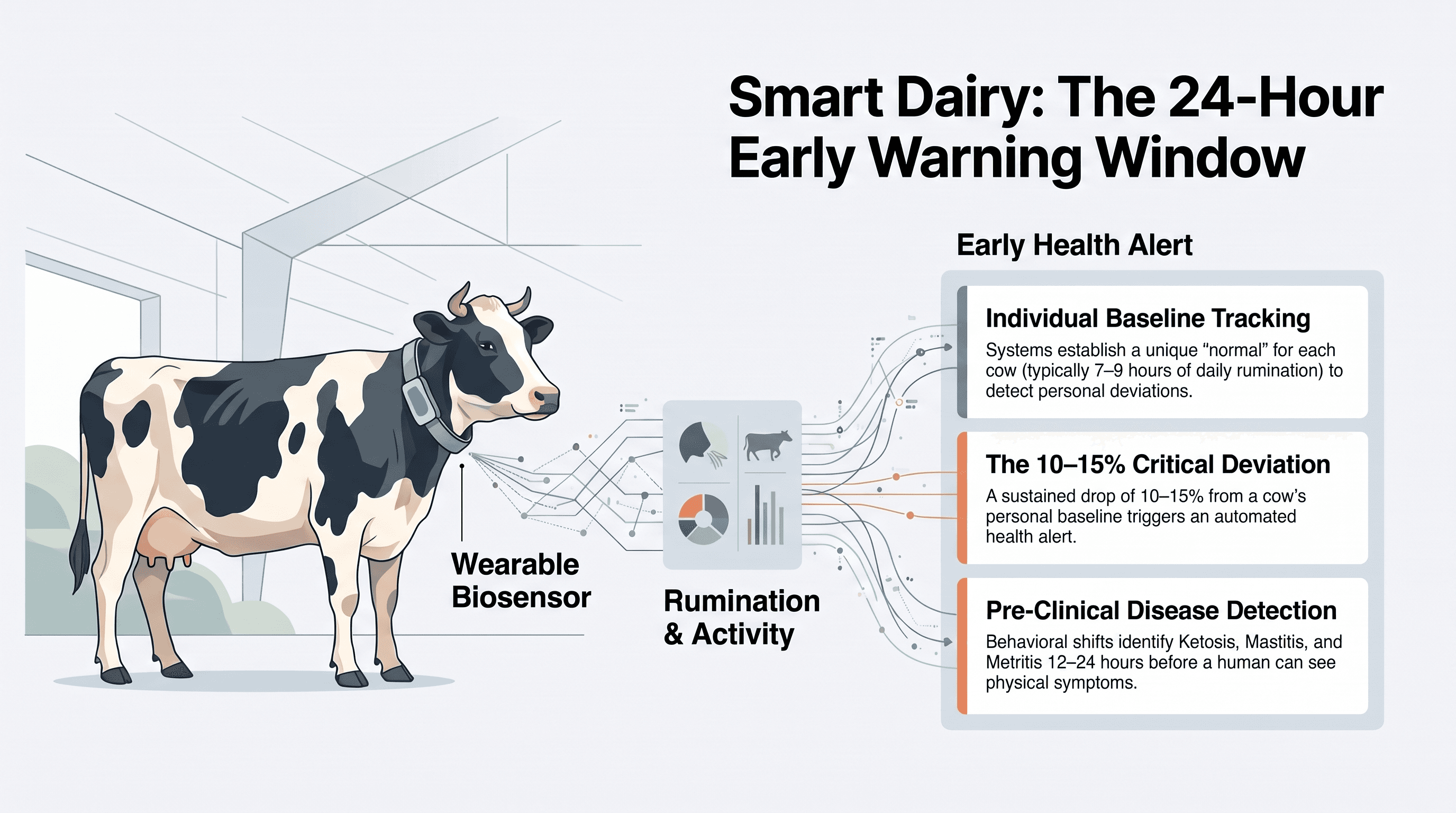
Wearable rumination and activity sensors watch what the eye cannot count all day: chewing minutes, restlessness, and deviation from each cow’s own “normal.” Used well, they shrink the time from “something changed” to “someone walked that pen.” Used poorly, they become a diagnosis machine that skips the cow.
Systems typically learn each animal’s pattern — often on the order of many hours of rumination per day in lactating cows — then flag sustained drops (commonly discussed in the 10–15% range relative to that cow). The signal is personal: a high-rumination cow falling to “average” can matter more than a low-rumination cow staying flat. Those alerts can precede visible illness, heat stress collapse, or intake crashes by hours. That early window is the value. It is not a lab result and not a treatment order.
A rumination drop can mean ketosis risk, mastitis onset, metritis, empty bunks, heat load, sorting, or a dead battery. The atlas rule is barn-first: see the cow, check bunk and water, look at manure and lying, then decide with your veterinarian and nutritionist. Sensors complement peNDF, saliva/buffer, and manure chapters — they do not replace them.
Treat the morning alert list like a parlor checklist. How many alerts cleared after a walk with no treatment? How many cows were already off feed at the bunk? If the list grows while the pen looks fine, recalibrate thresholds and battery/health of the devices before rewriting the SOP.
Sister notes on this universe cover saliva as the free buffer, reading manure before you rewrite the ticket, cud chewing as the cheapest sensor, and milk fat as the tank alarm. The transition universe’s when the fresh cow’s energy gap widens note picks up when intake and rest fail after calving; the heat stress universe’s water space is a ration ingredient note covers access that keeps rumination going. Educational only—not a diagnosis, prescription, or treatment protocol.
Keep reading
View the networkNext
Read manure before you rewrite the ticket
The alley is a daily report card on the ration the cow actually ate and fermented: consistency, fiber, and grain tell you before the mixer does.
Knowledge level in this topic: Intermediate. Barn-side working knowledge in this topic: checks, pairing, and what to do next.Sister note · 3 min
Home plate: Rumen · Inside the rumen
- Inside the rumenA dairy cow is a microbial fermentation system. Open the vat: four compartments, a stratified rumen, chewing, acids, and what leaves downstream.Placed here
- Saliva is the free bufferBagged bicarbonate has a line item. Saliva is the free, manageable buffer you earn with chewing — not the larger proton sink than SCFA absorption.Sister note
- Cud chewing is the cheapest rumen sensorRumination is how the cow rebuilds particle size and pumps saliva bicarbonate into the vat. If she stops, less buffer reaches the rumen.Sister note
- Stocking & cow flowStocking is stalls, bunk, lying, lockup, holding, and movement — not one percentage. Those resources fail separately.Bridge → Barn
Mark size is the kind. Color is the atlas area.
- Sheet
- Field note
- Rumen
- Barn
Sources
- Invited review: Current perspectives on eating and rumination activity in dairy cows — Beauchemin 2018, Journal of Dairy Science
- From Feed to Milk: Understanding Rumen Function — Penn State Extension
- Using Manure Evaluation to Enhance Dairy Cattle Nutrition — Penn State Extension
- Ruminant Digestive System — Merck Veterinary Manual