
Starch Rate, Not Starch Percent
Two rations can print the same starch percentage and still ferment at very different speeds. Grain type, processing and time in the silo set that speed, and the fall switch to new-crop corn silage changes it twice: once at the switch and again over the winter.
Knowledge level in this topic: Intermediate. Barn-side working knowledge in this topic: checks, pairing, and what to do next.
3 min read · 2026-09-26
In this note
- 52 to 78%
- 75 to 85%
- 42 to 73%
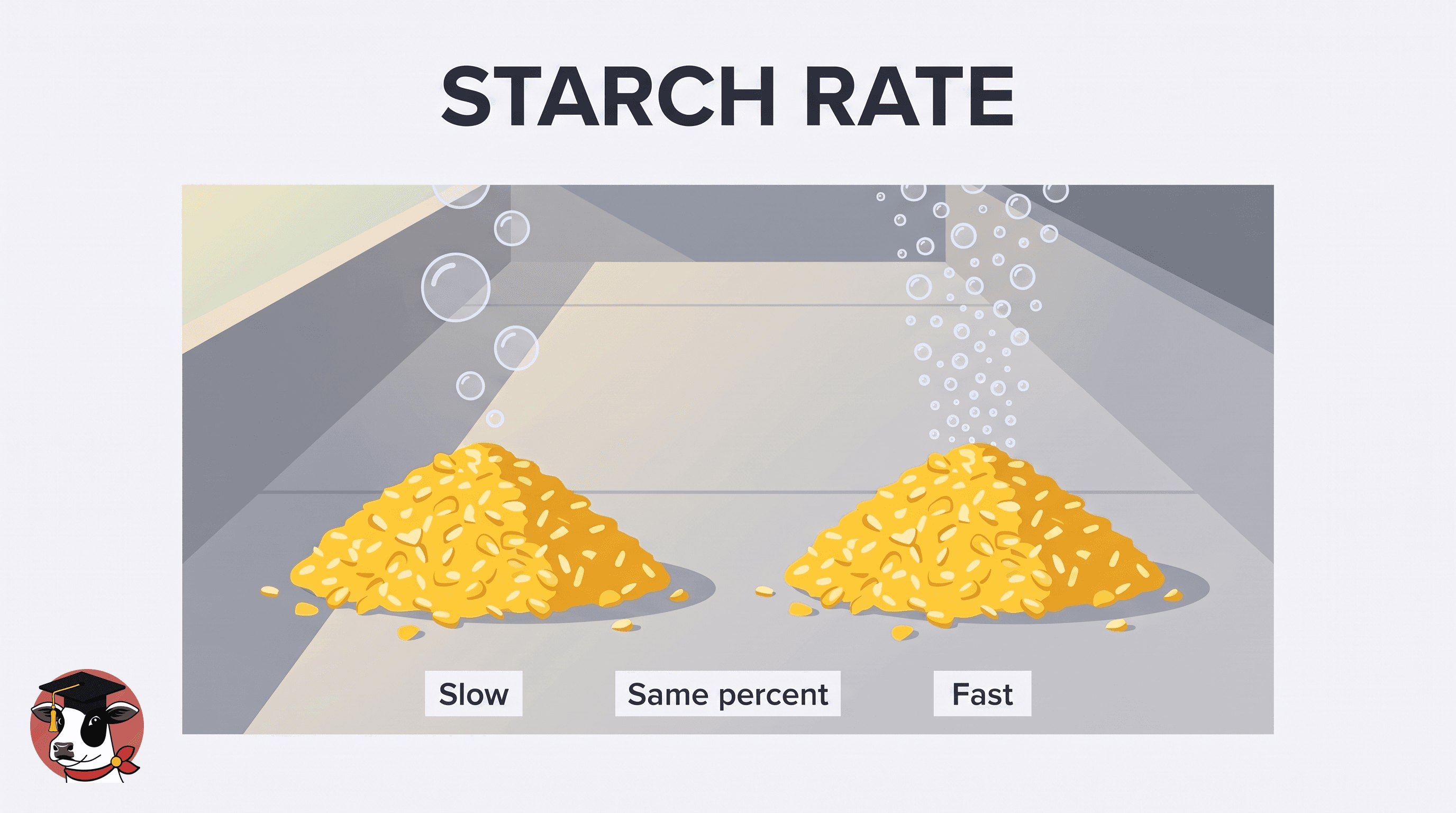
A feed report gives starch as a percentage of dry matter. That number is the dose. How fast the rumen ferments it is the rate, and the rate decides how much acid arrives after a meal. In one trial, cows fed diets at the same 32% starch fermented starch from high-moisture corn at about 28% per hour and starch from dry ground corn at about 15% per hour, and digested 71% versus 47% of it in the rumen. The measured starch line tells you how much is there. What happens when that starch arrives faster than the rumen can buffer it is covered under Fast starch on the Starch load & SARA sheet.
Cereal grains differ in how easily rumen microbes reach their starch. In corn, the granules sit in a matrix of water-repelling zein proteins that slows microbial access. In a classic steer trial, estimated ruminal starch availability was 98% for oats, 95% for wheat, 90% for barley, 62% for corn and 49% for sorghum. Those values came from rumen bags and one assumed passage rate, so read them as a ranking rather than numbers for your ration. Replacing corn with barley or wheat at the same starch percentage is still likely to speed fermentation up.
Processing opens the kernel and changes the starch itself. Compared with dry rolling, steam processing (flaking or rolling) raised ruminal starch digestion from 52 to 78% of intake for sorghum and from 75 to 85% for corn, and by six points or less for other grains. Finer grinding raises starch digestibility as well. Ensiling the grain also counts: in the trial above, the high-moisture corn fermented faster even though it was ground coarser than the dry corn. In corn silage, kernel processing does the same job at harvest.
Ensiled corn gets faster in storage. Protein breakdown in the silo slowly takes the zein matrix apart; in high-moisture corn, 240 days of ensiling cut the gamma zeins that cross-link it by 42 to 73%. Corn silage follows the same pattern. In a summary of four trials, up to six months of ensiling raised ruminal in vitro starch digestibility by about 15 percentage units on average. In one trial, starch concentration itself did not change over 240 days of storage. In another, protein breakdown was still active beyond two to three months. The size of the change can vary with hybrid and dry matter at harvest, so each pile follows its own curve.
Old-crop silage has had most of a year to make that change. New-crop silage opened after a few weeks has not, even if both test at similar starch. Extension guidance treats about three weeks as the minimum for fermentation to stabilize, prefers two months where inventory allows, and supports planning inventory so the new crop can sit at least four months before feeding. When silage has to be fed early, blend new into old over a transition, test the new crop, and adjust the ration with the nutritionist. The same pile then speeds up through the winter; as high-moisture corn ages, dietary starch may need to come down to hold the rumen steady. A 7-hour in vitro starch digestibility test, where your lab offers one, can track that drift. Packing and face management are in air at the face spoils the pack.
Check in the barn
What to check: In the week of the switch, put the new report next to the old one: starch, and starch digestibility if the lab runs it. In the high group, watch the bulk-tank fat test, manure consistency and cud chewing, the quiet cluster described in SARA is not grain overload. Empty bunks and sorting change how fast acid builds up too, so rule them out before blaming the silage. Two to three months later, re-test the same pile and repeat the barn check. Starch digestibility is likely still rising, so a ration that fit in the fall may be fermenting faster by midwinter. Any ration change stays with the nutritionist.
Educational only—not a diagnosis, prescription, or treatment protocol. Defer clinical and ration decisions to the herd veterinarian and nutritionist.
Keep reading
View the networkNext
Kernel Processing Unlocks the Starch
Corn silage starch is only worth what the rumen can reach. A whole or merely cracked kernel keeps it locked away, and harvest is the only time the processor can still fix that.
Knowledge level in this topic: Intermediate. Barn-side working knowledge in this topic: checks, pairing, and what to do next.Sister note · 3 min
Home plate: Rumen · Starch load & SARA · Fast starch
- Fast starchFermentation speedPlaced here
- Milk fat depression starts in the rumenHigh starch and unsaturated fat with weak effective fiber can shift biohydrogenation toward trans-10 intermediates that suppress mammary fat synthesis.Sister note
- Empty bunks are starch eventsCows that wait, then eat fast, can drop rumen pH even when the printed diet never changed.Sister note
- Intake & the energy gapIntakeBridge → Transition
Mark size is the kind. Color is the atlas area.
- Focus
- Field note
- Rumen
- Transition
Sources
- Dry matter, crude protein, and starch degradability of five cereal grains — Herrera-Saldana RE, Huber JT, Poore MH, J Dairy Sci (1990)
- Starch utilization by ruminants: from basics to the bunk — Huntington GB, J Anim Sci (1997)
- Effects of corn grain conservation method on ruminal digestion kinetics for lactating dairy cows at two dietary starch concentrations — Oba M, Allen MS, J Dairy Sci (2003)
- Effect of cereal grain type and corn grain harvesting and processing methods on intake, digestion, and milk production by dairy cows through a meta-analysis — Ferraretto LF, Crump PM, Shaver RD, J Dairy Sci (2013)
- Influence of ensiling time and inoculation on alteration of the starch-protein matrix in high-moisture corn — Hoffman PC, Esser NM, Shaver RD, Coblentz WK, Scott MP, Bodnar AL, Schmidt RJ, Charley RC, J Dairy Sci (2011)
- The effects of hybrid, maturity, and length of storage on the composition and nutritive value of corn silage — Der Bedrosian MC, Nestor KE Jr, Kung L Jr, J Dairy Sci (2012)
- Effect of ensiling time and hybrid type on fermentation profile, nitrogen fractions, and ruminal in vitro starch and neutral detergent fiber digestibility in whole-plant corn silage — Ferraretto LF, Shaver RD, Massie S, Singo R, Taysom DM, Brouillette JP, Prof Anim Sci (2015)
- Influence of ensiling on the digestibility of whole-plant corn silage — Ferraretto L, Shaver R, Lauer J, Focus on Forage, University of Wisconsin–Madison Division of Extension
- I need silage. Is it ready yet? — Carrasquillo Mangual M, Michigan State University Extension (2023)
- What's in your new crop corn silage? — Curtis Z, Hower K, Duppstadt L, Penn State Extension (updated 2025)
- Estimating and managing carbohydrate digestibility — Krogstad K, Buckeye Dairy News 28(2), The Ohio State University Extension