
The Four Compartments
Ruminants run specialized pre-gastric fermentation — four compartments, but field management lives or dies on rumen health (fiber → usable energy).
Knowledge level in this topic: Basic. First-pass in this topic — useful even if you already know another area well.
3 min read · 2026-09-21
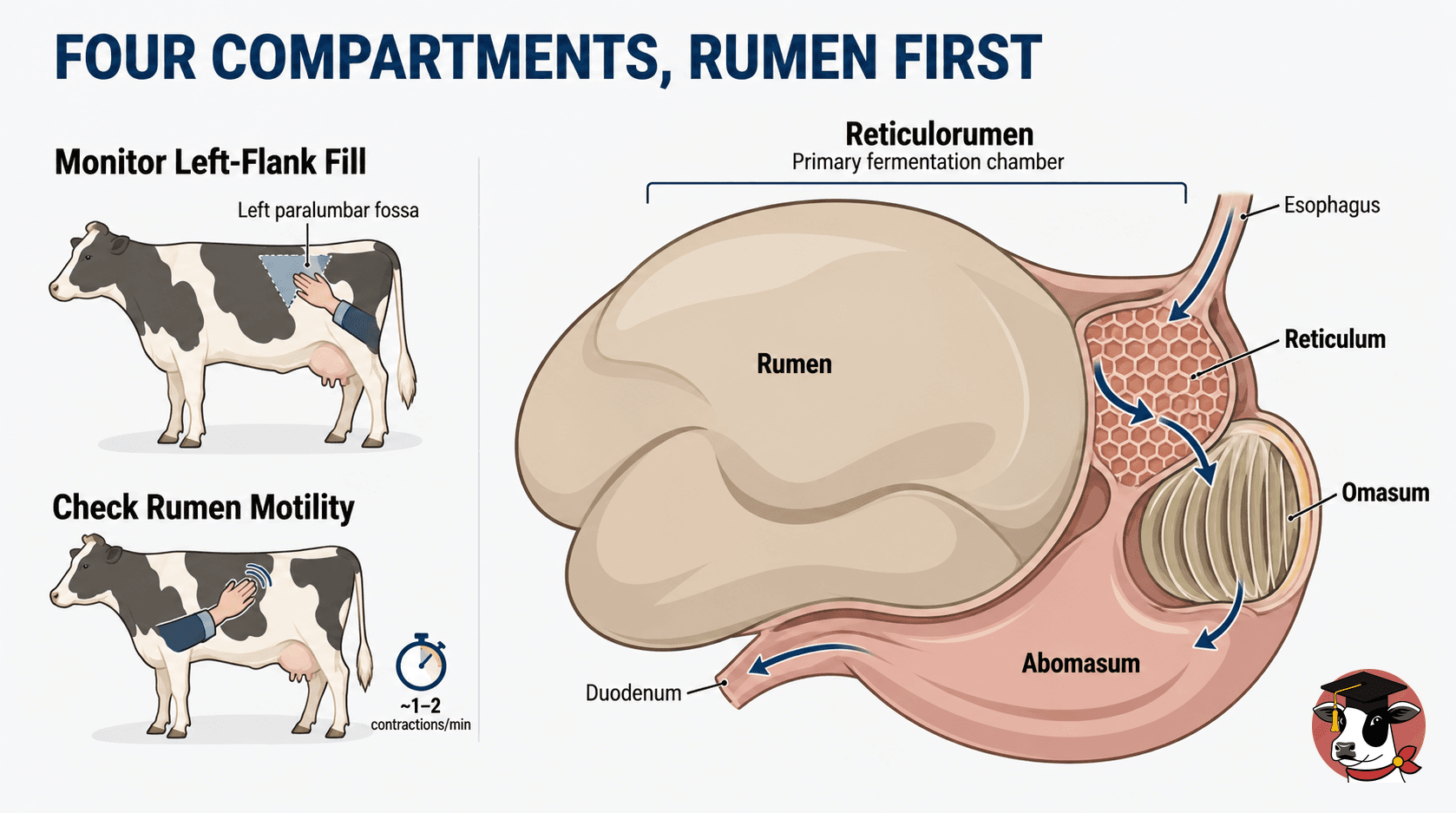
Cattle carry four stomach compartments, not four identical bags. The rumen is the large fermentation vat that holds roughly four-fifths of stomach capacity. The reticulum traps dense material beside it. The omasum squeezes water and some minerals from digesta. The abomasum is the true glandular stomach — acid and enzymes finish what the forestomachs started.
Feed does not march through on a factory timer. Material is mixed, regurgitated, re-chewed, and returned — the rumination loop that shrinks particle size and pumps bicarbonate-rich saliva into the vat. That is how fiber becomes usable volatile fatty acids. Extension guides from Minnesota, Mississippi State, and LSU describe the same architecture; field management lives or dies in the rumen long before the omasum or abomasum get the blame.
Check in the barn
What to check: read the left flank for fill contour and motility before you chase downstream trouble. Burfeind and colleagues published a repeatable rumen-fill scoring system for dairy cows — a barn-side picture that pairs with whether resting cows are chewing. A thin left contour, quiet motility, or a cow that stops chewing her cud are rumen alarms. Manage fiber, sorting, and meal pattern there first.
Left displaced abomasum and other downstream failures often trace back to rumen risk — inadequate effective fiber, slug meals, and a fiber mat that could not hold. Forestomach epithelia absorb cations and anions under tight regulation, but you will not fix that from a textbook in the alley. Treat the rumen as the management compartment — the other three matter for anatomy and diagnosis, not for daily bunk decisions.
Keep reading
View the networkNext
Reading milk fat as a rumen alarm
A falling fat test is often the first cheap signal that fermentation has shifted, not that the cow forgot how to make fat.
Knowledge level in this topic: Advanced. Mechanism and stacked risk in this topic — assumes the first-pass frame.
Sister note · 3 minHome plate: Rumen · Inside the rumen · Four compartments
- Four compartmentsAnatomyPlaced here
- The sensor is a barn alarm, not a diagnosisRumination and activity collars flag deviations from a cow’s own baseline — useful alarms that still need the cow, bunk, and stall before you act.Sister note
- Particle size holds the fiber matIf the TMR is too fine, the forage raft thins — less trapping, less re-chewing, less bicarbonate-rich saliva.Sister note
Mark size is the kind. Color is the atlas area.
- Focus
- Field note
- Rumen
Sources
- The ruminant digestive system — University of Minnesota Extension
- Understanding the ruminant animal digestive system — Mississippi State University Extension
- The ruminant digestive system — LSU AgCenter
- Technical note: Evaluation of a scoring system for rumen fill in dairy cows — Burfeind O, et al., Journal of Dairy Science (2010)
- Nutritional risk factors in the etiology of left displaced abomasum in dairy cows: a review — Shaver RD, Journal of Dairy Science (1997)
- Transport of cations and anions across forestomach epithelia: conclusions from in vitro studies — Leonhard-Marek S, et al., Animal (2010)