
Count the Unsaturated Fat, Not Just the Fat
Fat on the feed tag is not the count that matters. The unsaturated fat the rumen sees, from every ingredient, can stack with starch and weak fiber.
Knowledge level in this topic: Advanced. Mechanism and stacked risk in this topic — assumes the first-pass frame.
3 min read · 2026-10-03
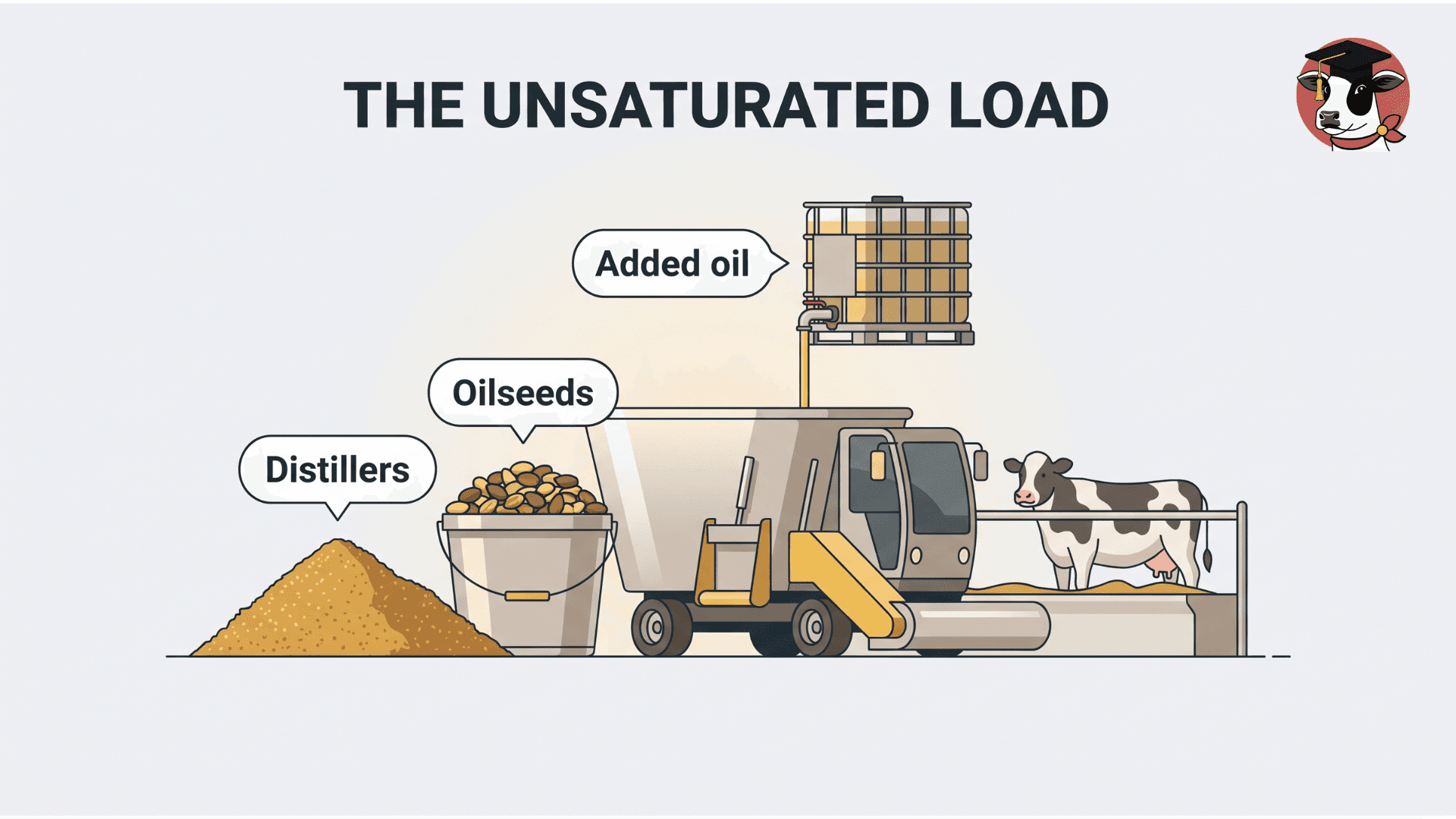
The ration sheet says the fat is fine, yet the tank test can say otherwise. Crude fat on a feed tag is a rough count, and it cannot tell unsaturated fat from saturated. What the rumen meets each day is the unsaturated C18 fat from every ingredient together: oleic, linoleic and linolenic acids, summed as the rumen unsaturated fatty acid load, or RUFAL. It was proposed as a better warning than the percentage of added fat, and a higher load raises the odds of the shift described in how milk fat depression starts in the rumen.
NASEM 2021 works from total fatty acids, not crude fat, which is the ether-soluble part of a feed and a poor index of true fatty acid content in many feeds. The gap is uneven. In a large laboratory dataset, total fatty acids rose by about 0.57 per unit of ether extract in forages, against about 0.9 in oilseeds and by-product feeds.
The load hides in several places. Distillers grains carry corn oil, mostly linoleic acid, and the amount varies: 20 samples ranged from 10 to 18% total fatty acids in dry matter, and reduced-fat products exist. Oilseeds such as soybean, cottonseed, canola and flax differ in profile and in how available their oil is. Forages and grains add a background share. Added oils count, and so does oleic acid: at 5% of diet dry matter, a high-oleic safflower oil still lowered milk fat percentage in a 24-cow trial.
The load can stack with starch, and how fast starch arrives matters too. In a distillers diet, added oil or added starch each lowered the concentration of fatty acids the udder makes itself by 13% (four cows), and both together by 27%. In 20 cows, milk fat fell from 3.3% to about 3.0% with either one and 2.7% with both, though fat yield was down about 0.25 kg/day on all three and fell no further with both.
A sizable load can be tolerated in some rations. In diets near 28% NDF, distillers grains or added corn oil left fat yield unchanged, although milk fat percentage fell with distillers because milk volume rose. Soybean oil at 2% of dry matter also left fat yield unchanged while percentage dipped and udder-made fatty acids fell. Neither trial was designed to test fiber, so they show tolerance in that ration, not why.
No validated ceiling exists. In commercial herd records, a higher load went with lower milk fat in a continuous way, and the data did not allow a threshold to be set. NASEM 2021 repeats an older general advice against more than 7% total fatty acids in dry matter. That advice was framed around feed intake, not milk fat. The extension rule of thumb for unsaturated fat is a suggestion, not a validated level. Pooled supplement trials varied widely: oilseeds lowered milk fat percentage on average but raised fat yield.
Check in the barn
What to check: Ask for the fatty acid result, not only crude fat, on each new distillers lot. Ask what changed in the weeks before the tank moved: a new lot, an oilseed or oil added, new-crop silage, a starch step. Walk the bunk for sorting, since sorting can leave the long fiber behind while the concentrate is eaten. Change one thing at a time, with the nutritionist.
Educational only: not a diagnosis, prescription, or ration formula. Defer clinical and ration decisions to the herd veterinarian and nutritionist.
Keep reading
View the networkNext
Milk fat depression starts in the rumen
High starch and unsaturated fat with weak effective fiber can shift biohydrogenation toward trans-10 intermediates that suppress mammary fat synthesis.
Knowledge level in this topic: Advanced. Mechanism and stacked risk in this topic — assumes the first-pass frame.Sister note · 3 min
Home plate: Rumen · Starch load & SARA · The microbial shift
- The microbial shiftPopulationPlaced here
- Starch Rate, Not Starch PercentTwo rations can print the same starch percentage and still ferment at very different speeds. Grain type, processing and time in the silo set that speed, and the fall switch to new-crop corn silage changes it twice: once at the switch and again over the winter.Sister note
- Milk fat first, then manureSARA rarely announces itself with a down cow. The tank and the alley move while the parlor still looks busy.Sister note
- The ±3-week windowThe windowBridge → Transition
Mark size is the kind. Color is the atlas area.
- Focus
- Field note
- Rumen
- Transition
Sources
- Fat and starch as additive risk factors for milk fat depression in dairy diets containing corn dried distillers grains with solubles — Ramirez Ramirez HA, Castillo Lopez E, Harvatine KJ, Kononoff PJ, J Dairy Sci (2015)
- Effect of increasing oil from distillers grains or corn oil on lactation performance — Leonardi C, Bertics S, Armentano LE, J Dairy Sci (2005)
- Effect of unsaturated fatty acids and triglycerides from soybeans on milk fat synthesis and biohydrogenation intermediates in dairy cattle — Boerman JP, Lock AL, J Dairy Sci (2014)
- Effect of fatty acid profile in vegetable oils and antioxidant supplementation on dairy cattle performance and milk fat depression — He M, Armentano LE, J Dairy Sci (2011)
- An appraisal of the concept of Rumen Unsaturated Fatty Acid Load and its relation to milk fat concentration using data from commercial dairy farms — Mannai H, Charbonneau E, Fadul-Pacheco L, Pellerin D, Chouinard PY, Prof Anim Sci (2016)
- Effect of fat additions to diets of dairy cattle on milk production and components: A meta-analysis and meta-regression — Rabiee AR, Breinhild K, Scott W, Golder HM, Block E, Lean IJ, J Dairy Sci (2012)
- Modeling fatty acids for dairy cattle: Models to predict total fatty acid concentration and fatty acid digestion of feedstuffs — Daley VL, Armentano LE, Kononoff PJ, Hanigan MD, J Dairy Sci (2020)
- Lactation performance and amino acid utilization of cows fed increasing amounts of reduced-fat dried distillers grains with solubles — Mjoun K, Kalscheur KF, Hippen AR, Schingoethe DJ, Little DE, J Dairy Sci (2010)
- Feeding for Milk Components — Lock AL, Van Amburgh ME, Western Canadian Dairy Seminar, University of Alberta (2012)
- Nutrient Requirements of Dairy Cattle: Eighth Revised Edition — National Academies of Sciences, Engineering, and Medicine, National Academies Press (2021)
- Feeding Supplemental Fat to Dairy Cattle — University of Wisconsin-Madison Division of Extension (Dairy)
- Understanding and Troubleshooting Milk Fat Depression in Dairy Herds — Greco LF, Santos JEP, University of Florida IFAS Extension, EDIS AN261 (2011, archival copy)