
Read manure before you rewrite the ticket
The alley is a daily report card on the ration the cow actually ate and fermented — consistency, fiber, and grain tell you before the mixer does.
3 min read · 2026-09-09
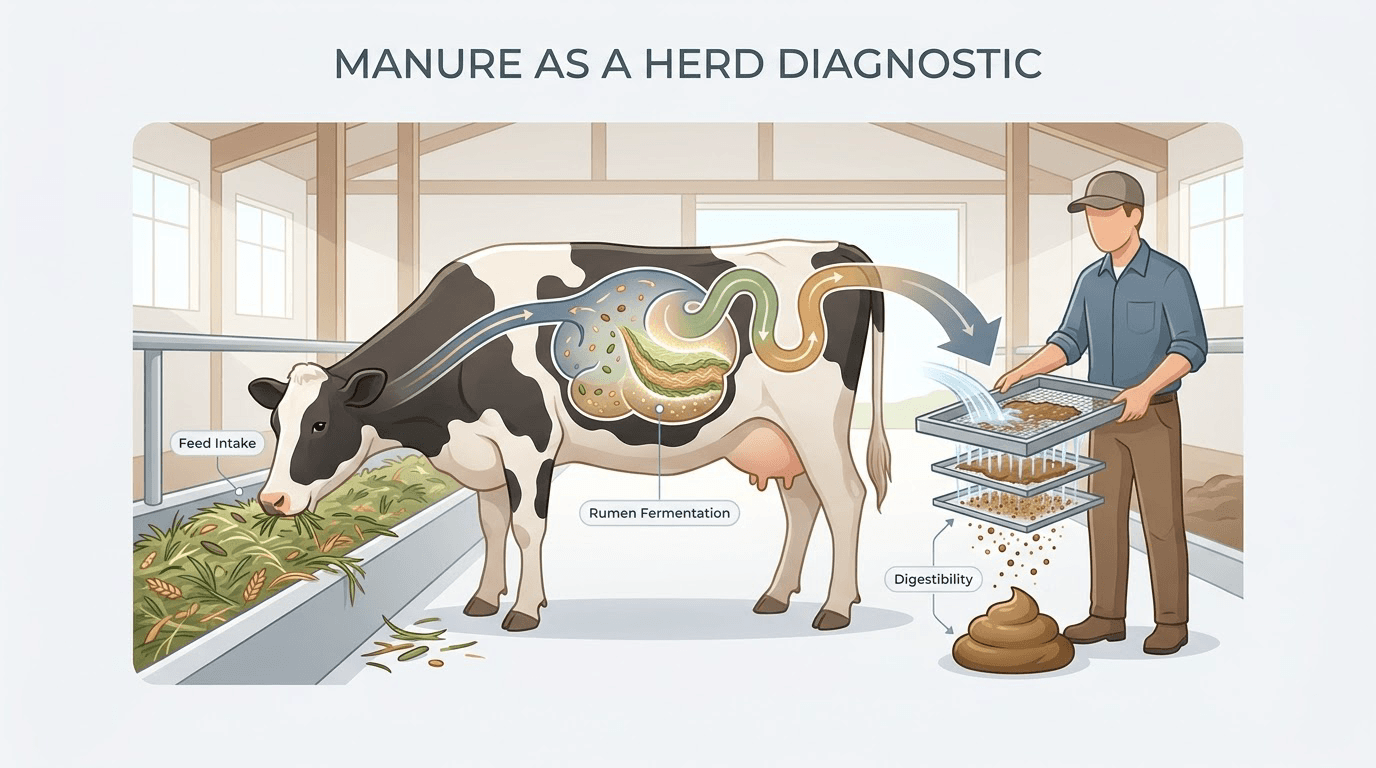
The mixer ticket describes what left the wagon. Manure describes what the rumen finished. Walk the alley after a meal and you get a herd-level report card on particle size, starch load, passage rate, and sorting — without waiting for next month’s milk fat slip.
Penn State's manure-evaluation article is the lead field guide: look at consistency, undigested fiber and grain, and pen variation. Shared farm language often uses a 1–5 consistency scale (Michigan / CowSignals-style shared language; Stallings' earlier scoring work is related but not a PSU-taught 1–5 checklist). Treat any scorecard as a shared vocabulary, not a diagnosis. Very loose manure can flag rapid passage or fermentable overload; stiff, dry piles can flag fiber or water issues. More useful than a single score is pen variation: if piles differ wildly cow-to-cow, sorting and competition are part of the story.
Undigested long fiber or whole grain in a rinse or sieve points back to effective fiber, processing, and starch availability. Mucin casts and frothy, bubbly manure are warning lights that the gut lining and fermentation are under stress — reasons to call the nutritionist and veterinarian, not to “fix” the diet yourself.
Manure that looks “wrong” after a ration change is often the peNDF and starch chapters talking. Read manure with the same eyes you use for cud chewing and milk fat — they are one system. Once a week, walk both sides of the alley after fresh feed. If the alley and the ticket disagree, believe the alley first — then ask what the cow actually sorted, chewed, and fermented.
Keep reading
View the networkNext
The sensor is a barn alarm, not a diagnosis
Rumination and activity collars flag deviations from a cow’s own baseline — useful alarms that still need the cow, bunk, and stall before you act.
Sister note · 3 min
Home plate: Rumen · Inside the rumen
- Inside the rumenA dairy cow is a microbial fermentation system. Open the vat: four compartments, a stratified rumen, chewing, acids, and what leaves downstream.Placed here
- Reading milk fat as a rumen alarmA falling fat test is often the first cheap signal that fermentation has shifted, not that the cow forgot how to make fat.Sister note
- Air at the face spoils the packDense packing and oxygen-barrier cover lock fermentation in. A ragged, slow face lets air back in and burns dry matter at the bunk.Same sheet
Mark size is the kind. Color is the atlas area.
- Sheet
- Field note
- Rumen
Sources
- Using Manure Evaluation to Enhance Dairy Cattle Nutrition — Penn State Extension
- Manure scoring as a management tool — Stallings, C.C. — WCDS 1998