
Particle size holds the fiber mat
If the TMR is too fine, the forage raft thins — less trapping, less re-chewing, less bicarbonate-rich saliva.
Knowledge level in this topic: Advanced. Mechanism and stacked risk in this topic — assumes the first-pass frame.
3 min read · 2026-09-07
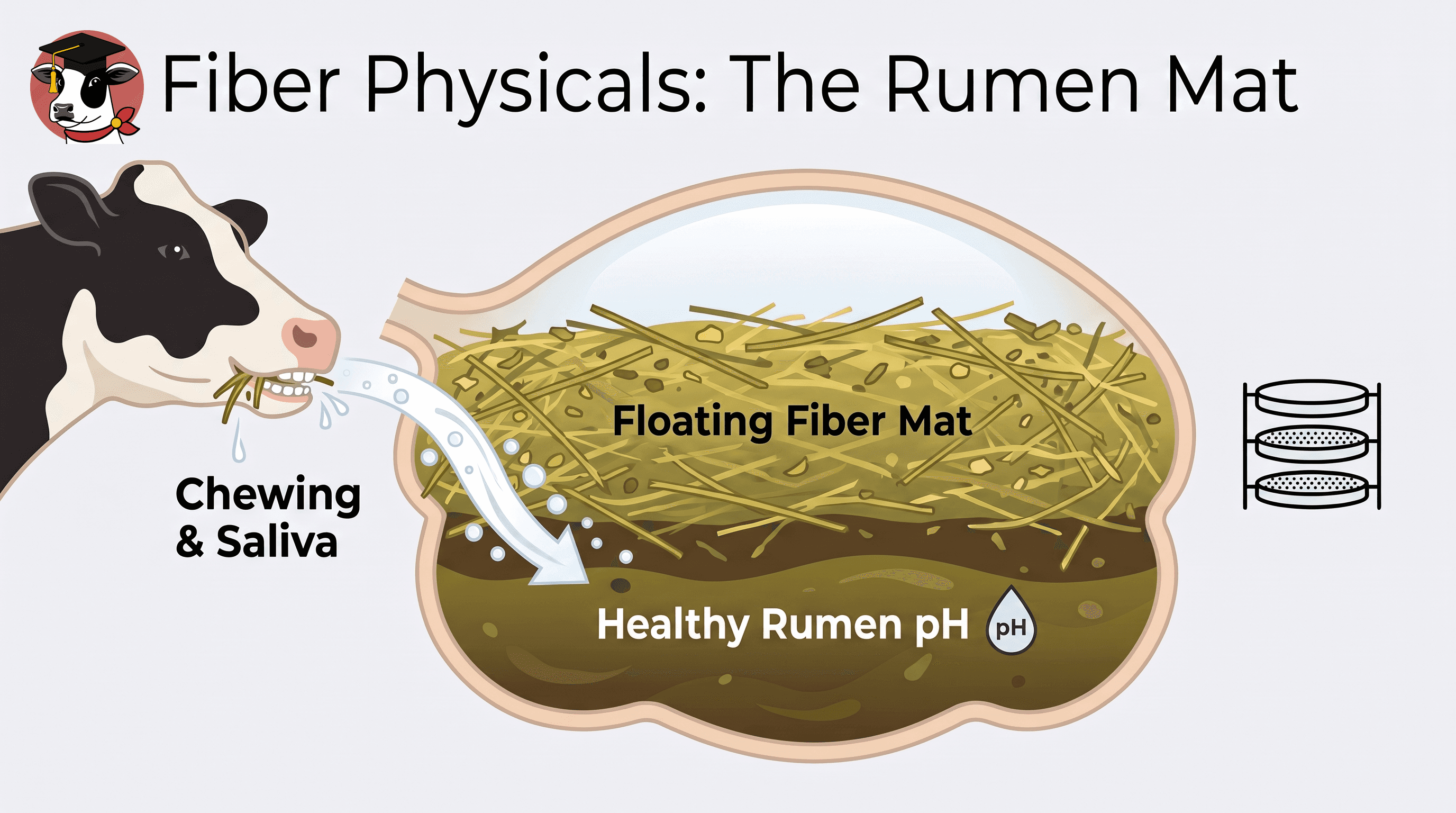
The rumen mat is a floating raft of longer forage particles. It traps smaller feed, slows passage, and gives the cow something to re-chew — which pumps bicarbonate-rich saliva back into the vat.
Chemical NDF on the sheet does not guarantee that structure. Over-mixing, an aggressive knife setup or over-processing, a fine chop, or cows sorting against long stems can shrink the raft while the formulation still looks fine.
Measure the ration after mixing and delivery with the Penn State Particle Separator, then shake the refusals the same way. A jump in long particles left behind is sorting against physically effective fiber. Pair the sieve with the barn walk: resting cows chewing, manure that looks loose or grainy, and a bunk that is not just empty.
peNDF is the physical bridge that supports chewing and mat formation; uNDF240 is a different fill constraint from undegradable fiber after long fermentation. NASEM frames related ideas through physically adjusted NDF (paNDF), while Tri-State and Miner work treat peNDF and uNDF240 as linked field measures — useful together, not interchangeable.
The mat also matters because of its bulk. A thick raft of long forage presses outward on the rumen wall, and stretch receptors in the wall send that signal up the vagus nerve. The brainstem answers with the regular mixing contractions, and coarse mat material touching the area near the esophagus is one of the main triggers for bringing up a cud. When the ration is too fine, the mat thins, the wall is stretched less, and contractions and cud activity tend to slow together.
Check in the barn
What to check: the left flank behind the ribs should look moderately full rather than deeply hollow. A firm fist pressed into it for about 30 to 60 seconds should meet a springy, layered feel rather than a doughy or fluid one. Strong rolling contractions normally arrive about one to three times every two minutes. These are teaching cues, not a diagnosis.
Fix the particle the cow actually eats before you rewrite the chemistry.
Keep reading
View the networkNext
Cud chewing is the cheapest rumen sensor
Rumination is how the cow rebuilds particle size and pumps saliva bicarbonate into the vat. If she stops, less buffer reaches the rumen.
Knowledge level in this topic: Basic. First-pass in this topic — useful even if you already know another area well.Sister note · 3 min
Home plate: Rumen · Inside the rumen · The fiber mat
- The fiber matThe raftPlaced here
- What Leaves the RumenLiquid and solid digesta leave the rumen on different clocks. Fast fluid outflow harvests microbial protein, while fiber particles leave only after they shrink and sink.Sister note
- Microbes and FermentationFeed the microbes first: fiber + NFC → VFAs for energy; dietary N upgrades to microbial crude protein; biohydrogenation of PUFA is microbial survival, not an MFD deep dive.Sister note
Mark size is the kind. Color is the atlas area.
- Focus
- Field note
- Rumen
Sources
- Penn State Particle Separator — Penn State Extension
- From Feed to Milk: Understanding Rumen Function — Penn State Extension
- Nutrient Requirements of Dairy Cattle, 8th revised edition (paNDF framing) — NASEM (2021)
- A Tale of Two Fibers: Physically Effective and Undegradable Neutral Detergent Fiber and Their Interaction with Starch — Grant R, Smith W, Miller M, Smith K, Tri-State Dairy Nutrition Conference / Miner Institute (2021)
- Physically Effective Fiber: How Much Is Enough? — William H. Miner Agricultural Research Institute
- Effects of diet on short-term regulation of feed intake by lactating dairy cattle — Allen MS, J Dairy Sci (2000)
- The ruminant digestive system — University of Minnesota Extension