
NFC Is a Remainder
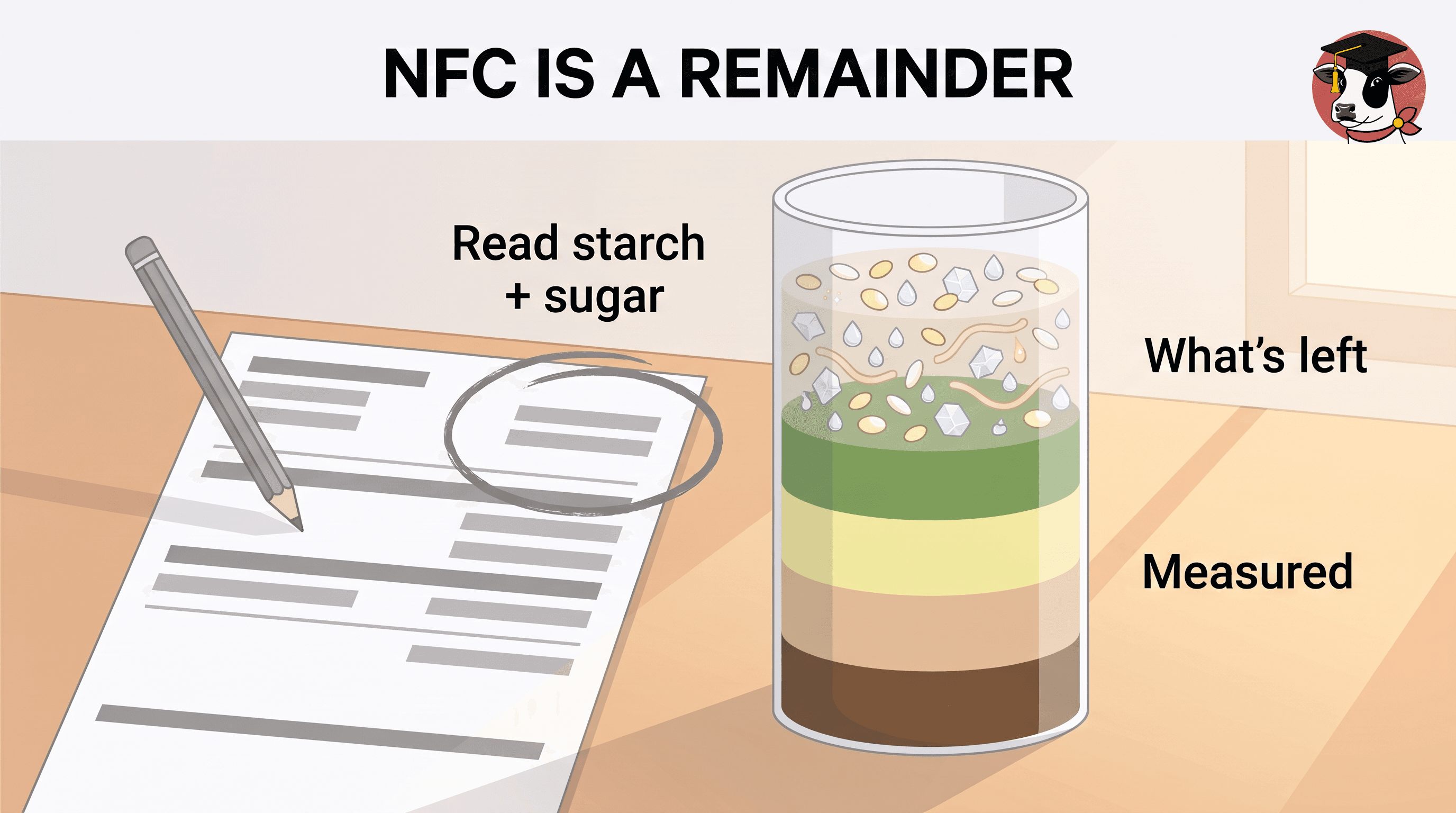
Most carbohydrate lines on a feed report come from a lab assay. NFC does not. It is what is left after NDF, protein, fat and ash are subtracted from 100, so it carries their errors, and it holds a lot more than starch.
Knowledge level in this topic: Intermediate. Barn-side working knowledge in this topic: checks, pairing, and what to do next.
5 min read · 2026-09-25
In this note
- 60 to 70%
- 41.0%
- 34.7%
Carbohydrates usually make up 60 to 70% of a lactating cow's diet dry matter, as covered in the rumen chamber. On a feed report they split into two kinds of line. NDF is the structural part: it fills the rumen and keeps the cow chewing. Non-fiber carbohydrate (NFC) is the rest, the faster carbohydrates that supply energy for milk but do less to keep the rumen stable. This note is about how those lines get onto the report. Fermentation is in microbes and fermentation, fiber digestibility and fill in uNDF240 sets the fill limit, physical form in NDF vs physically effective fiber, and the same printed-line problem for protein in MP is not crude protein.
Dry matter, crude protein, fat (ether extract), ash, NDF, starch and sugar each come from an assay aimed at that nutrient. Many labs predict them by NIR from calibrations instead of running wet chemistry on every sample, and every method has its own error, but each line still estimates one thing. NFC is different. No assay measures it; the lab calculates it from the other lines. The energy lines (TDN, NEL and similar) are calculated too, and the equations differ between labs and ration programs. NSC, where it appears, is usually measured starch plus water-soluble sugar, but labs define it and their sugar assay differently, so read the footnotes.
The basic equation is NFC = 100 − (NDF + CP + fat + ash), with every term as % of DM. A common version subtracts neutral detergent insoluble crude protein (NDICP) from NDF first. Some protein stays in the fiber residue, so without the correction it is counted once in CP and again in NDF, and NFC comes out low. When NDF is run with sodium sulfite, most of that protein is removed and the correction is small. Because NFC is whatever is left, an error in any of the other four lines lands in NFC in the opposite direction. If NDF reads 2 units low, NFC reads 2 units high. If ash reads 1 unit high, NFC reads 1 unit low. Soil is the classic case: when NDF is not ash-corrected, soil caught in the fiber residue is counted as NDF and counted again as ash, so it is subtracted twice. Protein adds its own error for feeds where the standard 6.25 nitrogen factor does not fit. None of this means the lab did poor work. It is what happens when one number is built from four others.
NFC holds starch, sugars, soluble fiber such as pectin, and in silages the organic acids made during fermentation. NSC leaves out pectin and the fermentation acids, and those two make up much of the difference between the lines. Table values in NRC (2001), adapted from older data, show the size of the gap: alfalfa silage at 18.4% NFC but 7.5% NSC, and corn silage at 41.0% NFC and 34.7% NSC, all % of DM. In the same source, starch was about a quarter of alfalfa silage NFC, pectin about a third, and fermentation acids the rest, while corn silage NFC was about 71% starch and 29% acids. Treat those as an illustration, not as values for your forage. The parts do not behave alike. Pectin is a cell-wall carbohydrate that neutral detergent happens to dissolve, so it lands outside NDF; it is highly digestible, but it is not starch. Silage acids are what fermentation in the silo already produced. They still count as energy, but gram for gram they carry less gross energy than starch. Two feeds with the same NFC can therefore feed the rumen quite differently. How much starch the rumen can actually reach is a separate question, covered in kernel processing unlocks the starch.
NASEM (2021), the current dairy requirements, dropped the NFC term that NRC (2001) used in its energy equations. Starch is now its own measured fraction, and the rest goes into a new by-difference term, residual organic matter (ROM): roughly 100 minus ash, NDF, starch, fatty acids and crude protein, with small corrections for fat and supplemental nonprotein nitrogen. ROM holds sugars, soluble fiber, fermentation acids, glycerol and anything else not measured, plus the analytical error from the main fractions. The unmeasured pool is smaller because starch now comes from an assay, but it is still a remainder. The same system also uses NDF that includes ash, because that is what its underlying research used, and advises resampling or switching to ash-corrected NDF when soil contamination is heavy. An ash-corrected line is not automatically the one your ration software expects.
Check in the barn
What to check: Circle the calculated lines. On the latest corn silage and haylage reports, mark NFC, the energy lines, and NSC if the footnotes say it is calculated. Everything left unmarked came from an assay or an NIR prediction of one. Put starch plus sugar next to NFC. On a wet silage or haylage, a wide gap is mostly acids and soluble fiber, not hidden starch. Ask the lab before comparing reports. Was NDF ash-corrected (aNDFom) or not, and run with or without sulfite? Is NFC NDICP-corrected? Is sugar ethanol-soluble (ESC) or water-soluble (WSC)? WSC also counts long-chain fructans and lactose. Was the sample run by wet chemistry or NIR? Compare reports only on the same basis. Read ash when NFC looks odd. If ash runs well above what that forage usually shows on your farm, suspect soil, expect NFC to read low, and talk with the nutritionist before a ration change rests on NFC alone.
Educational only—not a diagnosis, prescription, or treatment protocol. Defer clinical and ration decisions to the herd veterinarian and nutritionist.
Keep reading
View the networkNext
uNDF240 Sets the Fill Limit
NDF tells you how much cell wall a forage carries. uNDF240 estimates how much of it the rumen cannot digest, and that fraction takes up space until it is chewed small enough to leave. In high-producing cows, it can cap how much they eat.
Knowledge level in this topic: Intermediate. Barn-side working knowledge in this topic: checks, pairing, and what to do next.Sister note · 5 min
Home plate: Rumen · Physically effective fiber · NDF vs physically effective fiber
- NDF vs physically effective fiberTwo different jobsPlaced here
- Chop length is not peNDFChop length is a harvester setting; peNDF is the fiber structure that actually reaches the rumen after moisture, processing, mixing, and sorting.Same focus
- Refusals read the peNDF storyShake fresh TMR and the refusal pile with the same particle separator — divergence shows whether formulated peNDF actually reached the cow.Same sheet
- Intake & the energy gapIntakeBridge → Transition
Mark size is the kind. Color is the atlas area.
- Focus
- Field note
- Rumen
- Transition
Sources
- Nutrient Requirements of Dairy Cattle, 7th revised edition, Chapter 4, Carbohydrates — National Research Council (2001)
- Nutrient Requirements of Dairy Cattle, 8th revised edition — National Academies of Sciences, Engineering, and Medicine (2021)
- Challenges with nonfiber carbohydrate methods — Hall MB, J Anim Sci (2003)
- Gravimetric determination of amylase-treated neutral detergent fiber in feeds with refluxing in beakers or crucibles: collaborative study — Mertens DR, J AOAC Int (2002)
- Estimating digestible energy values of feeds and diets and integrating those values into net energy systems — Weiss WP, Tebbe AW, Transl Anim Sci (2019)
- What do today's forage analyses tell us? — Hall MB, Proc Western Dairy Management Conference (2015), Reno, NV
- Forage analysis definitions, SP 774 (Rev. 05/25) — McIntosh D, Pedreira B, Mason K, Ivey J, Eckelkamp E, Shanks J, Florence R, University of Tennessee Extension (2025)