
Early Lameness Detection: Why Treating the First Lame Step Matters
Catching the first mild limp beats waiting for an obvious non-weight-bearing cow — early follow-up shortens lesion progression and protects lying time and milk.
3 min read · 2026-09-14
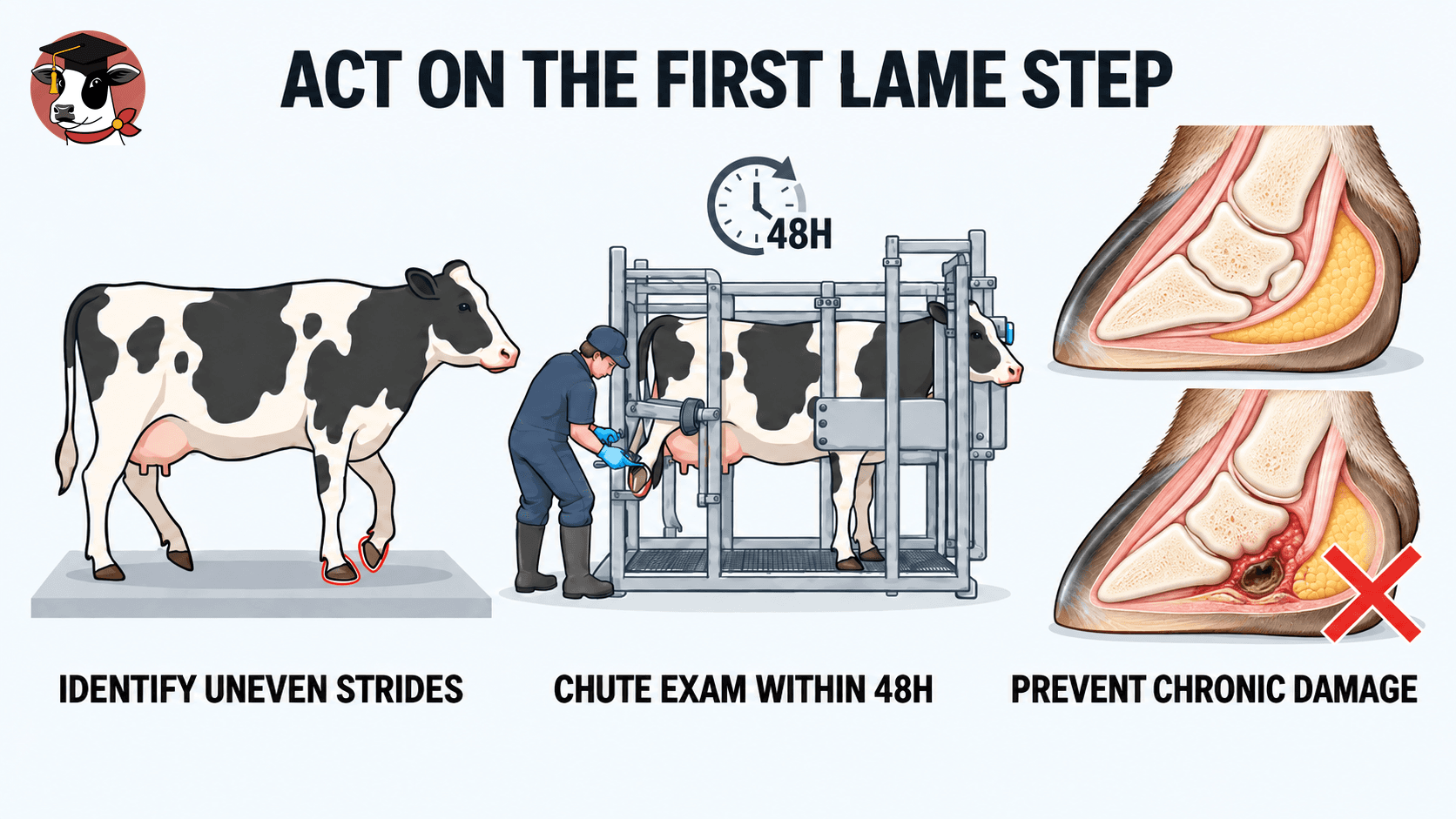
The cow that cannot bear weight is already late in the story. The economic and welfare cost of lameness — milk, fertility, treatment, and early cull — rises as lesions progress and lying time collapses. The management win is catching the first consistently identifiable limp and getting that foot into a chute before the lesion hardens into a chronic case.
Mobility and locomotion scoring systems differ in labels and threshold numbers — AHDB 0–3 is not interchangeable with a common 1–5 locomotion chart (Sprecher-style). When uneven weight-bearing or a shortened stride is immediately and consistently obvious, the cow is no longer "watch and hope." On AHDB that is score 2 — examine and treat, with new cases attended within about 48 hours. On a typical 1–5 chart, that same cow often reads closer to score 3, not score 2. Waiting for "really lame" trades away recovery odds that early trim, offload, and pain planning were meant to protect. Farmers who rely only on casual visual observation often miss a large share of lame cows. Designated scoring on a hard, non-slip surface with uninterrupted strides is the antidote.
Early detection is a herd rhythm, not a milking-shift emergency drill. Extension guidance points to regular screening (often every one to two weeks), a named person who can pull cows, and trained eyes on every shift for new cases between formal scores. Cameras and wearables can help screen continuously — they do not replace a foot exam or a veterinary protocol. Behavioral clues often travel with gait: longer lying time (often longer bouts, not simply more bouts), less feeding time, awkward rise or sit. Use them as a pull list for the next walk-by score, not as a substitute for looking at the limb.
Prompt follow-up shortens how long a painful claw carries load. That protects digital cushion and horn, keeps blocks and corrective trims more effective, and limits the cascade into lower milk and poorer reproductive performance. Lesion typing still comes first at the chute — infectious skin versus claw-horn disruption — so the early pull does not become a one-spray-fits-all mistake.
Keep reading
View the networkNext
Camera scores are screening — not diagnoses
Computer-vision gait scores can prioritize cows and track herd trends — useful screening when camera setup is honest, never a veterinary diagnosis on their own.
Sister note · 3 min
Home plate: Hoof · From lameness to lesion · Recognize lameness
- Recognize lamenessThe alleyPlaced here
- Name horn or skin before you sprayDigital dermatitis and a sole ulcer fail entirely different tissues. One protocol cannot fix both.Sister note
- Hoof Blocks and Off-Loading: Taking Pressure Off the Painful ClawA hoof block is mechanical off-load for a painful claw-horn lesion — not a spray substitute. Sound-claw selection, placement, and a timed recheck decide whether it helps or harms.Same publisher
Mark size is the kind. Color is the atlas area.
- Focus
- Field note
- Hoof
Sources
- Mobility scoring: How to score your cows — AHDB Knowledge Library
- Locomotion Scoring as a Management Tool — Cornell University College of Veterinary Medicine (NYSCHAP)
- Locomotion Scoring — The Dairyland Initiative (UW–Madison)
- Optimising lameness detection in dairy cattle by using handheld infrared thermometers — Lin YC, et al., Veterinary Medicine and Science (2018);4(3):218–226
- Optimising lameness detection in dairy cattle by using handheld infrared thermometers (PMC full text) — Lin YC, et al., Veterinary Medicine and Science (2018)
- Moderate lameness leads to marked behavioral changes in dairy cows — Weigele B, et al., Journal of Dairy Science (2018)
- Use of Extended Characteristics of Locomotion and Feeding Behavior for Automated Identification of Lame Dairy Cows — Beer G, et al., PLOS ONE (2016)