Walk the dry yard at two o’clock
The milk barn can look cooled while the next lactation pants in a still pocket.
3 min read · 2026-09-07
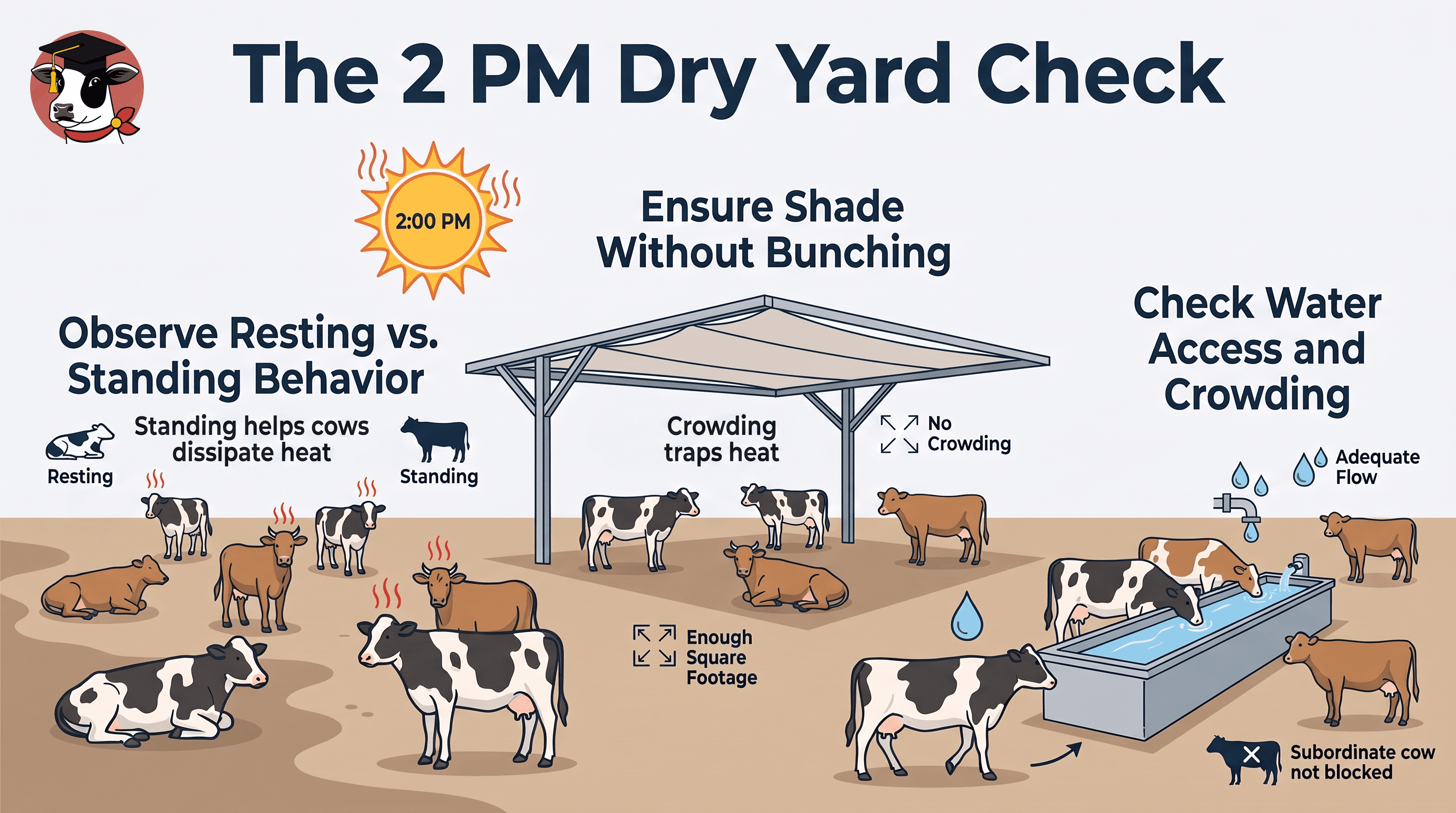
Penn State’s dry-cow cooling work is easy to skip because those cows are not on the parlor sheet. They still make heat, and they still need shade, air, and water. Lactating cows get the soakers and the shift attention; dry cows often sit in the pocket that never got the retrofit.
Walk the dry yard at 14:00 on a muggy day. Count who is standing with flared nostrils versus lying in shade. Check whether water is reachable without a boss fight, and whether any air actually crosses the cows — not just the fenceline. A south-facing dirt lot with one tank and no moving air is a heat trap, not a rest pen.
Dry-period heat stress does not stay in the dry pen. Penn State’s dry-cow cooling bulletins tie late-gestation heat load to lower milk next lactation and weaker calves. Tao and Dahl’s Journal of Dairy Science work on early-pregnancy heat stress reinforces that the uterine environment carries forward — cooling that stops at the milk barn is half a plan.
Keep reading
View the networkNext
The holding pen was the hottest room
Parlor fans were fine. The packed pen before the gate was still.
Same focus · 4 min
Home plate: Barn · Heat stress · High-risk zones
- High-risk zonesWhere the load hidesPlaced here
- THI and air speed stage the coolingBarn THI alone can miss the cow's microclimate — pair temperature-humidity with cow-level air speed so fans, misters, and soakers stage against what she actually feels.Same sheet
- Water space is a ration ingredientLinear water space and refill rate behave like ration ingredients — if subordinate cows wait, intake and milk are already slipping.Same sheet
Mark size is the kind. Color is the atlas area.
- Focus
- Field note
- Barn
Sources
- Cooling Dry Cows to Improve Health and Production — Penn State Extension
- Heat Stress Abatement Techniques for Dairy Cattle — Penn State Extension
- Heat stress effects during early pregnancy on uterine artery hemodynamics and offspring development — Tao & Dahl 2013, Journal of Dairy Science