
Dry Matter and As Fed Are Different Jobs
Scales weigh feed with its water, rations are balanced on dry matter, and a wetter or drier silage means the same scale weight no longer delivers the same dry matter.
Knowledge level in this topic: Basic. First-pass in this topic — useful even if you already know another area well.
3 min read · 2026-10-04
In this note
- 35%
- 30%
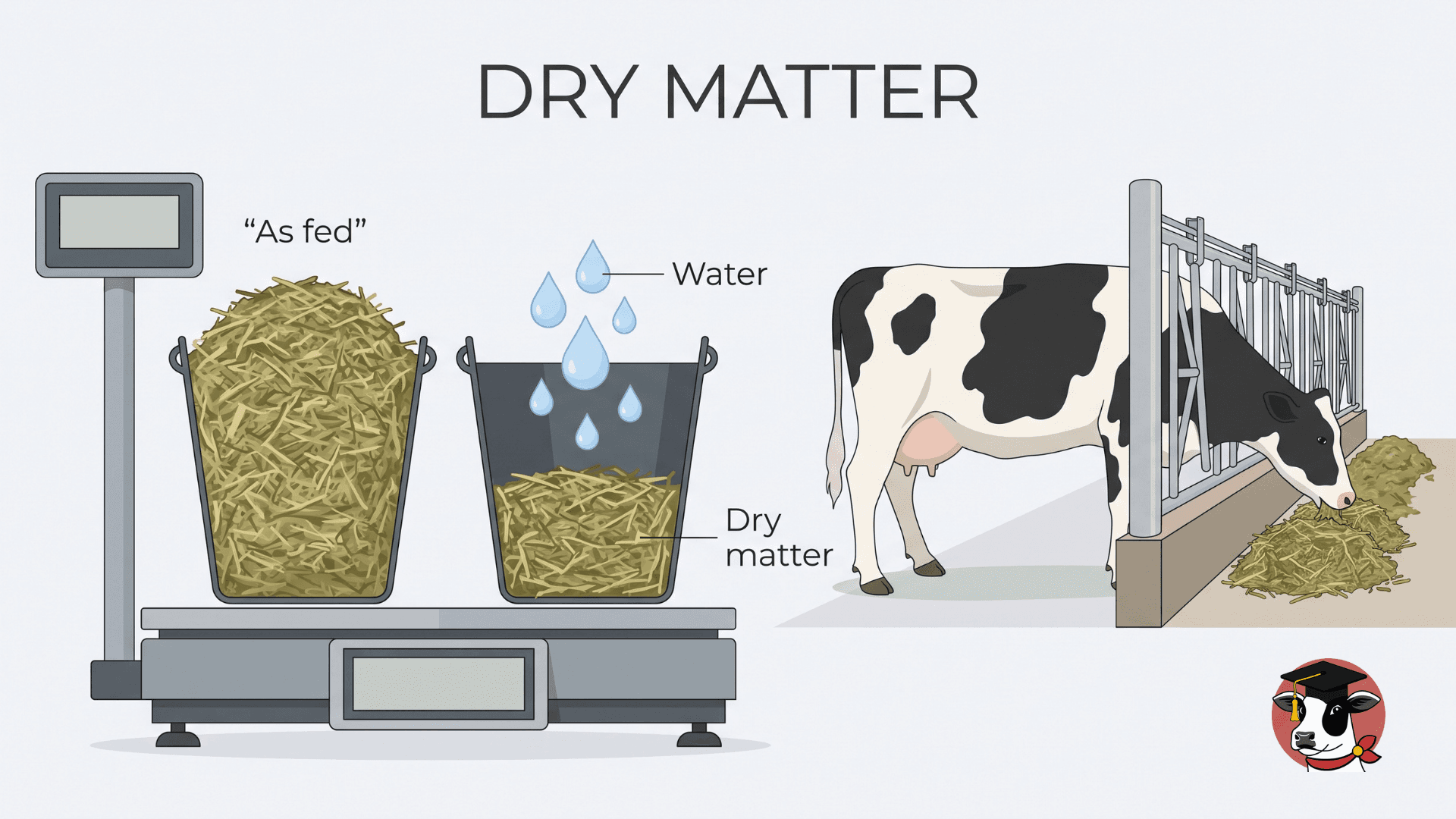
A scale weighs feed together with its water, but a ration is balanced on what is left when the water is gone. Those are two different jobs, and a feed number cannot be used safely until you know which basis it is on.
As-fed (AF) weight, also called as-received or as-is, includes the water in the feed. Dry matter (DM) is the part that is not water, and the DM percentage is the share of the AF weight that is DM. Moisture percentage is 100 minus DM percentage. To convert, kg DM = kg AF × DM% / 100, and kg AF = kg DM / (DM% / 100). The DM percentage comes from a DM test of the feed.
Rations are usually formulated on a DM basis but mixed and fed as a total mixed ration (TMR) that is weighed as-fed. In the feed composition tables of the Nutrient Requirements of Dairy Cattle (NASEM 2021, from the National Academies of Sciences, Engineering, and Medicine), everything except DM itself is given on a DM basis. Laboratory reports often show both columns, and feed report lines are typically read as percent of DM, while the DM percentage describes the sample as received. The same quantity can be written both ways, as silage density targets show, so say AF or DM out loud.
Illustration only, with invented values and no animal group assumed (not a benchmark or a recommendation). A feeding sheet line calls for 30 kg of silage as-fed, and the silage tests 35% DM: 30 × 0.35 = 10.5 kg DM. A later test shows 30% DM, a wetter silage (see how moisture changes the TMR for the mixing side). Holding 10.5 kg DM now needs 10.5 / 0.30 = 35 kg as-fed (about 77 lb as-fed), which is 5 kg more as-fed. Leaving the scale at 30 kg as-fed delivers only 30 × 0.30 = 9 kg DM, which is 1.5 kg DM short.
This correction holds the DM of one ingredient constant, nothing more. Other ingredients still require review; this is a moisture correction, not a new balanced ration, and total ration DM and nutrient balance stay with the nutritionist. The mixer and push-up then decide whether the corrected as-fed weight is what the cow actually eats. If a sheet does not state its basis, or the DM percentage is missing, the conversion cannot be done reliably.
The DM percentage is itself a measurement. Extension describes moisture as the most variable aspect of forages and advises testing DM regularly. The oven or tester can also move the result. In a grass silage study, oven drying drove off lactic acid and volatile fatty acids along with the water, more so at higher drying temperatures. On-farm microwave and Koster-type testers were strongly correlated with a laboratory forced-air oven, though not identical. One extension source notes the Koster tester tends to read lower than the microwave. A different DM percentage changes the corrected as-fed weight, so record the method and date beside the number.
Check in the barn
What to check: Which basis, as-fed or DM, is each number on? Is a DM percentage printed, dated and tied to its test method for each wet feed on the sheet? Did the last silage test change the DM, and was the as-fed weight reviewed with the nutritionist? Is the unit stated (kg per cow per day, or per batch), and which group of cows is the sheet for? Leave any ration change to the nutritionist.
Educational only: not a diagnosis, prescription, or ration formula. Defer clinical and ration decisions to the herd veterinarian and nutritionist.
Keep reading
View the networkNext
The mixer and push-up are part of the ration
Scales, mix time, and bunk push-ups decide whether the printed recipe is what the cow actually eats; empty bunks and drifted loads rewrite the ration.
Knowledge level in this topic: Intermediate. Barn-side working knowledge in this topic: checks, pairing, and what to do next.Sister note · 3 min
Home plate: Rumen · Physically effective fiber · Offered vs eaten diet
- Offered vs eaten dietBehaviorPlaced here
- NFC Is a RemainderMost carbohydrate lines on a feed report come from a lab assay. NFC does not. It is what is left after NDF, protein, fat and ash are subtracted from 100, so it carries their errors, and it holds a lot more than starch.Sister note
- uNDF240 Sets the Fill LimitNDF tells you how much cell wall a forage carries. uNDF240 estimates how much of it the rumen cannot digest, and that fraction takes up space until it is chewed small enough to leave. In high-producing cows, it can cap how much they eat.Sister note
- The ±3-week windowThe windowBridge → Transition
Mark size is the kind. Color is the atlas area.
- Focus
- Field note
- Rumen
- Transition
Sources
- Nutrient Requirements of Dairy Cattle: Eighth Revised Edition — National Academies of Sciences, Engineering, and Medicine, National Academies Press (2021)
- Manual for Batch Mix Spreadsheet — Jones CM, Heinrichs J, Penn State Extension (updated 2026)
- Determining Forage Dry Matter (video) — Heinrichs J, Jones CM, Penn State Extension
- Corn Silage Production and Utilization (iGrow Best Management Practices, Chapter 18) — Garcia A, South Dakota State University Extension (2019)
- Feed Dry Matter Conversions (NebGuide G2093) — Reiling B, University of Nebraska-Lincoln Extension (2023)
- Understanding Your Forage Test Results (EM 8801) — Arispe S, Filley S, Oregon State University Extension Service (revised 2020, reviewed 2023)
- The volatility of components of grass silage on oven drying and the inter-relationship between dry-matter content estimated by different analytical methods — Porter MG, Murray RS, Grass and Forage Science (2001)
- Comparison of on-farm forage-dry-matter methods to forced-air oven for determining forage dry matter — Pino FH, Heinrichs AJ, Professional Animal Scientist (2014)