
Digital Dermatitis Staging: M0 to M4.1
M-stages (M0–M4.1) turn “hairy heel wart” into a herd language for active vs chronic lesions — staging drives treatment urgency, footbath strategy, and whether chronic cows are seeding the pen.
3 min read · 2026-09-15
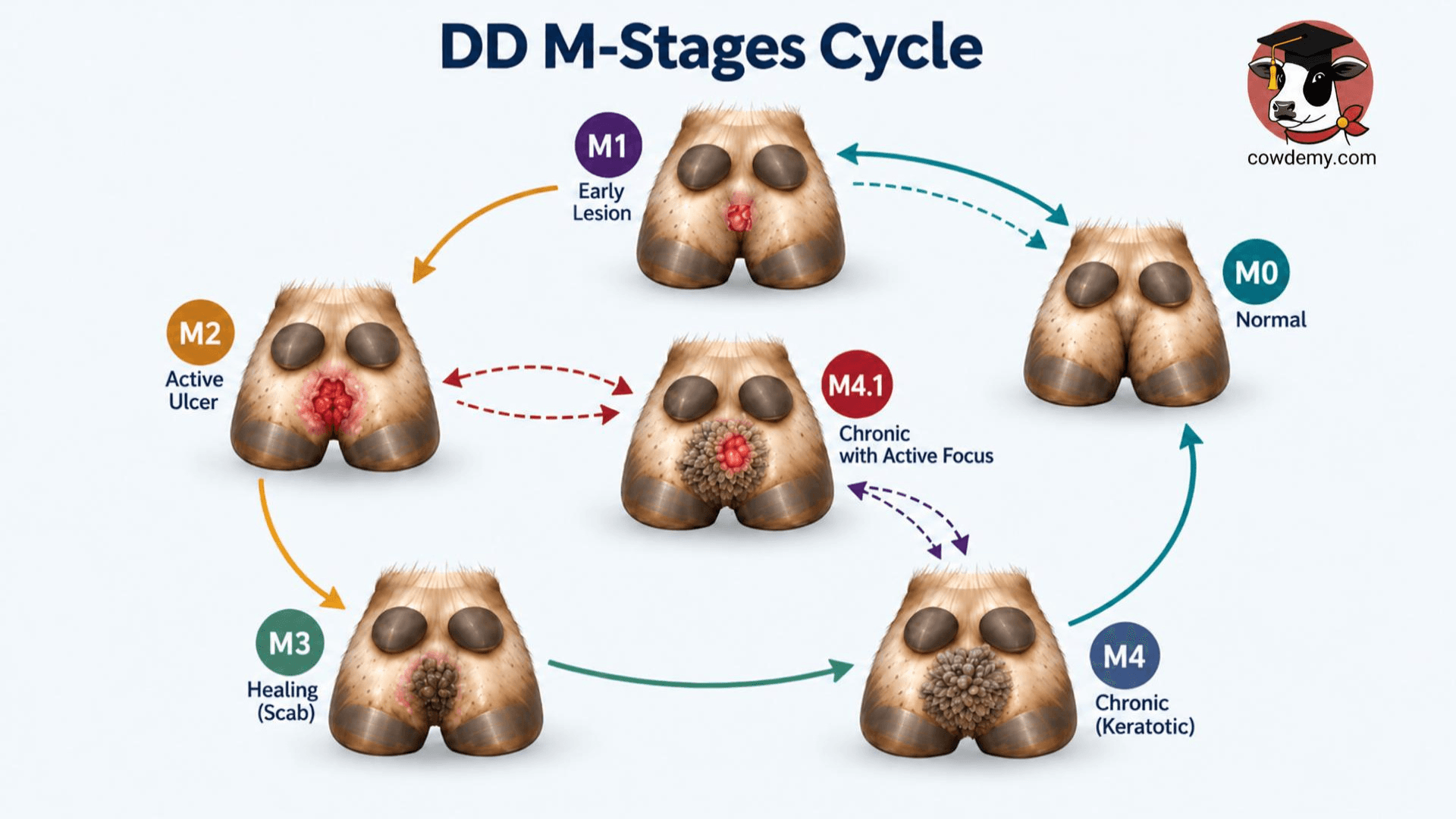
“Hairy heel wart” collapses a cycling infectious disease into one parlor label. Digital dermatitis moves through morphological stages with different pain, infectivity, and response to care. The Döpfer/Berry M-stage ladder (M0–M4.1), used in ICAR claw-health guidance, gives the herd a shared language so active ulcers, healing scabs, and chronic reservoirs are not managed as the same problem.
M0 is healthy digital skin with no lesion. M1 is a small active focus usually under 2 cm — early disease. When that small active focus sits on a chronic M4 mass, score M4.1, not M1 alone. M2 is an acute, often painful ulcerative lesion ≥2 cm; the stage that most clearly drives clinical lameness. M3 is a firm dark scab after effective topical care — a healing transition, not “done.” M4 is a chronic dyskeratotic or proliferative (“hairy”) mass; often low pain, hard to clear topically, and the long-lived reservoir in endemic herds. M4.1 is an M4 mass with a new small active focus on its surface — reactivation that restarts the acute cycle.
Individual topical care targets acute M2 and the active focus in M4.1; identify M1 early so footbaths and hygiene suppress progression to M2. M4 is the quiet shedder problem: models and field epidemiology consistently point to chronic cows, not only the bright-red M2, as the main drivers of pen-level transmission and risk to naïve heifers entering the lactating group.
An M2 cow is far more likely to look lame than an M0 cow, but locomotion scoring alone misses most of the DD burden. Chronic M4 lesions are often compensated and non-obvious on a walk-by. The field lesson is direct visual staging — washed hind feet in the parlor with a headlamp and mirror, plus periodic chute exams — not gait alone.
Parlor screening is strong for lesion present vs absent and for spotting many M4 and some M2 lesions. It is weak for M1 and M4.1, which often need chute light and clean skin. Use parlor walks for herd trends and obvious pulls; use the chute when you need stage-accurate lists for early actives and reactivations.
Treat acute M2 (and the active focus on M4.1) promptly with topical care under the herd veterinarian’s protocol, with a short path to M3. Identify M1 early so footbaths and hygiene suppress progression to M2 — not the same individual topical window as M2. Chronic M4 masses respond poorly to the same one-off spray; they belong in a population hygiene plan (footbaths and hygiene) aimed at suppressing reactivation — not at “curing” an M2 with a bath alone. Pair staging with footbath chemistry; do not collapse staging and bath decisions into one parlor guess.
Heifers entering a pen seeded by undetected M4 cows face a steep first-lactation risk. Staging chronic cows is therefore as much about protecting the next lactation as about treating today’s limp.
Check in the barn
What to check: Do parlor or pen checks name M-stages, or only “wart / no wart”? Who lists M2 (and M4.1) for same-day or next-trim triage — and who owns washed-foot mirror scoring? What share of “healed” cows are really M4, still in the infectious mix? Are first-lactation heifers scored after entry into pens with known M4 prevalence? When an M2 becomes M3, is there a recheck so non-healers escalate rather than quietly becoming M4?
Keep reading
View the networkNext
Digital Dermatitis in Heifers: Prevention Before First Lactation
Heifers that meet endemic digital dermatitis before first calving pay for it in early lactation — prevention in the rearing pen beats chasing first-lactation ulcers after they hit the parlor.
Sister note · 3 min
Home plate: Hoof · From lameness to lesion · Classify the lesion
- Classify the lesionHorn or skinPlaced here
- Footbaths: Prevention, Not TreatmentA footbath is a herd prevention tool for digital dermatitis pressure — not a cure for an active painful lesion waiting in the chute. Concentration, cow passes, and cleanliness decide whether the bath reduces new cases or just paints dirty heels.Sister note
- Footbath Design: Length, Depth, Cow Passes, and CleanlinessA footbath only works if every cow gets enough clean contact — length, depth, and how often the bath is refreshed decide whether heels are treated or just splashed with dirty solution.Same focus
- Contagious reservoirsThe infected glandBridge → Udder
Mark size is the kind. Color is the atlas area.
- Focus
- Field note
- Udder
- Hoof
Sources
- Digital Dermatitis — The Dairyland Initiative (UW–Madison)
- Digital Dermatitis M-score and the ICAR guide — AHDB
- Annex 1 of Section 7 — Digital Dermatitis Stages (M-stages) — ICAR
- Histological and bacteriological evaluation of digital dermatitis in cattle, with special reference to spirochaetes and Campylobacter faecalis — Döpfer D, et al., Veterinary Record (1997);140(24):620–623
- Long-term observations on the dynamics of bovine digital dermatitis lesions on a California dairy after topical treatment with lincomycin HCl — Berry SL, et al., Veterinary Journal (2012);193(3):654–658
- Validation of the M-stage scoring system for digital dermatitis on dairy cows in the milking parlor — Solano L, et al., Journal of Dairy Science (2017);100(2):1592–1603
- Digital Dermatitis in dairy cattle: The contribution of different disease classes to transmission — Biemans F, et al., Epidemics (2018);23:76–84