
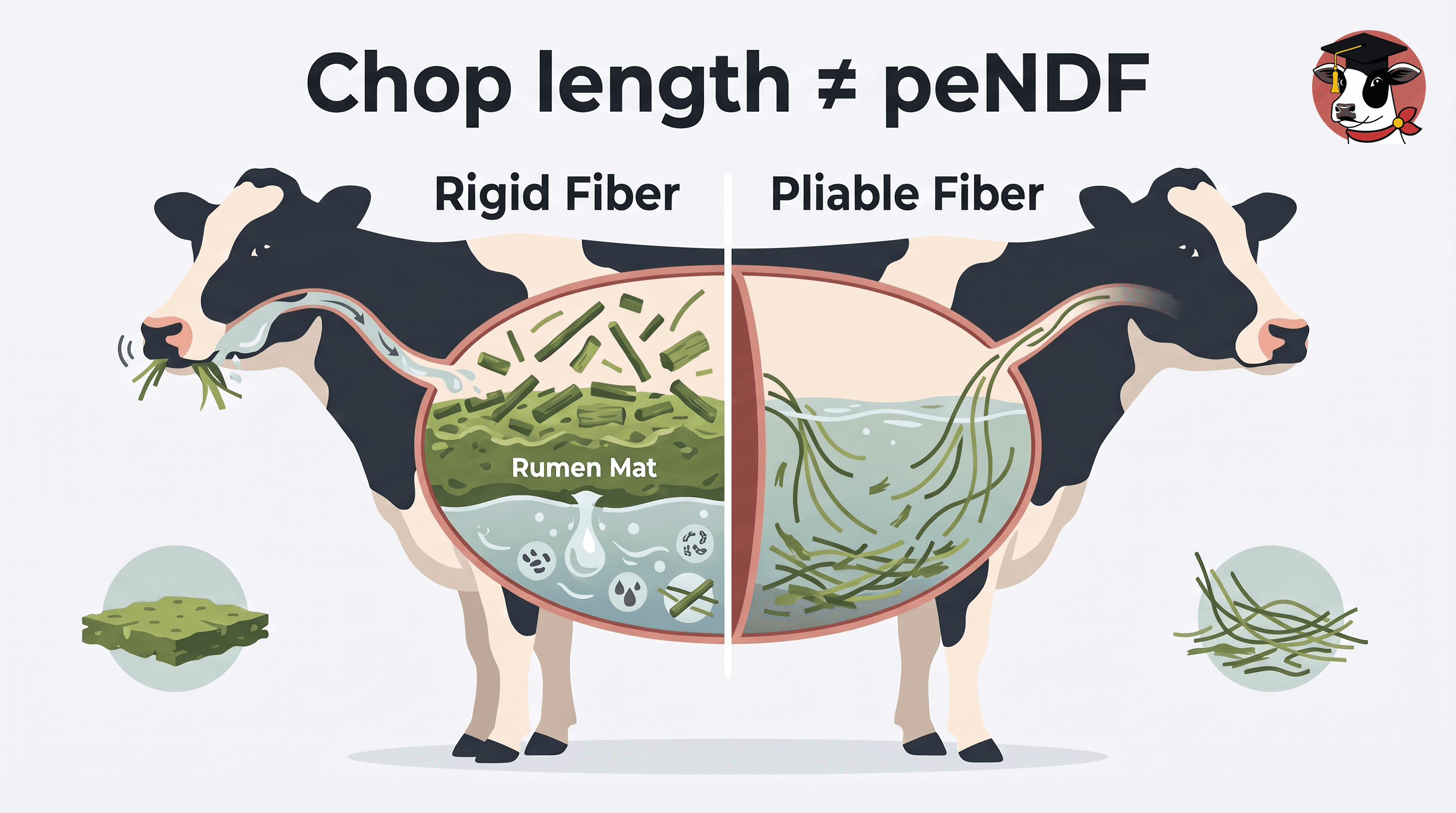
Chop length is not peNDF
Chop length is a harvester setting; peNDF is the fiber structure that actually reaches the rumen after moisture, processing, mixing, and sorting.
Knowledge level in this topic: Advanced. Mechanism and stacked risk in this topic — assumes the first-pass frame.
3 min read · 2026-09-10
In this note
- 30%
- 60%
- 18%
- 5%
- 4 mm
Chop length on the harvester is a useful target, not the fiber story itself. On farm, peNDF is commonly estimated as the fraction of as-fed particles retained on the ≥4 mm Penn State Particle Separator screens, multiplied by NDF — and the number that matters is the diet the cow actually ate, not the ticket. Theoretical length describes what left the cutterhead. Delivered peNDF describes the physical effectiveness of particles after moisture, mixing, bunk push-ups, and sorting.
Kernel processing is a grain-starch story. It can change how fast starch ferments, but it is not the main way peNDF disappears from the bunk. peNDF usually leaks when overmixing grinds forage structure into fines, when dry fluffy hay floats out of a wet TMR, or when cows sort toward the pan. Prefer an as-fed TMR shake over arguing soft versus rigid stems on paper: shake fresh feed and refusals with the same separator and compare the distributions.
Check delivery, then the refusals, then walk the bunk after the first meal — not a locked two-hour stopwatch. If chop targets look right but cows sort or chew less, fix dry matter, load order, moisture, and mix time before you rewrite peNDF on paper. Overmixing is a common thief of structure; under-mixing leaves clumps that invite sorting.
The original peNDF system counted NDF on particles retained on a 1.18 mm sieve, sieved dry in the lab. That cut came from passage work in sheep and cattle fed near maintenance, where less than 5% of fecal particles stayed on a 1.18 mm sieve. The Penn State Particle Separator began in 1996 with 19 and 8 mm sieves and added a 1.18 mm sieve in 2002 (described in the research literature in 2003). Later work in high-producing cows found larger particles escaping; in one trial, more than a third of fecal particles were larger than 1.18 mm. The 2013 box replaced that sieve with a 4 mm sieve. Passage itself is covered in what leaves the rumen.
On farm, add the shares retained on the 19, 8 and 4 mm sieves and multiply by ration NDF. A TMR at 30% NDF with 60% of the sample on those three sieves estimates 30 × 0.60 = 18% peNDF of dry matter. If another 20% sat between 1.18 and 4 mm, the older cut would count 80% and print 24%. Both numbers describe the same feed, so compare peNDF values only when they were built the same way.
Treat the result as an estimate. The math assumes every fraction carries the same NDF; grain, pellets and byproducts on the 4 mm sieve break that assumption and should be discounted. Drying a sample shifts more of it into the fine fractions, so an as-fed shake will not match laboratory sieving of dried feed. And adequate peNDF does not guarantee rumen pH when dietary starch is high.
Keep reading
View the networkNext
uNDF240 Sets the Fill Limit
NDF tells you how much cell wall a forage carries. uNDF240 estimates how much of it the rumen cannot digest, and that fraction takes up space until it is chewed small enough to leave. In high-producing cows, it can cap how much they eat.
Knowledge level in this topic: Intermediate. Barn-side working knowledge in this topic: checks, pairing, and what to do next.Sister note · 5 min
Home plate: Rumen · Physically effective fiber · NDF vs physically effective fiber
- NDF vs physically effective fiberTwo different jobsPlaced here
- Water is a fiber plasticizerForage dry matter changes how the TMR mixes and how the particle box reads — even when chop length matches a drier day.Sister note
- Refusals read the peNDF storyShake fresh TMR and the refusal pile with the same particle separator — divergence shows whether formulated peNDF actually reached the cow.Sister note
Mark size is the kind. Color is the atlas area.
- Focus
- Field note
- Rumen
Sources
- Penn State Particle Separator — Penn State Extension
- Methods Used to Measure Forage and Ration Particle Size — Penn State Extension
- Total Mixed Rations for Dairy Cows — Penn State Extension
- TMR Management – Ensuring Formulated Rations Make it to the Bunk — Penn State Extension
- Creating a system for meeting the fiber requirements of dairy cows — Mertens DR, J Dairy Sci (1997)
- The validity of the critical size theory for particles leaving the rumen — Poppi DP, Norton BW, Minson DJ, Hendricksen RE, J Agric Sci (1980)
- A simple method for the analysis of particle sizes of forage and total mixed rations — Lammers BP, Buckmaster DR, Heinrichs AJ, J Dairy Sci (1996)
- Modification of the Penn State forage and total mixed ration particle separator and the effects of moisture content on its measurements — Kononoff PJ, Heinrichs AJ, Buckmaster DR, J Dairy Sci (2003)
- Effect of varying total mixed ration particle size on rumen digesta and fecal particle size and digestibility in lactating dairy cows — Maulfair DD, Fustini M, Heinrichs AJ, J Dairy Sci (2011)