When the fresh cow’s energy gap widens
After calving, milk demand rises faster than intake — the gap is where ketone risk lives.
Knowledge level in this topic: Intermediate. Barn-side working knowledge in this topic: checks, pairing, and what to do next.
3 min read · 2026-09-09
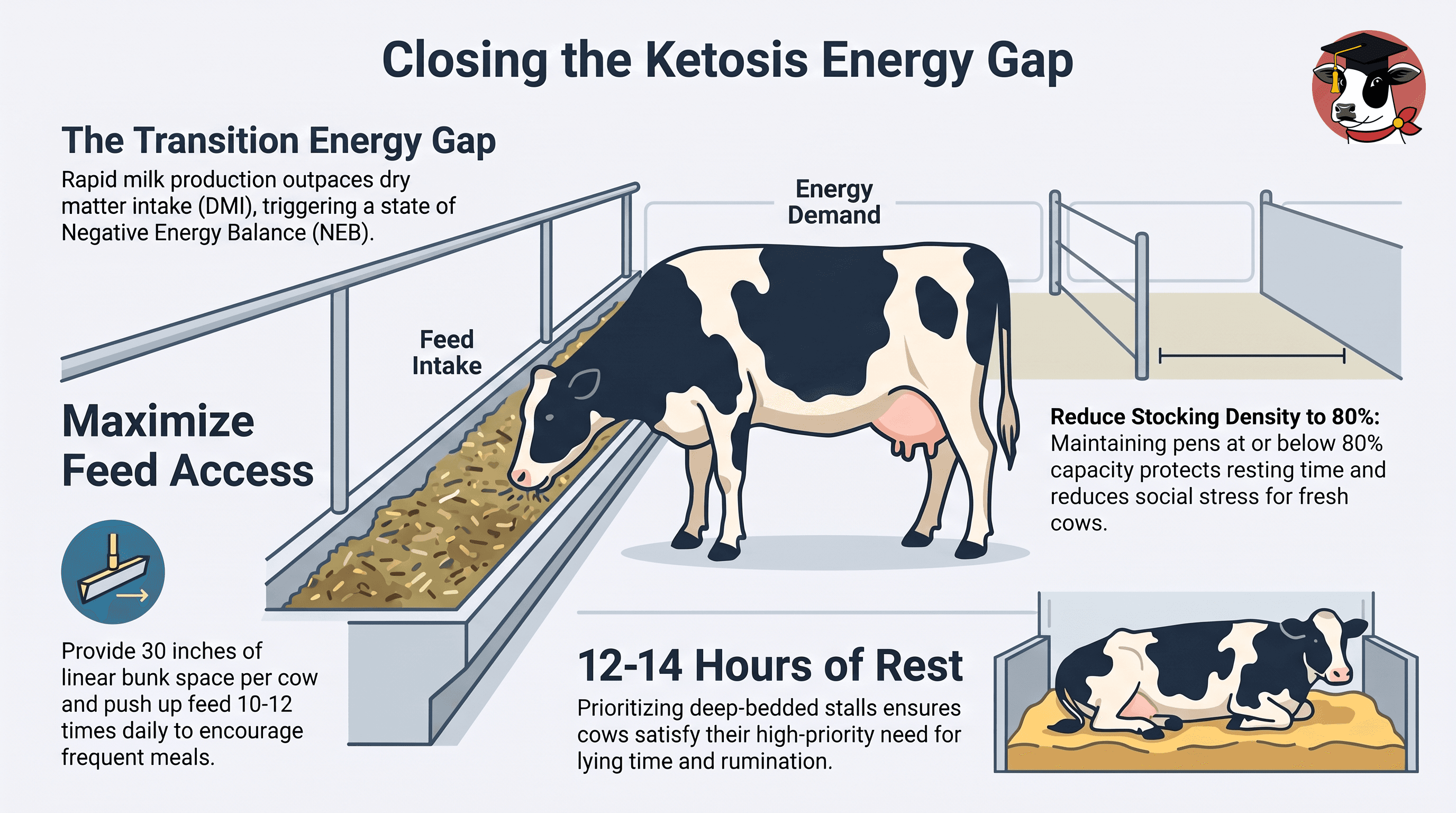
She calves overnight. By morning the udder is filling and the mammary gland’s demand for glucose and fatty acids is climbing fast. Appetite does not keep pace. That mismatch (energy out running energy in) is the transition energy gap. It is ordinary biology. It becomes a herd problem when the gap stays wide for days.
Early lactation pulls hard on glucose for lactose. When diet energy cannot cover the demand, the cow mobilizes body fat. Nonesterified fatty acids flood the liver. When hepatic capacity is overwhelmed, ketone bodies rise. Many cows never look “sick” in the classic sense; subclinical ketosis is common in the first weeks after calving and still costs milk, fertility, and disease resilience. This is not a moral failure of the cow. It is a systems mismatch between mammary demand and what the barn lets her eat, drink, and rest.
Extension and transition research keep returning to the same floor-level controls. Protect dry matter intake in the fresh pen: bunk space, push-ups, sorting control, and a diet she will actually clean up. Protect lying time; overstocking and long lock-ups steal rest and suppress intake. Keep water and feed always available. Fresh cows pay for empty bunks and empty troughs twice.
Metabolic monitoring and veterinary protocols matter, but they sit on top of those basics. If the pen steals intake and rest, no label on a bottle closes the gap for the whole group. Sister notes on this universe already cover the heifer who never owned a stall at 120% stocking and why intake comes before the next additive. This note is the biology underneath those barn checks: after calving, milk demand rises faster than intake; body-fat mobilization and ketones follow when the hole stays open. Manage the fresh pen so cows can eat, drink, and lie, then use herd checks as decision support, not as a substitute for comfort and access. Educational only—not a diagnosis, prescription, or ration formula.
Keep reading
View the networkNext
Intake before the next additive
Transition-cow intake is the first ration to protect: a heating TMR lowers the nutrients she can actually consume.
Knowledge level in this topic: Basic. First-pass in this topic — useful even if you already know another area well.Sister note · 3 min
Home plate: Transition · The transition cow · Intake & the energy gap
- Intake & the energy gapIntakePlaced here
- The fresh pen was stocked at 120%Calving went well; in the fresh pen, 96 cows competed for 80 headlocks, and first-lactation cows paid in lost bunk access and intake.Sister note
- Dry period is recovery timeA controlled dry period plus close-up bunk access is mammary recovery time — not an empty parking lot before calving.Sister note
- From lameness to lesionMost dairy lameness is a foot. Score the walk, localize the limb, look at the foot, name the lesion, record it — and know when it is not the hoof.Bridge → Hoof
Mark size is the kind. Color is the atlas area.
- Sheet
- Focus
- Field note
- Hoof
- Transition
Sources
- Maximizing Feed Intake: Key for Transition Cow Success — Penn State Extension
- Subclinical Ketosis Types, Impacts, and Risk Factors — Penn State Extension
- Transition Cow Housing — UW Dairyland Initiative