
What Leaves the Rumen
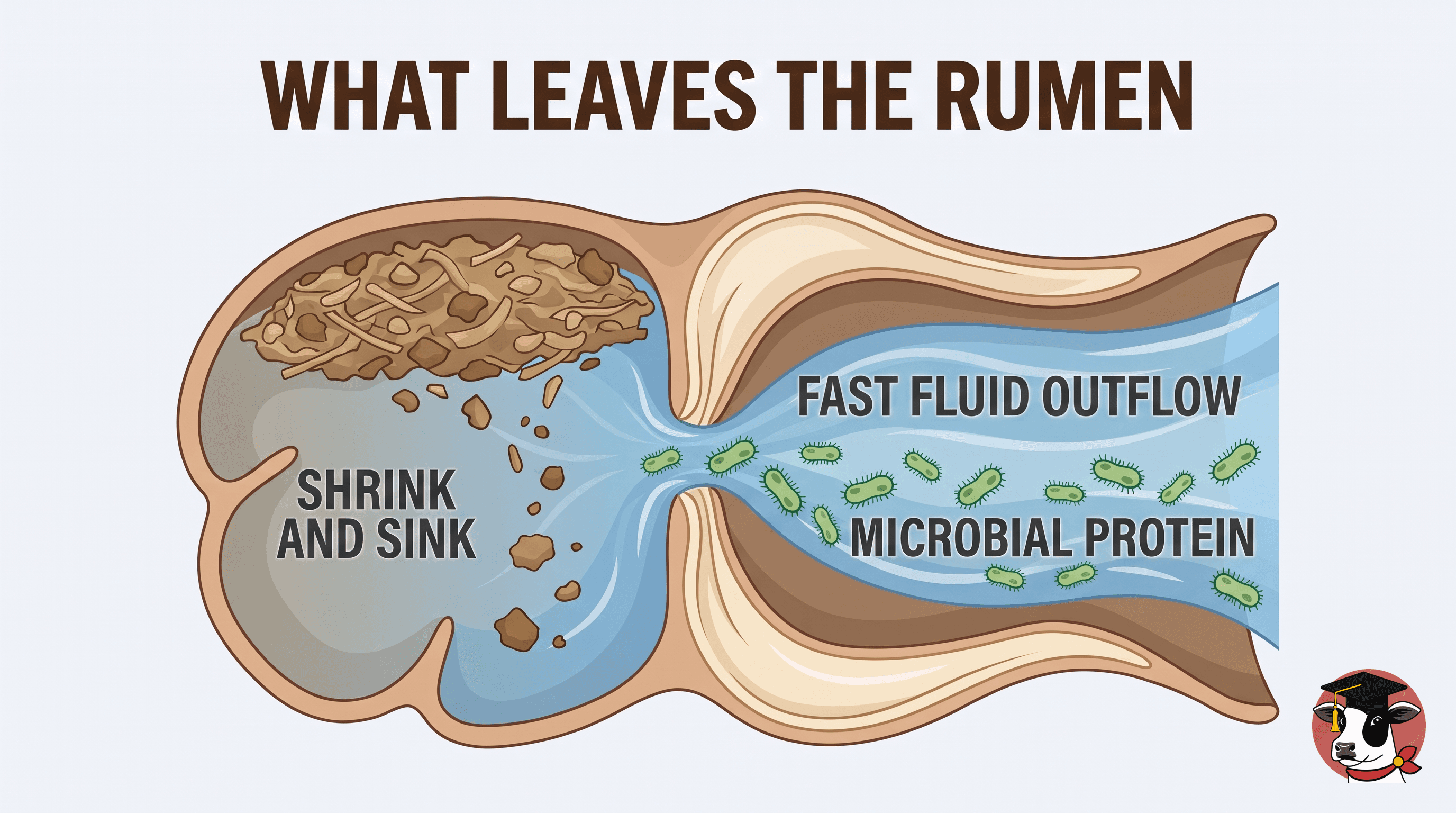
Liquid and solid digesta leave the rumen on different clocks. Fast fluid outflow harvests microbial protein, while fiber particles leave only after they shrink and sink.
Knowledge level in this topic: Intermediate. Barn-side working knowledge in this topic: checks, pairing, and what to do next.
3 min read · 2026-09-22
In this note
- 10–20%
- 60–85%
- 4–6%
- 12 mm
- 4 mm
What crosses the rumen wall as absorbed volatile fatty acids is host energy. What travels downstream through the reticulo-omasal orifice (ROO) into the omasum is a different cargo: microbial crude protein, undegraded dietary protein, undigested and partially digested particles, and fatty acids. This note is about that physical exit stream — liquid versus solid outflow, why fluid passage supports microbial yield, and what the cargo means for the protein reaching the small intestine. Leave wall absorption of VFAs, feed-the-bugs fermentation detail, fiber-mat fundamentals, rumination/saliva depth, and milk-fat depression pathways to their companions.
The ROO is the anatomical gatekeeper. Coordinated with reticular contractions, it admits digesta that meets physical criteria and holds back coarse, buoyant material still entangled in the dorsal mat. Digesta is not a uniform slurry: liquid and solid phases leave on different clocks. That differential is the design: fluid turns over fast enough to harvest microbes; solids linger long enough for fiber work, until intake pressure and particle readiness tip the balance toward passage.
The liquid phase (water, dissolved nutrients, loosely attached or free-swimming microbes) passes relatively freely when the orifice relaxes. Fractional liquid passage in lactating cows is commonly measured at about 10–20% of rumen fluid volume per hour. The solid phase must first be reduced by chewing and fermentation until particles are small enough and dense enough (higher functional specific gravity) to sink toward the ventral reticulum and clear the gateway. Solid passage is slower, roughly 4–6% per hour. Older teaching used a ~1.18 mm critical size for escape; later work on digesta and fecal particle distributions shows the critical size for rumen escape in high-producing cows is larger than 1.18 mm, and Penn State now places it closer to 4 mm. Treat these figures as educational ranges, not barn-side constants.
Microbes spend fermented ATP on maintenance (ion gradients, pH defense, motility, protein turnover) or on growth (new cells = microbial crude protein). Residence time is a maintenance tax: the longer a cell sits in the vat, the larger the share of lifetime energy spent merely surviving. A faster liquid dilution rate shortens that residence and pushes populations toward faster specific growth to avoid washout, so a smaller share of energy goes to maintenance. The trade-off is real: pushing passage harder (for example by grinding forage) also lowers feed digestibility.
Continuous-culture teaching therefore couples fluid outflow to efficiency of microbial protein synthesis (grams of MCP per unit of organic matter fermented). Higher dry matter intake, water intake, and salivary fluid input all raise the fluid that must leave through the ROO, sweeping young, protein-dense biomass toward the abomasum and small intestine.
Three educational cargo classes leave together: Microbial crude protein (plus RUP). MCP suspended in fluid and attached to fine particles supplies most of the amino acids reaching the small intestine (60–85% in the estimate Hackmann and Firkins cite), with an essential amino acid profile close to milk protein. How that feeds the MP balance lives in mp-is-not-crude-protein. Rumen-undegradable dietary protein rides alongside. Passage rate itself shifts the apparent RUP fraction: faster outflow shortens residence so some slowly degradable protein escapes before full proteolysis. Undigested and partially digested particles. Indigestible NDF must leave by passage alone. Potentially digestible fiber also escapes when passage outruns digestion — a trade-off high-intake cows accept so physical fill clears for the next meal. Some escaped starch and fiber may ferment in the hindgut, but energy capture there is less efficient and microbial protein made post-ruminally is not absorbed as amino acids the way ruminal MCP is. Fatty acids. Dietary unsaturated fats leave only partly hydrogenated, and how that shifts milk fat is covered in the milk-fat notes (milk-fat-depression-starts-in-the-rumen, milk-fat-as-a-rumen-alarm).
Check in the barn
What to check: These cues are educational signposts about outflow and gateway sorting — not a field diagnosis. Are cows sorting against long forage so they eat the fine, fast-exit fraction first? On a manure rinse, are fiber pieces mostly short and uniform? Some long pieces are normal, but if most are longer than about 0.5 inch (roughly 12 mm), Penn State treats that as a cue that passage may be outrunning size reduction and fermentation. Are intact or barely fractured grain kernels common in manure? Some grain shows up in nearly all high-producing herds. A large amount points to grain processing (including hard corn silage kernels) or fast passage, and an intact kernel can still have had much of its starch digested, so inspect before you judge.
Educational only—not a diagnosis, prescription, or treatment protocol. Defer clinical decisions to the herd veterinarian.
Keep reading
View the networkNext
MP is not crude protein
Crude protein counts nitrogen. Metabolizable protein asks what amino acids actually reach the cow after the rumen.
Knowledge level in this topic: Advanced. Mechanism and stacked risk in this topic — assumes the first-pass frame.Sister note · 3 min
Home plate: Rumen · Inside the rumen · What leaves the rumen
- What leaves the rumenDownstreamPlaced here
- Microbes and FermentationFeed the microbes first: fiber + NFC → VFAs for energy; dietary N upgrades to microbial crude protein; biohydrogenation of PUFA is microbial survival, not an MFD deep dive.Sister note
- VFAs and AbsorptionVFAs absorbed across the rumen wall supply most of the cow's metabolizable energy: acetate for milk fat and maintenance, propionate for glucose and lactose, butyrate for the wall itself.Sister note
- Intake & the energy gapIntakeBridge → Transition
Mark size is the kind. Color is the atlas area.
- Focus
- Field note
- Rumen
- Transition
Sources
- From feed to milk: understanding rumen function — Penn State Extension
- The ruminant digestive system — University of Minnesota Extension
- Maximizing efficiency of rumen microbial protein production — Hackmann TJ, Firkins JL, Front Microbiol (2015)
- Predicting ruminally undegraded and microbial protein flows from the rumen — Hanigan MD, Souza VC, Martineau R, Daley VL, Kononoff P, J Dairy Sci (2021)
- Effect of varying total mixed ration particle size on rumen digesta and fecal particle size and digestibility in lactating dairy cows — Maulfair DD, Fustini M, Heinrichs AJ, J Dairy Sci (2011)
- Lipid metabolism in the rumen — Jenkins TC, J Dairy Sci (1993)
- Penn State Particle Separator — Penn State Extension
- Using manure evaluation to enhance dairy cattle nutrition — Penn State Extension
- Effects of sodium bicarbonate, magnesium oxide, and a commercial buffer mixture in early lactation cows fed hay crop silage — Stokes MR, Vandemark LL, Bull LS, J Dairy Sci (1986)