
The Rumen Chamber
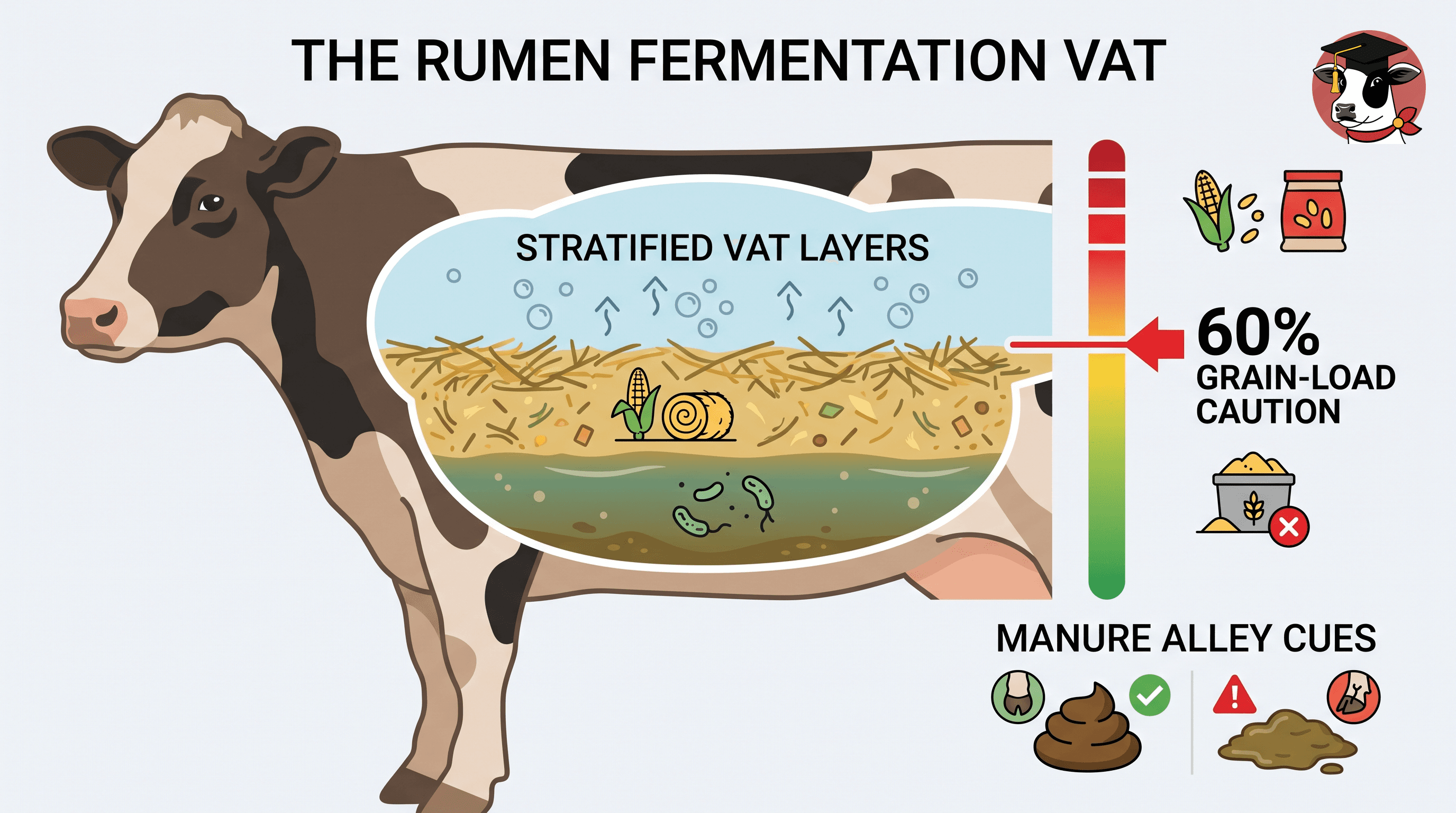
The rumen is a fluid-filled fermentation vat: carbs often make up 60–70% of dietary DM, and how much concentrate it handles depends on forage, fiber, starch, processing, and the bunk.
Knowledge level in this topic: Intermediate. Barn-side working knowledge in this topic: checks, pairing, and what to do next.
3 min read · 2026-09-21
In this note
- 60–70%
- 50–60%
A mature dairy rumen is a continuous-flow anaerobic fermentation vat, not a simple feed bag. Gas caps the top. A buoyant fiber mat floats above a denser fluid pool of microbes, water, and dissolved acids. Carbohydrates often dominate dietary dry matter, so this note frames the chamber as a stratified reactor and a grain-load risk, not a full tour of SARA taxonomy, peNDF, four-compartment anatomy, cud and saliva depth, or clinical laminitis. Those live in companion notes.
The chamber holds tens of gallons of digesta that stratify by density. Mixing contractions roll through the vat about two or three times every two minutes, a little faster while she eats. When the mat thins or acid pools in the fluid phase, the reactor is unstable; fermentation outruns the cow's buffering and absorption capacity.
Carbohydrates often make up 60–70% of dietary DM. Many high-group rations sit somewhere around 50–60% concentrate, but that is a common guideline, not a hard ceiling. How much grain a rumen handles depends on forage quality, NDF and peNDF, how fast the starch ferments, processing, and bunk management. Finer processing speeds starch fermentation, and a fast push can keep rumen pH low for longer. Low pH has been linked with more endotoxin in rumen fluid and with poorer claw health in some herds, but that is not a proven chain to sore feet. Sole ulcers also depend heavily on standing time, flooring, and transition changes. Read manure first after any grain change.
Barn-walk cues: manure color, consistency, content, and pen-to-pen variation are the daily report card. After a grain change, are there porridge piles? Whole kernels or forage pieces longer than about half an inch? Mucin casts? Wild within-pen divergence? If lameness climbs weeks after a diet change, review standing time, flooring, and transition records alongside the ration with your vet and nutritionist, not as a guess in the alley.
Keep reading
View the networkNext
Particle size holds the fiber mat
If the TMR is too fine, the forage raft thins — less trapping, less re-chewing, less bicarbonate-rich saliva.
Knowledge level in this topic: Advanced. Mechanism and stacked risk in this topic — assumes the first-pass frame.Sister note · 3 min
Home plate: Rumen · Inside the rumen · The rumen chamber
- The rumen chamberThe vatPlaced here
- Microbes and FermentationFeed the microbes first: fiber + NFC → VFAs for energy; dietary N upgrades to microbial crude protein; biohydrogenation of PUFA is microbial survival, not an MFD deep dive.Sister note
- The Four CompartmentsRuminants run specialized pre-gastric fermentation: four compartments, but field management lives or dies on rumen health (fiber → usable energy).Sister note
- Claw-horn lesionsSole haemorrhage, sole ulcer, white-line disease, thin and double sole, toe and wall lesions — what tissue failed and where.Bridge → Hoof
Mark size is the kind. Color is the atlas area.
- Sheet
- Focus
- Field note
- Rumen
- Hoof
Sources
- The ruminant digestive system — University of Minnesota Extension
- Carbohydrate nutrition for lactating dairy cattle — Penn State Extension
- Using manure evaluation to enhance dairy cattle nutrition — Penn State Extension
- On-farm tools to evaluate feeding programs — University of Minnesota Extension
- Feeding to minimize acidosis and laminitis in dairy cows — Shaver RD, University of Wisconsin Extension
- Bovine acidosis: implications on laminitis — Nocek JE, Journal of Dairy Science (1997)
- Disorders of acid-base balance promote rumen lipopolysaccharide biosynthesis in dairy cows by modulating the microbiome — Hou G, et al., Front Microbiol (2024)
- Integrating subacute ruminal acidosis, lipopolysaccharide, and trained immunity: a comprehensive review — Hou G, et al., Int J Biol Sci (2025)
- Total Mixed Rations for Dairy Cows — Penn State Extension
- Invited review: Role of physically effective fiber and estimation of dietary fiber adequacy in high-producing dairy cattle — Zebeli Q, et al., Journal of Dairy Science (2012)
- Subacute ruminal acidosis in dairy cows: the physiological causes, incidence and consequences — Plaizier JC, et al., The Veterinary Journal (2008)
- Impact of nutrition on lameness and claw health in cattle — Lean IJ, Westwood CT, Golder HM, Vermunt JJ, Livestock Science (2013)
- Differentiation of gastrointestinal diseases in adult cattle — Belknap EB, Navarre CB, Veterinary Clinics of North America: Food Animal Practice (2000)
- Nutrient Requirements of Dairy Cattle, 8th revised edition — NASEM (2021)
- A prospective cohort study of digital cushion and corium thickness. Part 2: Does thinning of the digital cushion and corium lead to lameness and claw horn disruption lesions? — Newsome RF, et al., Journal of Dairy Science (2017)
- Low body condition predisposes cattle to lameness: an 8-year study of one dairy herd — Randall LV, et al., Journal of Dairy Science (2015)
- The influence of the environment on dairy cow behavior, claw health and herd lameness dynamics — Cook NB, Nordlund KV, The Veterinary Journal (2009)