
The laboratory cannot fix the sample
A precise analysis of one biased handful is still a poor estimate of the feed the herd is eating.
4 min read · 2026-09-17
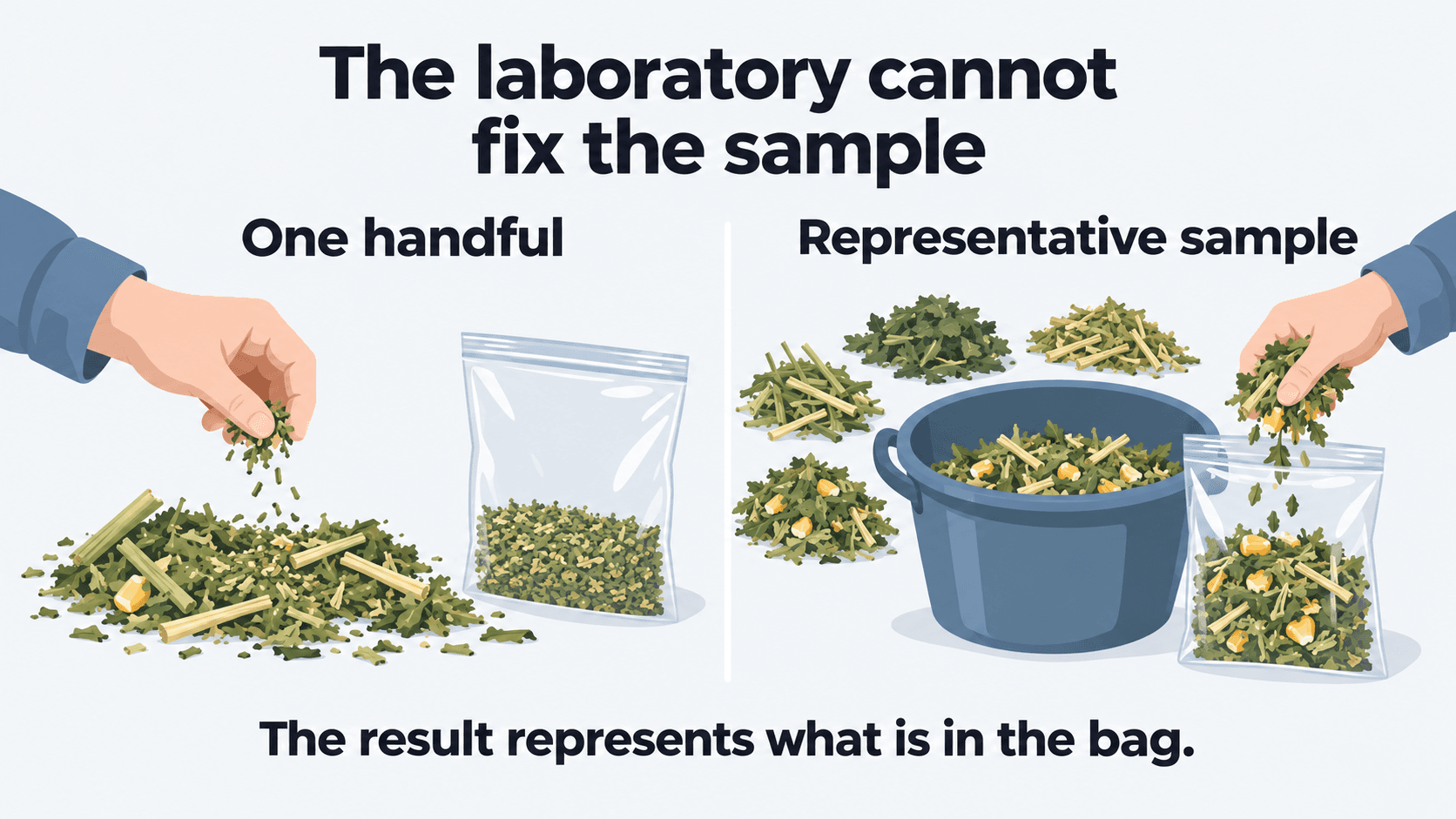
A bunker, hay lot, commodity bay, and TMR are not one feed. They are layers, wet pockets, fines, and faces that changed since yesterday. One convenient grab can overrepresent the pretty top, the exposed shoulder, or a single bale. The laboratory can repeat its method on what arrived in the bag. It cannot recover the parts of the lot that never entered it.
Penn State’s forage-testing guide treats the sample as the first method: one lot is one field, cutting, and harvest date — not a mixed week of bales. For small-square hay, core at least 20 widely separated bales; for large rounds, sample 10 to 12 bales through the layers, not a flake off the end. Combine cores in a clean bucket, label the structure and date, and keep wet silage cold. The practical lesson is that sampling error begins on farm, before analytical error begins in the laboratory.
Check in the barn
What to check: Is the bag labeled to the lot cows are actually eating? Did someone use a probe or a handful? Were increments taken across the face or wagon, then mixed, rather than scooped from one pretty spot? Was wet forage sealed and cooled, or left to heat in a truck? Treat that checklist as the first analytical method.
Sister notes on this universe cover compare-dry-matter-not-water and a-number-without-a-unit-is-not-a-result — a clean bag still has to carry the right basis and unit. The physically-effective-fiber universe’s shake-the-bunk-not-the-memory note is the same idea at the mixer: the result represents what you sampled, not what you wished was in the pile. Educational only — not a diagnosis, prescription, or ration formula.
Keep reading
View the networkNext
A number without a unit is not a result
Percent, ppm, mg/kg, Mcal/lb, and Mcal/kg can turn the same digits into very different decisions.
Sister note · 4 min
Home plate: Rumen · Reading the feed report · The representative sample
- The representative sampleBefore the laboratoryPlaced here
- Compare the feed, not the waterAs-fed columns answer loading questions; dry-matter columns answer nutrient-concentration questions.Sister note
- Dry-matter drift changes the loadWhen silage moisture moves and mixer kilograms stay fixed, nutrient delivery moves even if the written ration does not.Sister note
Mark size is the kind. Color is the atlas area.
- Focus
- Field note
- Rumen
Sources
- Forage Quality Testing: Why, How, and Where — Penn State Extension
- Sampling Bales for Forage Quality Analysis — Penn State Extension
- Understanding and Using a Feed Analysis Report — University of Nebraska–Lincoln Extension