
The Four Compartments
Ruminants run specialized pre-gastric fermentation: four compartments, but field management lives or dies on rumen health (fiber → usable energy).
Knowledge level in this topic: Basic. First-pass in this topic — useful even if you already know another area well.
3 min read · 2026-09-21
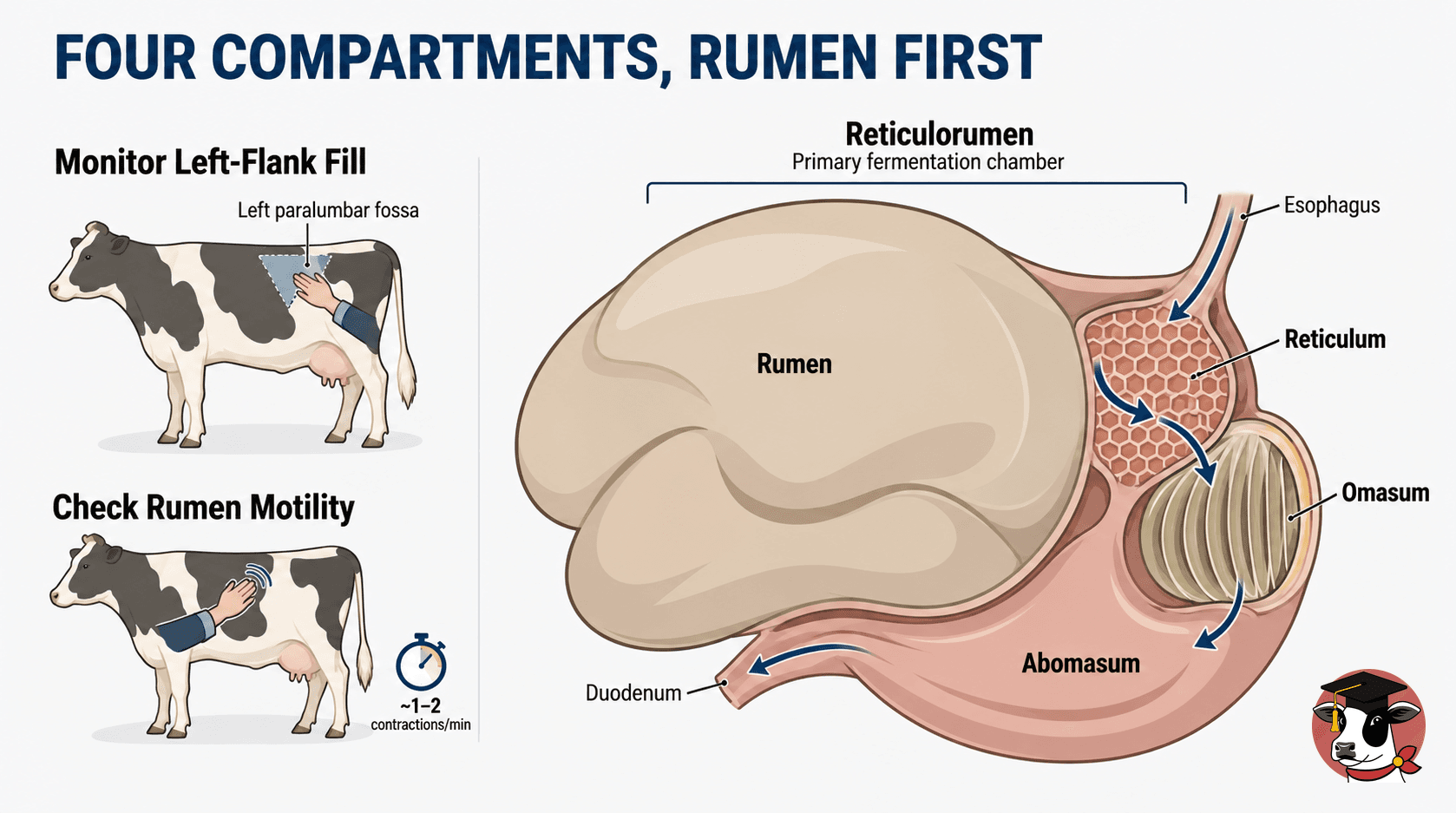
Cattle carry four stomach compartments, not four identical bags. The reticulorumen holds most (~four-fifths) of stomach capacity. The rumen is the large fermentation vat; the reticulum traps dense material beside it. The omasum squeezes water and some minerals from digesta. The abomasum is the true glandular stomach; acid and enzymes finish what the forestomachs started.
Feed does not march through on a factory timer. Material is mixed, regurgitated, re-chewed, and returned in the rumination loop that shrinks particle size and pumps bicarbonate-rich saliva into the vat. That is how fiber becomes usable volatile fatty acids. Extension guides from Minnesota, Mississippi State, and LSU describe the same architecture; field management lives or dies in the rumen long before the omasum or abomasum get the blame.
Check in the barn
What to check: read the left flank for fill contour and motility before you chase downstream trouble. Burfeind and colleagues published a repeatable rumen-fill scoring system for dairy cows, a barn-side picture that pairs with whether resting cows are chewing. A thin left contour, quiet motility, or a cow that stops chewing her cud are rumen alarms. Manage fiber, sorting, and meal pattern there first.
Left displaced abomasum and other downstream failures often trace back to rumen risk: inadequate effective fiber, slug meals, and a fiber mat that could not hold. Forestomach epithelia absorb cations and anions under tight regulation, but you will not fix that from a textbook in the alley. Treat the rumen as the management compartment. The other three matter for anatomy and diagnosis, not for daily bunk decisions.
Keep reading
View the networkNext
Microbes and Fermentation
Feed the microbes first: fiber + NFC → VFAs for energy; dietary N upgrades to microbial crude protein; biohydrogenation of PUFA is microbial survival, not an MFD deep dive.
Knowledge level in this topic: Intermediate. Barn-side working knowledge in this topic: checks, pairing, and what to do next.Sister note · 3 min
Home plate: Rumen · Inside the rumen · Four compartments
- Four compartmentsAnatomyPlaced here
- The Rumen ChamberThe rumen is a fluid-filled fermentation vat: carbs often 60–70% of dietary DM; past ~60% concentrate of DMI is a cautionary overload threshold, not a universal law.Sister note
- Reading milk fat as a rumen alarmA falling fat test is often the first cheap signal that fermentation has shifted, not that the cow forgot how to make fat.Sister note
Mark size is the kind. Color is the atlas area.
- Focus
- Field note
- Rumen
Sources
- The ruminant digestive system — University of Minnesota Extension
- Understanding the ruminant animal digestive system — Mississippi State University Extension
- The ruminant digestive system — LSU AgCenter
- Technical note: Evaluation of a scoring system for rumen fill in dairy cows — Burfeind O, et al., Journal of Dairy Science (2010)
- Nutritional risk factors in the etiology of left displaced abomasum in dairy cows: a review — Shaver RD, Journal of Dairy Science (1997)
- Transport of cations and anions across forestomach epithelia: conclusions from in vitro studies — Leonhard-Marek S, et al., Animal (2010)