
Stocking density is a time budget
Overstocking steals lying and eating time. Manage stalls, bunk, and flow, not headcount alone.
Knowledge level in this topic: Intermediate. Barn-side working knowledge in this topic: checks, pairing, and what to do next.
3 min read · 2026-09-09
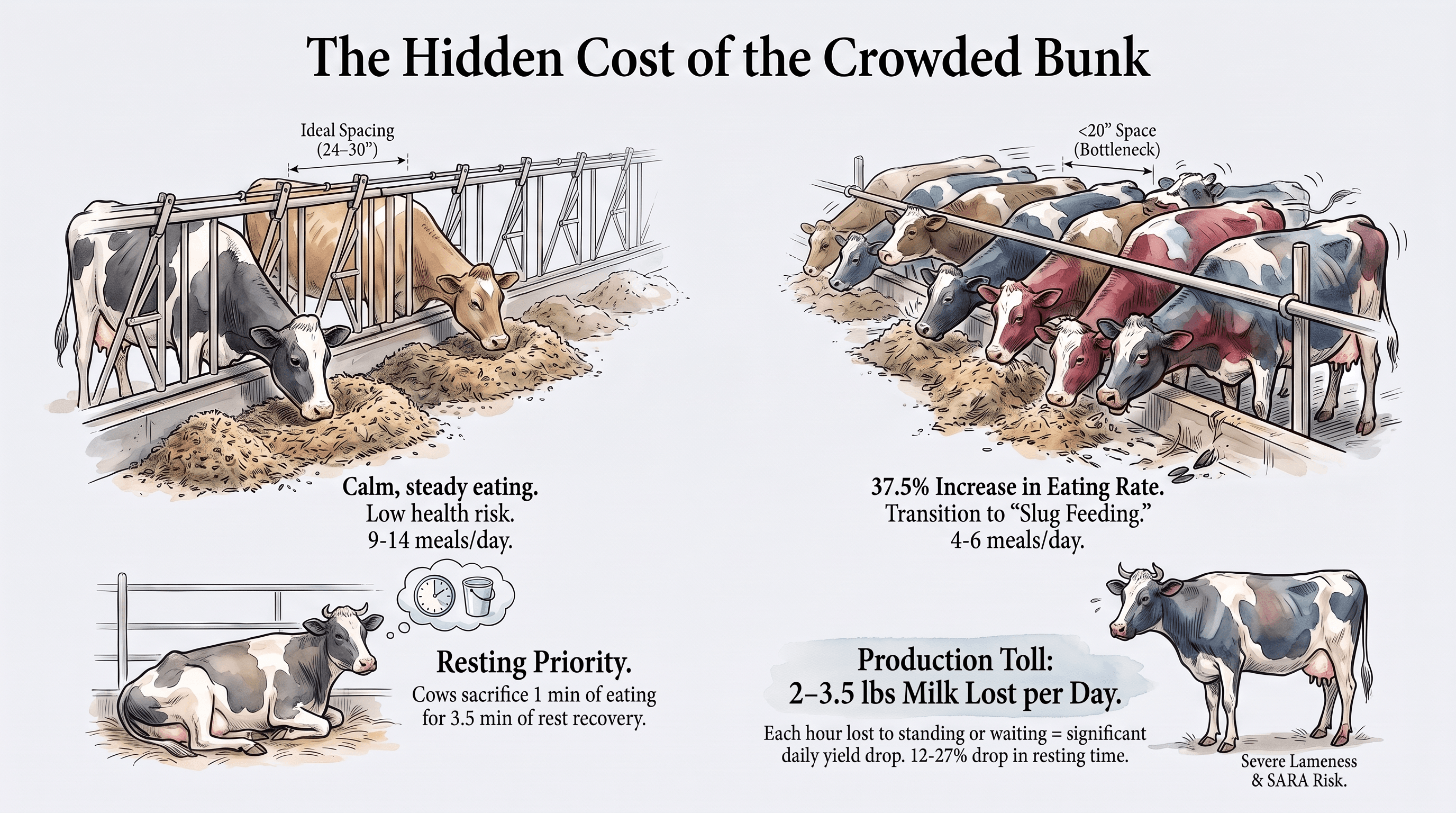
The clipboard says 110 cows in a 100-stall pen. That number feels precise. It is also incomplete. What the cow experiences is not a percentage; it is whether a stall is empty when she wants to lie down, whether bunk space is open when the mixer wagon leaves, and how many minutes she spends waiting in alleys and holding pens.
University of Wisconsin–Madison and other extension summaries treat stocking as a package: stalls, feed bunk, and time. A pen can look "only mildly overstocked" on paper and still fail if lock-up is long, push-ups are late, or subordinate cows lose the bunk after milking.
When bunk space collapses, cows eat faster, take fewer meals, and shift toward slug feeding. When stalls are short, lying time drops and standing time rises: the same standing "dose" that shows up later as claw-horn risk. Fresh pens feel overcrowding first: the cows with the least reserve are asked to compete hardest, and the pen average can hide who loses.
Walk the pen with a stopwatch mindset. Stalls: can every cow lie without perching or waiting? Bunk: roughly 24–30 inches of eating space per cow at peak demand, not a shared rail fight. Time: parlor and lock-up minutes that steal from eating and resting. If those three fail, milk and health pay even when the spreadsheet looks tidy.
Stocking density is a time budget. Overstocking steals lying and eating, especially in fresh and high-flow pens. Manage stalls, bunk space, and cow flow together; a headcount alone will not tell you what the cow lost today. Educational only — not a diagnosis, prescription, or facility design certification.
Keep reading
View the networkNext
Build the stall around the rise
Lying time is the budget a stall protects. A stall that blocks the rise charges that time back as standing, collisions, and lesions.
Knowledge level in this topic: Intermediate. Barn-side working knowledge in this topic: checks, pairing, and what to do next.Sister note · 3 min
Home plate: Barn · Stocking & cow flow · Resource-based stocking
- Resource-based stockingNot one percentagePlaced here
- The Pen Average Hides the Cows That LoseA pen average weights every cow equally, so a small group that is doing badly can disappear inside a number that looks acceptable.Sister note
- A rising fetch list is a time-budget failureRobots succeed when cows choose the box and still get their lying time. A climbing fetch list is a prompt to check where the barn is stealing it.Sister note
- The transition cowClose-up through early fresh: intake lags milk, calcium must adapt, the uterus involutes, and space is part of the protocol.Bridge → Transition
Mark size is the kind. Color is the atlas area.
- Sheet
- Focus
- Field note
- Transition
- Barn
Sources
- Stocking Density — UW Dairyland Initiative
- Transition Cow Housing — UW Dairyland Initiative