
Standing time is the dose
Prolonged standing load can bruise the corium and surface weeks later as a claw-horn lesion.
Knowledge level in this topic: Advanced. Mechanism and stacked risk in this topic — assumes the first-pass frame.
3 min read · 2026-09-08
In this note
- six to eight weeks
- 12 to 14 hours
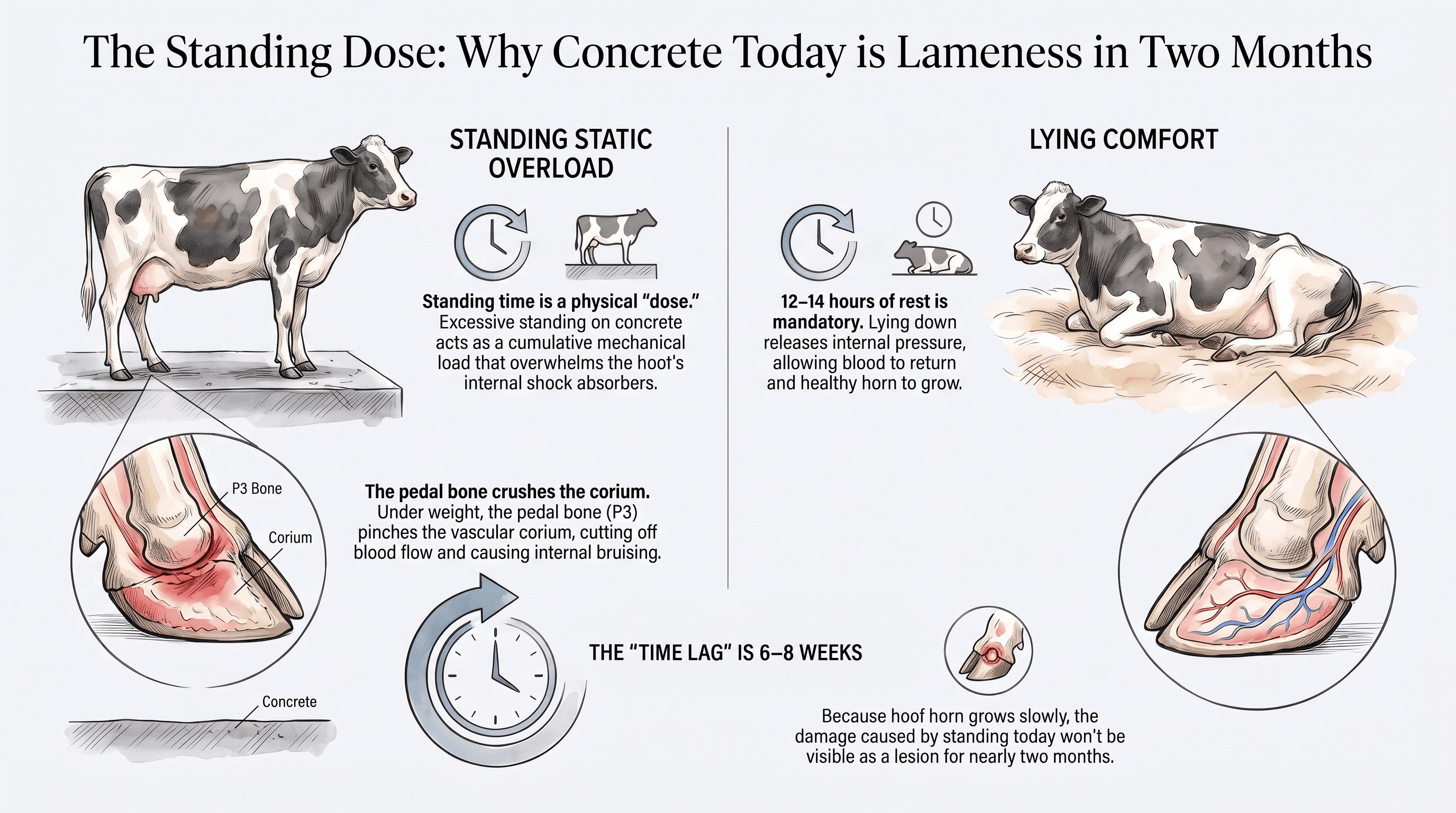
The crowd gate inches forward in the early morning darkness. A 1,500-pound Holstein shifts her weight awkwardly from her left hind leg to her right, then back again. By the time she exits the parlor, returns to her pen, and hits the feed bunk, she will have been on concrete for nearly three straight hours. Later, if her freestall is too short or the brisket board is positioned incorrectly, she might spend another hour "perching" — front feet in the stall, back feet in the alley. Every extra minute she spends on her feet is a physical transaction, and the internal structures of her hooves pay the bill.
We often think of lameness as a sudden injury or an infectious outbreak. But non-infectious claw-horn lesions — specifically sole ulcers and white line disease — are mechanical failures. Time on the feet is one of the biggest drivers you can manage, alongside transition changes, body condition loss, flooring, and claw shape. Inside the hoof, the pedal bone (P3) is suspended by a hammock of connective tissue and rests on a shock-absorbing fat pad called the digital cushion. Directly beneath that cushion lies the corium, a highly vascular, blood-rich tissue layer responsible for manufacturing the hard horn of the sole. When a cow stands, her immense body weight pushes the pedal bone down, compressing the corium against the hard floor. In normal, short intervals, the digital cushion absorbs this shock. When the cow lies down, the pressure is released, blood flow returns, and healthy hoof horn continues to grow.
Think of standing time as a physical "dose" of pressure. If the dose gets too high — driven by overcrowded pens, long parlor waits, heat stress, or uncomfortable stalls — the pedal bone relentlessly pinches the corium. This prolonged compression causes local ischemia (a severe restriction of blood flow). The corium bruises, becomes inflamed, and bleeds internally. Because this damaged tissue can no longer manufacture strong, healthy horn, it lays down weak, defective horn at the site of the bruise instead. The useful frame: hours on concrete and poor lying comfort load the corium long before the trimmer sees the sole.
You will not see the cow go lame today. The hoof wall grows at a slow rate of about a quarter-inch per month. It takes roughly six to eight weeks for that pocket of weak, defective horn to grow out to the weight-bearing surface of the sole. When it finally surfaces, the mechanical stress of walking tears the weak horn open. You lift the foot in the trimming chute in October and find a bleeding sole ulcer or a separated white line. But the lesion you are treating today may trace back to a standing-time "overdose" back in August, often stacked on transition stress. Claw-horn guidance and herd lameness surveys both point at the same lag: the chute list is a delayed readout of standing load, not only last month’s trim.
Standing time is the dose; lameness is the delayed response. The hoof’s internal suspension can only withstand so much continuous pressure before the corium bruises. To prevent claw-horn lesions, you must manage lying time as strictly as a ration — aiming for 12 to 14 hours of rest per day by minimizing parlor lock-ups and maximizing freestall comfort. Sister notes on this universe cover the parlor that added two hours of standing and why you name horn or skin before you spray. This note is the corium clock underneath those signs. Educational only — not a diagnosis or treatment protocol.
Keep reading
View the networkNext
The new parlor added two hours of standing
Throughput rose. Thin soles followed the extra hold time.
Knowledge level in this topic: Intermediate. Barn-side working knowledge in this topic: checks, pairing, and what to do next.Sister note · 4 min
Home plate: Hoof · Why hoof lesions develop · Standing time
- Standing timeThe dosePlaced here
- Digital Cushion Thickness, Transition, and Sole-Ulcer RiskThe digital cushion helps dissipate load beneath the pedal bone. Thin sole soft tissues have been associated with later claw-horn lesions, but cushion thickness is not simply a reflection of body condition. Stage of lactation, parity, farm conditions, previous lesions, and tissue structure all appear to matter.Sister note
- Flooring, Traction, Wear, and Their Effect on Claw HealthFlooring is a daily mechanical dose: traction and abrasive wear shape claw horn faster than most herds measure, and the wrong surface quietly builds the next ulcer cohort.Sister note
- Stocking & cow flowStocking is stalls, bunk, lying, lockup, holding, and movement — not one percentage. Those resources fail separately.Bridge → Barn
Mark size is the kind. Color is the atlas area.
- Sheet
- Focus
- Field note
- Hoof
- Barn
Sources
- Non-infectious claw horn lesions in cows — AHDB Knowledge Library
- The influence of the environment on dairy cow behavior, claw health and herd lameness dynamics — Cook & Nordlund, The Veterinary Journal (2009)
- Lameness prevalence and risk factors in large dairy herds in Wisconsin — Cook 2003, Journal of the American Veterinary Medical Association
- Low body condition predisposes cattle to lameness: an 8-year study of one dairy herd — Randall LV, et al., Journal of Dairy Science (2015)
- A prospective cohort study of digital cushion and corium thickness. Part 2: Does thinning of the digital cushion and corium lead to lameness and claw horn disruption lesions? — Newsome RF, et al., Journal of Dairy Science (2017)
- Lameness in dairy cattle: A debilitating disease or a disease of debilitated cattle? A cross-sectional study of lameness prevalence and thickness of the digital cushion — Bicalho RC, Machado VS, Caixeta LS, Journal of Dairy Science (2009)