
Sole Ulcers, Laminitis, and Diet: Separating Evidence from Assumption
Sole ulcers get blamed on “too much grain” more often than the evidence supports — separate diet risk from flooring, standing time, and claw mechanics before rewriting the ration.
Knowledge level in this topic: Advanced. Mechanism and stacked risk in this topic — assumes the first-pass frame.
3 min read · 2026-09-18
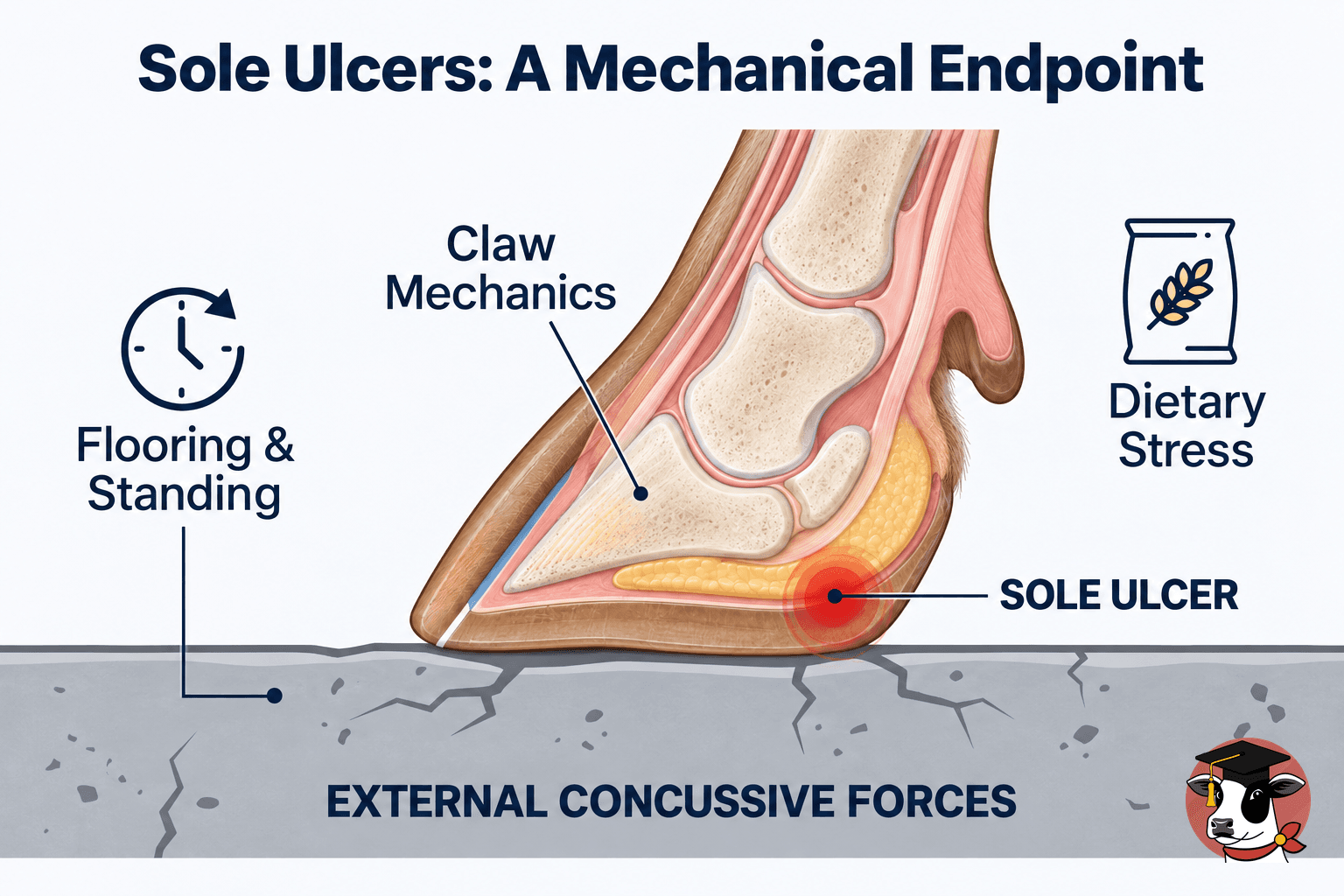
Finding a sole ulcer often triggers an automatic ration rewrite. The old story is simple: too much starch → SARA → “laminitis” → sole ulcer. Real herds are messier. Diet can contribute to systemic stress, but a sole ulcer is a mechanical endpoint — pressure on the corium and interrupted horn formation. Leave SARA taxonomy, holding-pen standing clocks, flooring traction, digital-cushion biology, and trim programs to those companion notes; use them here only as co-suspects.
Separate the labels before you change the bunk. SARA is a ruminal/feed-management state — transient low pH — not a hoof diagnosis. Claw-horn disruption describes corium and suspensory stress that can show up as hemorrhage or ulcer; it is not a synonym for “ate too much grain.” A sole ulcer is a focal physical lesion. It does not, by itself, prove yesterday’s starch rate.
Herd-level work links higher concentrate and grain feeding with elevated lameness risk in some analyses — a population association, not a one-lesion proof of overload. Abrupt transitions, sorting, and poorly managed high-fermentable diets can drive inflammation and metabolic stress that may weaken claw resilience. The chain from starch → inflammatory mediators → ulcer without mechanical load is not established as a standalone rule. Controlled nutrition models rarely produce sole ulcers without standing time, hard floors, or transition claw vulnerability in the picture.
Horn grows slowly: today’s ulcer often fingerprints an event weeks earlier. Cutting starch after one or two ulcers can cut milk and deepen energy deficit without fixing holding pens, polished alleys, thin cushions after BCS loss, or an over-aggressive trim. Pull the ration when hoof lesions ride alongside bunk chaos — sorting, intake swings, manure inconsistency, fresh-cow metabolic clusters, or a recent forage or formulation shock — not as a reflex to a single chute finding.
Check in the barn
What to check: Isolated ulcer or a herd pattern by parity, DIM, or pen? Where are cows standing — holding pen, overcrowding, poor stalls? Flooring wear, slip, and long walks before blaming starch? BCS and transition stress clustering with lesions? Recent trim records — thin soles after a herd trim day? Feed delivery: sorting, empty bunks, abrupt concentrate changes?
Sister notes on this universe cover standing time as the dose, the parlor that added two hours of standing, digital cushion thickness, flooring traction and wear, and hoof records as herd trends. Educational only — not a diagnosis, prescription, or treatment protocol.
Keep reading
View the networkNext
Digital Cushion Thickness, Transition, and Sole-Ulcer Risk
The digital cushion helps dissipate load beneath the pedal bone. Thin sole soft tissues have been associated with later claw-horn lesions, but cushion thickness is not simply a reflection of body condition. Stage of lactation, parity, farm conditions, previous lesions, and tissue structure all appear to matter.
Knowledge level in this topic: Advanced. Mechanism and stacked risk in this topic — assumes the first-pass frame.Sister note · 4 min
Home plate: Hoof · Claw-horn lesions · Sole ulcer
- Sole ulcerHorn failed throughPlaced here
- Flooring, Traction, Wear, and Their Effect on Claw HealthFlooring is a daily mechanical dose: traction and abrasive wear shape claw horn faster than most herds measure, and the wrong surface quietly builds the next ulcer cohort.Sister note
- SARA is not grain overloadAcute acidosis is an emergency. SARA is a chronic, almost-normal herd pattern that can quietly cost milk fat and fiber digestion, and it is associated with poorer claw health.Sister note
- Starch load & SARAWatch the same rumen when starch arrives too fast: pH spends hours too low, milk fat slips, and the fiber mat thins.Bridge → Rumen
Mark size is the kind. Color is the atlas area.
- Sheet
- Focus
- Field note
- Rumen
- Hoof
Sources
- Impact of nutrition on lameness and claw health in cattle — Lean IJ, Westwood CT, Golder HM, Vermunt JJ, Livestock Science (2013)
- The Relationship of Cow Comfort and Flooring to Lameness Disorders in Dairy Cattle — Endres MI, Veterinary Clinics of North America: Food Animal Practice (2017)
- Prevalence of lameness and associated risk factors in Canadian Holstein-Friesian cows housed in freestall barns — Solano L, et al., Journal of Dairy Science (2015)
- Hoof health and nutrition — UW–Madison Extension
- Prevention and treatment of lameness in dairy cattle — University of Minnesota Extension