
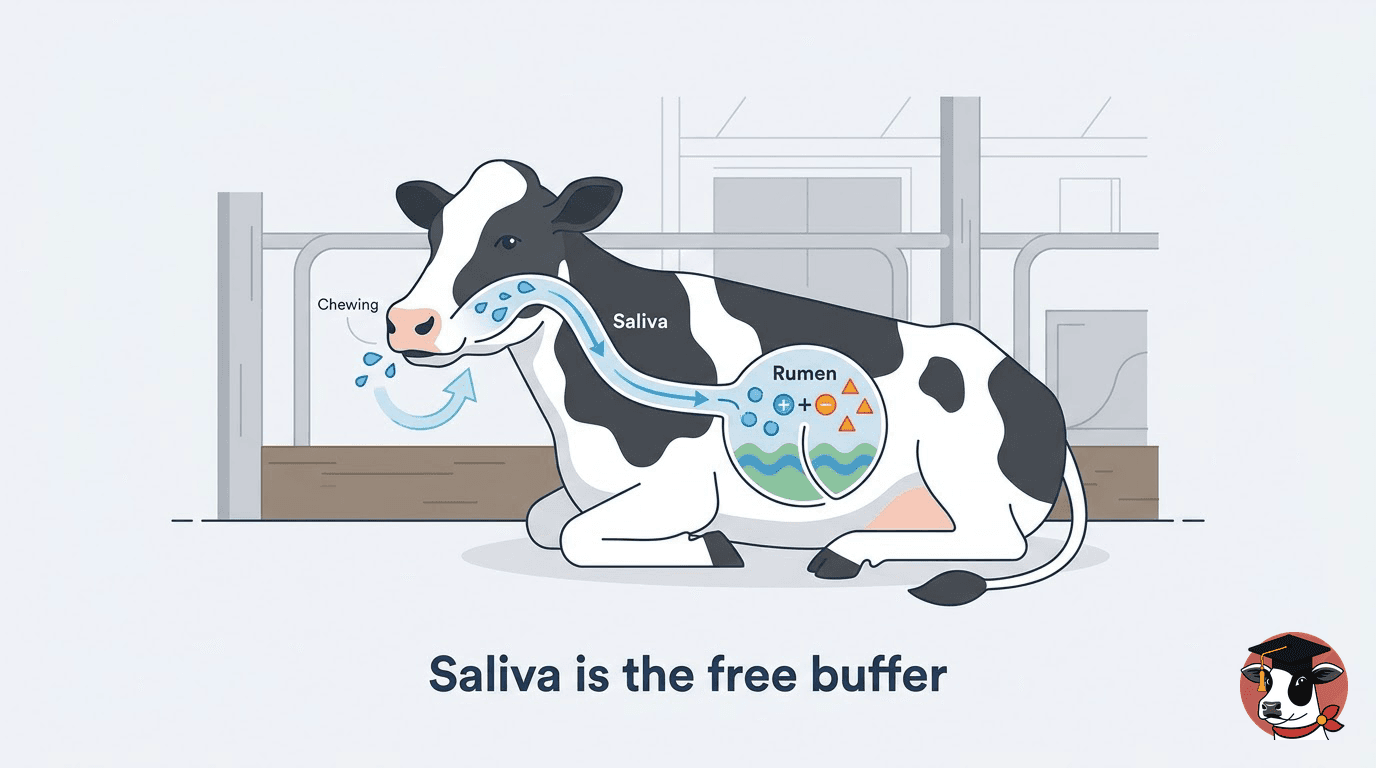
Saliva is the free buffer
Bagged bicarbonate has a line item. Saliva is the free, manageable buffer you earn with chewing — not the larger proton sink than SCFA absorption.
3 min read · 2026-09-09
Walk a freestall after the second delivery and you can hear the difference before you see it. Quiet pens that still have full bunks often have cows that ate fast and then stopped chewing. The mixer ticket may look balanced. The free buffer may already be thin.
Saliva is free and manageable — alkaline fluid that arrives mostly when she chews. Most of it arrives when she chews; resting rates are much lower. Penn State’s From Feed to Milk puts farm units around six to eight hours of chewing a day and tens of gallons of saliva, rich in bicarbonate and phosphate. Beauchemin’s Journal of Dairy Science review puts lactating cows nearer about 4.5 hours eating plus about 7 hours ruminating (roughly 11.5 hours chewing total). Use both as ranges, not a duel: the practical point is that chewing drives salivary buffer flow, and fine, wet, or pelleted feeds cut saliva per pound of dry matter.
That does not make saliva the primary proton sink in the rumen. Aschenbach and related work (including OSU summaries of ruminal pH regulation) put the larger share of acid removal on absorption of short-chain fatty acids across the rumen wall. Saliva is the free lever you can still manage with particle size, bunk access, heat abatement, and water. Bagged sodium bicarbonate (or sesquicarbonate) is an aid for high–corn-silage or low-fiber diets, not a replacement for the endogenous stream.
Check in the barn
What to check without rewriting the ration: empty hours that force slug meals; heat or sore feet that steal night rumination; water access that limits the fluid needed to make saliva; and whether the pen still looks “full” while the jaws have gone quiet.
Keep reading
View the networkNext
The sensor is a barn alarm, not a diagnosis
Rumination and activity collars flag deviations from a cow’s own baseline — useful alarms that still need the cow, bunk, and stall before you act.
Sister note · 3 min
Home plate: Rumen · Inside the rumen · Rumination & saliva
- Rumination & salivaThe buffer pumpPlaced here
- Particle size holds the fiber matIf the TMR is too fine, the forage raft thins — less trapping, less re-chewing, less bicarbonate-rich saliva.Sister note
- Cud chewing is the cheapest rumen sensorRumination is how the cow rebuilds particle size and pumps saliva bicarbonate into the vat. If she stops, the buffer stops.Same focus
Mark size is the kind. Color is the atlas area.
- Focus
- Field note
- Rumen
Sources
- From Feed to Milk: Understanding Rumen Function — Penn State Extension
- Invited review: Current perspectives on eating and rumination activity in dairy cows — Beauchemin, K.A. (2018)
- Role of fermentation acid absorption in the regulation of ruminal pH — Aschenbach et al. (2011)
- Rumen Acidosis in Dairy Cattle – A Cause for Concern? — Ohio State Buckeye Dairy News