
Rumen-Inert Fat Is Energy with a Catch
Rumen-inert fat can increase dietary energy density, but its value depends on the fatty acids supplied, their digestibility, and how the cow responds.
Knowledge level in this topic: Advanced. Mechanism and stacked risk in this topic — assumes the first-pass frame.
3 min read · 2026-10-03
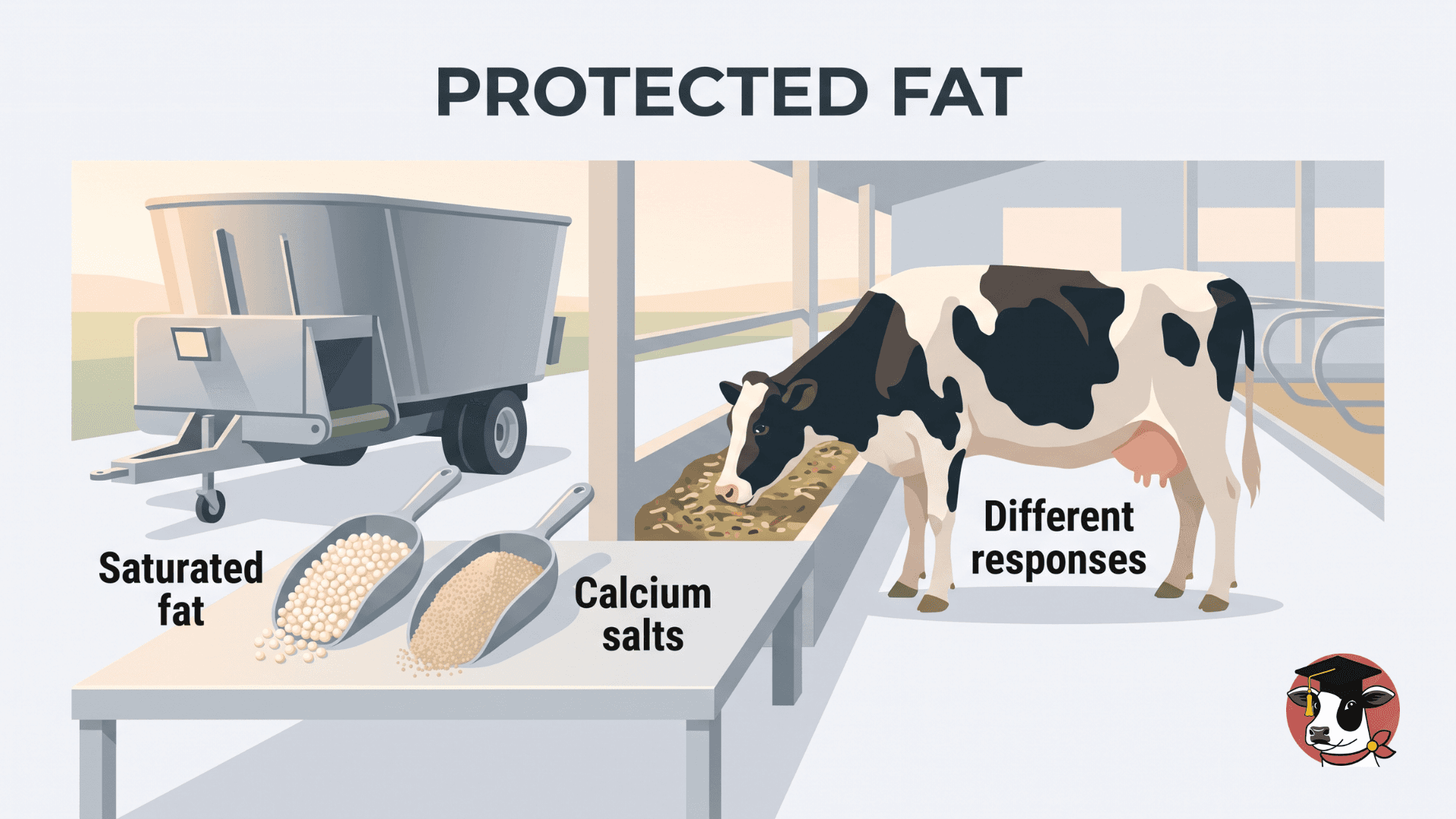
Rumen-inert fat can add energy while limiting the rumen disruption associated with feeding unprotected unsaturated fat. But "inert" means little effect on fermentation at moderate feeding rates, not complete protection. Its value depends on what the cow digests and whether the response pays.
Common options are saturated fatty acid supplements, which may be prilled (small solid beads) or flaked, and calcium salts of fatty acids. Prilled or flaked describes physical form, which does not by itself tell you the fatty acid profile or digestibility. Products differ in palmitic, stearic and oleic acids. In laboratory tests, calcium salts became less stable as pH fell, more so with more unsaturated fatty acids. Some unsaturated fatty acids in a calcium salt can still be modified in the rumen.
Fat is energy dense, but energy on a specification is not energy available to the cow. NASEM 2021 uses different fatty acid digestibility coefficients for different feed and supplement classes. Its default of 73% true digestibility applies to fatty acids from most feeds, not automatically to every commercial fat supplement. Compare products on evidence for their composition and form, not kilograms of fat.
Digestibility may help explain differences between products. In one trial of two products, estimated apparent fatty acid digestibility was about 77% for a palmitic-rich product and 55% for a palmitic-stearic blend. The palmitic-rich product supported more milk fat and energy-corrected milk than the blend, yet the average milk fat yield of the two supplemented treatments did not differ from the unsupplemented control.
More milk energy does not necessarily mean better body reserves. In a trial starting supplementation soon after calving, multiparous cows fed a palmitic-rich supplement made more milk fat but had lower body weight (about 21 kg) and body condition score (0.09 points) than cows fed no supplemental fat, a gap that opened after the second week. That does not show all supplemental fat worsens the fresh-cow energy gap. It shows why milk response and body condition should be judged together, especially soon after calving.
Intake and milk components can respond differently. In a meta-analysis of 33 publications, calcium salts of palm fatty acids fed at up to 3% of diet dry matter, compared with diets without supplemental fat, reduced intake by about 0.56 kg/d and milk protein concentration by 0.05 percentage points, with protein yield unchanged. Milk yield rose about 1.5 kg/d, milk fat yield about 0.04 kg/d and fiber digestibility about 1.6 percentage points. A lower protein percentage alone does not show a loss of protein output. These are averages, not a guaranteed farm result.
Check in the barn
What to check: Ask what fatty acids the product supplies, what evidence supports its digestibility, and what it replaces in the ration. Monitor dry matter intake, milk yield, fat and protein yields, and body condition over several weeks, and compare the component response with the change in ration cost. Evaluate fat within the whole ration, not as a stand-alone fix for milk fat depression. The two trials come from one research group, which also wrote the meta-analysis, so treat effect sizes as indications; leave ration decisions to the nutritionist.
Educational only: not a diagnosis, prescription, or ration formula. Defer clinical and ration decisions to the herd veterinarian and nutritionist.
Keep reading
View the networkNext
Count the Unsaturated Fat, Not Just the Fat
Fat on the feed tag is not the count that matters. The unsaturated fat the rumen sees, from every ingredient, can stack with starch and weak fiber.
Knowledge level in this topic: Advanced. Mechanism and stacked risk in this topic — assumes the first-pass frame.Sister note · 3 min
Home plate: Rumen · Starch load & SARA · The microbial shift
- The microbial shiftPopulationPlaced here
- Milk fat depression starts in the rumenHigh starch and unsaturated fat with weak effective fiber can shift biohydrogenation toward trans-10 intermediates that suppress mammary fat synthesis.Sister note
- Starch Rate, Not Starch PercentTwo rations can print the same starch percentage and still ferment at very different speeds. Grain type, processing and time in the silo set that speed, and the fall switch to new-crop corn silage changes it twice: once at the switch and again over the winter.Same sheet
- Intake & the energy gapIntakeBridge → Transition
Mark size is the kind. Color is the atlas area.
- Focus
- Field note
- Rumen
- Transition
Sources
- Nutrient Requirements of Dairy Cattle: Eighth Revised Edition — National Academies of Sciences, Engineering, and Medicine, National Academies Press (2021)
- Dissociation of calcium soaps of long-chain fatty acids in rumen fluid — Sukhija PS, Palmquist DL, J Dairy Sci (1990)
- Digestibility and effects of hydrogenated palm fatty acid distillate in lactating dairy cows — Elliott JP, Drackley JK, Weigel DJ, J Dairy Sci (1996)
- Effects of commercially available palmitic and stearic acid supplements on nutrient digestibility and production responses of lactating dairy cows — Western MM, de Souza J, Lock AL, J Dairy Sci (2020)
- Effects of timing of palmitic acid supplementation on production responses of early-lactation dairy cows — de Souza J, Lock AL, J Dairy Sci (2019)
- Effects of calcium salts of palm fatty acids on nutrient digestibility and production responses of lactating dairy cows: A meta-analysis and meta-regression — dos Santos Neto JM, de Souza J, Lock AL, J Dairy Sci (2021)