
Read manure before you rewrite the ticket
The alley is a daily report card on the ration the cow actually ate and fermented: consistency, fiber, and grain tell you before the mixer does.
Knowledge level in this topic: Intermediate. Barn-side working knowledge in this topic: checks, pairing, and what to do next.
3 min read · 2026-09-09
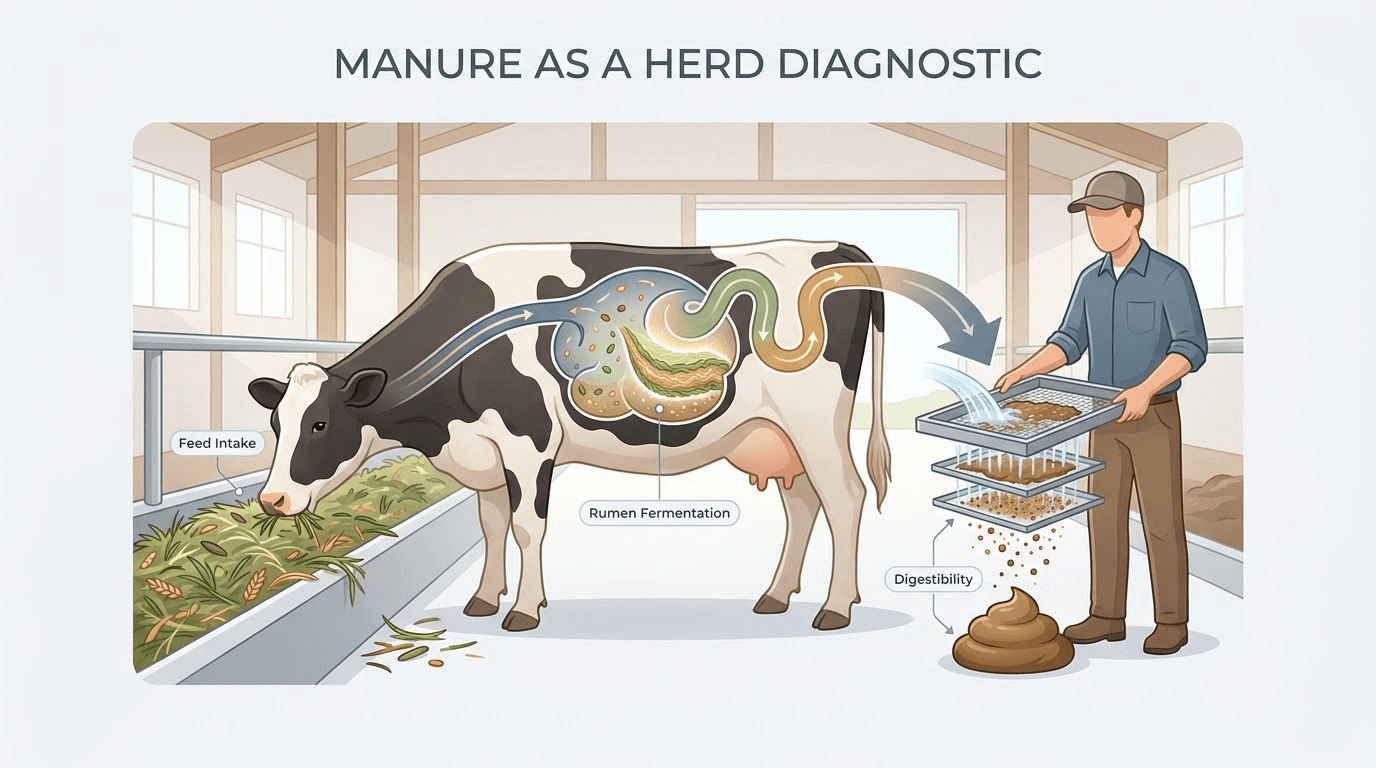
The mixer ticket describes what left the wagon. Manure describes what the rumen finished. Walk the alley after a meal and you get a herd-level report card on particle size, starch load, passage rate, and sorting, without waiting for next month’s milk fat slip.
Penn State's manure-evaluation article is the lead field guide: look at consistency, undigested fiber and grain, and pen variation. Shared farm language often uses a 1–5 consistency scale (Michigan / CowSignals-style shared language; Stallings' earlier scoring work is related but not a PSU-taught 1–5 checklist). Treat any scorecard as a shared vocabulary, not a diagnosis. Very loose manure can flag rapid passage or fermentable overload; stiff, dry piles can flag fiber or water issues. More useful than a single score is pen variation: if piles differ wildly cow-to-cow, sorting and competition are part of the story.
Undigested long fiber or whole grain in a rinse or sieve points back to effective fiber, processing, and starch availability. Mucin casts and frothy, bubbly manure are warning lights that the gut lining and fermentation are under stress: reasons to call the nutritionist and veterinarian, not to “fix” the diet yourself.
Manure that looks “wrong” after a ration change is often the peNDF and starch chapters talking. Read manure with the same eyes you use for cud chewing and milk fat; they are one system. Once a week, walk both sides of the alley after fresh feed. If the alley and the ticket disagree, believe the alley first, then ask what the cow actually sorted, chewed, and fermented.
Keep reading
View the networkNext
The sensor is a barn alarm, not a diagnosis
Rumination and activity collars flag deviations from a cow’s own baseline — useful alarms that still need the cow, bunk, and stall before you act.
Knowledge level in this topic: Intermediate. Barn-side working knowledge in this topic: checks, pairing, and what to do next.Sister note · 3 min
Home plate: Rumen · Inside the rumen
- Inside the rumenA dairy cow is a microbial fermentation system. Open the vat: four compartments, a stratified rumen, chewing, acids, and what leaves downstream.Placed here
- Reading milk fat as a rumen alarmA falling fat test is often the first cheap signal that fermentation has shifted, not that the cow forgot how to make fat.Sister note
- The Rumen ChamberThe rumen is a fluid-filled fermentation vat: carbs often 60–70% of dietary DM; past ~60% concentrate of DMI is a cautionary overload threshold, not a universal law.Same sheet
Mark size is the kind. Color is the atlas area.
- Sheet
- Field note
- Rumen
Sources
- Using Manure Evaluation to Enhance Dairy Cattle Nutrition — Penn State Extension
- Manure scoring as a management tool — Stallings, C.C. — WCDS 1998