
MP is not crude protein
Crude protein counts nitrogen. Metabolizable protein asks what amino acids actually reach the cow after the rumen.
Knowledge level in this topic: Advanced. Mechanism and stacked risk in this topic — assumes the first-pass frame.
3 min read · 2026-09-09
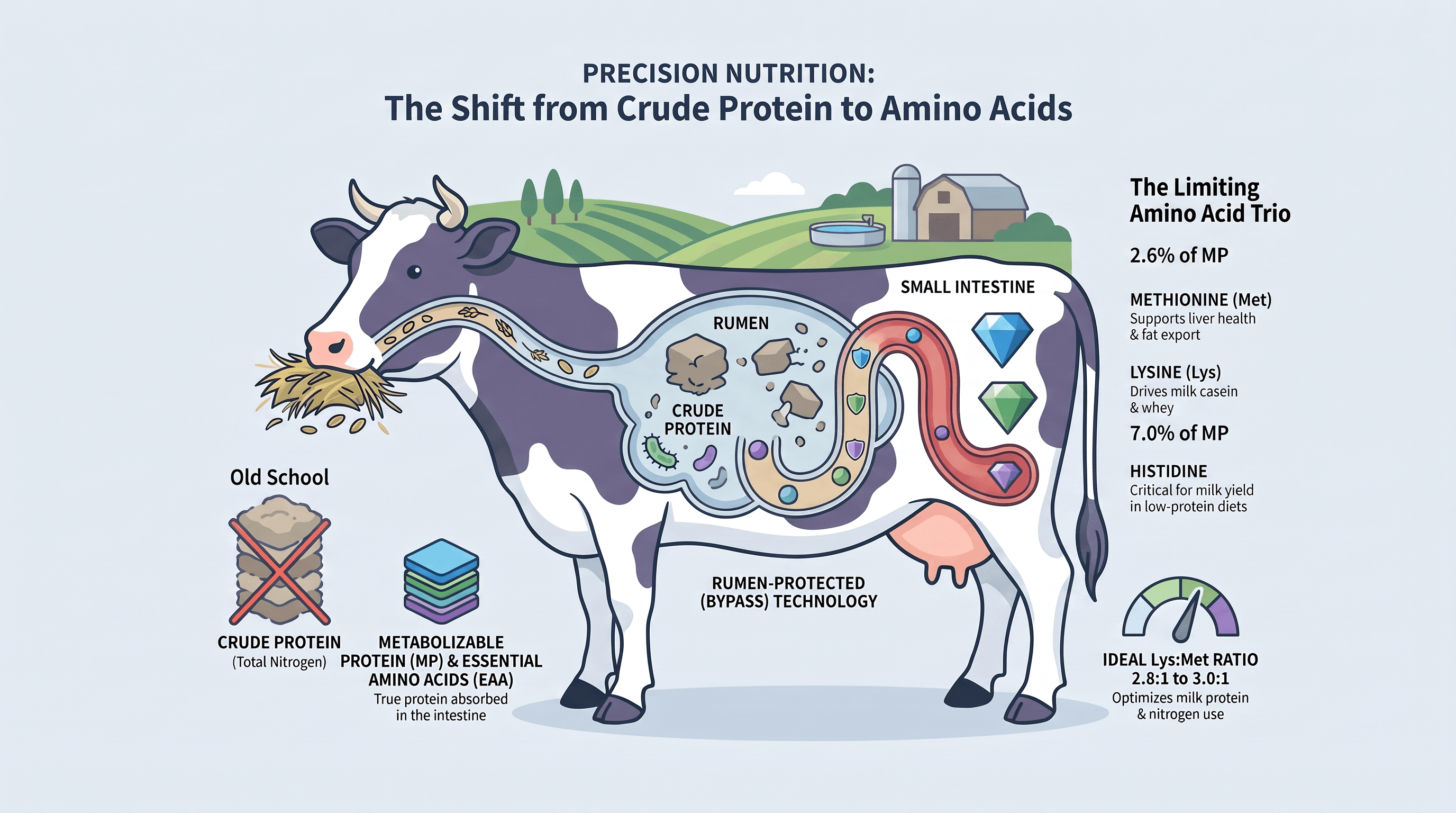
Crude protein is a convenient lab number: nitrogen × 6.25. It does not tell you how much true protein the cow absorbs after rumen microbes and bypass protein finish their work. That absorbed supply is closer to what nutritionists call metabolizable protein (MP), and the amino acid profile of that MP is what builds milk protein.
Much of dietary protein is broken down in the rumen. Microbes rebuild amino acids into microbial protein, which later digests in the small intestine. Some feed protein escapes (“bypass”) and also contributes amino acids downstream. The cow’s usable amino acid pool is the sum of those streams, not the crude protein on the tag.
On a feed report, those two streams are rumen-degradable protein (RDP) and rumen-undegradable protein (RUP). Microbes need fermentable starch and fiber to turn RDP into microbial protein (see microbes and fermentation). NASEM (2021) suggests a general minimum of about 10% of dry matter as RDP, because intake can drop when RDP runs short. How much of the RUP is then digested in the small intestine differs by feed.
The RUP line on a feed report is calculated from a degradation rate and an assumed passage rate, and faster passage lets more protein escape (what leaves the rumen). Checked against measured flows, the NRC (2001) model overpredicted RUP in high-RUP feeds, so the 2021 model lowered its passage rates. The same feed now prints less RUP and more RDP, most of all in high-RUP concentrates. Compare RUP values only within one system.
When diets are short on key essential amino acids relative to MP (lysine and methionine are the usual first limits in many North American dairy diets, and histidine can be co-limiting), milk protein yield and nitrogen efficiency suffer even if crude protein looks “high enough.” NASEM (2021) moves the conversation toward essential amino acid supply and response, not a single CP finish line.
Efficiency changed too. The older model assumed the MP used for milk became milk protein at a fixed 67%. The 2021 model dropped that constant: milk protein is predicted mainly from absorbed histidine, isoleucine, leucine, lysine and methionine plus digestible energy, and each extra gram returns less as total supply rises. Efficiency is calculated for the diet and compared with the model's target efficiencies, about 0.70 to 0.75 for these five amino acids. An amino acid running above its target is the likeliest to respond to more supply. One well below target is probably in surplus; the extra is broken down and its nitrogen excreted.
Exact MP and amino acid targets belong with the herd nutritionist and the model they use. The atlas lesson is directional: stop treating crude protein as the finish line. Ask whether the rumen is fed for microbial protein, whether bypass protein is intentional, and whether Lys/Met (and sometimes His) balance is part of the conversation.
Keep reading
View the networkNext
What Leaves the Rumen
Liquid and solid digesta leave the rumen on different clocks. Fast fluid outflow harvests microbial protein, while fiber particles leave only after they shrink and sink.
Knowledge level in this topic: Intermediate. Barn-side working knowledge in this topic: checks, pairing, and what to do next.Sister note · 3 min
Home plate: Rumen · Inside the rumen · What leaves the rumen
- What leaves the rumenDownstreamPlaced here
- Microbes and FermentationFeed the microbes first: fiber + NFC → VFAs for energy; dietary N upgrades to microbial crude protein; biohydrogenation of PUFA is microbial survival, not an MFD deep dive.Sister note
- The Rumen ChamberThe rumen is a fluid-filled fermentation vat: carbs often make up 60–70% of dietary DM, and how much concentrate it handles depends on forage, fiber, starch, processing, and the bunk.Same sheet
- The ±3-week windowThe windowBridge → Transition
Mark size is the kind. Color is the atlas area.
- Focus
- Field note
- Rumen
- Transition
Sources
- Nutrient Requirements of Dairy Cattle, 8th revised edition — National Academies (NASEM, 2021)
- What's New in the NRC for How We Formulate for Protein in Diets for Dairy Cattle? — Hanigan MD, Tri-State Dairy Nutrition Conference (2022)
- A 100-Year Review: Protein and amino acid nutrition in dairy cows — Schwab CG, Broderick GA, J Dairy Sci (2017)
- Predicting ruminally undegraded and microbial protein flows from the rumen — Hanigan MD, Souza VC, Martineau R, Daley VL, Kononoff P, J Dairy Sci (2021)
- Review: How the efficiency of utilization of essential amino acids can be applied in dairy cow nutrition — Lapierre H, Martineau R, Hanigan MD, Ouellet DR, Animal (2023)