
Milk fat depression starts in the rumen
High starch and unsaturated fat with weak effective fiber can shift biohydrogenation toward trans-10 intermediates that suppress mammary fat synthesis.
Knowledge level in this topic: Advanced. Mechanism and stacked risk in this topic — assumes the first-pass frame.
3 min read · 2026-09-09
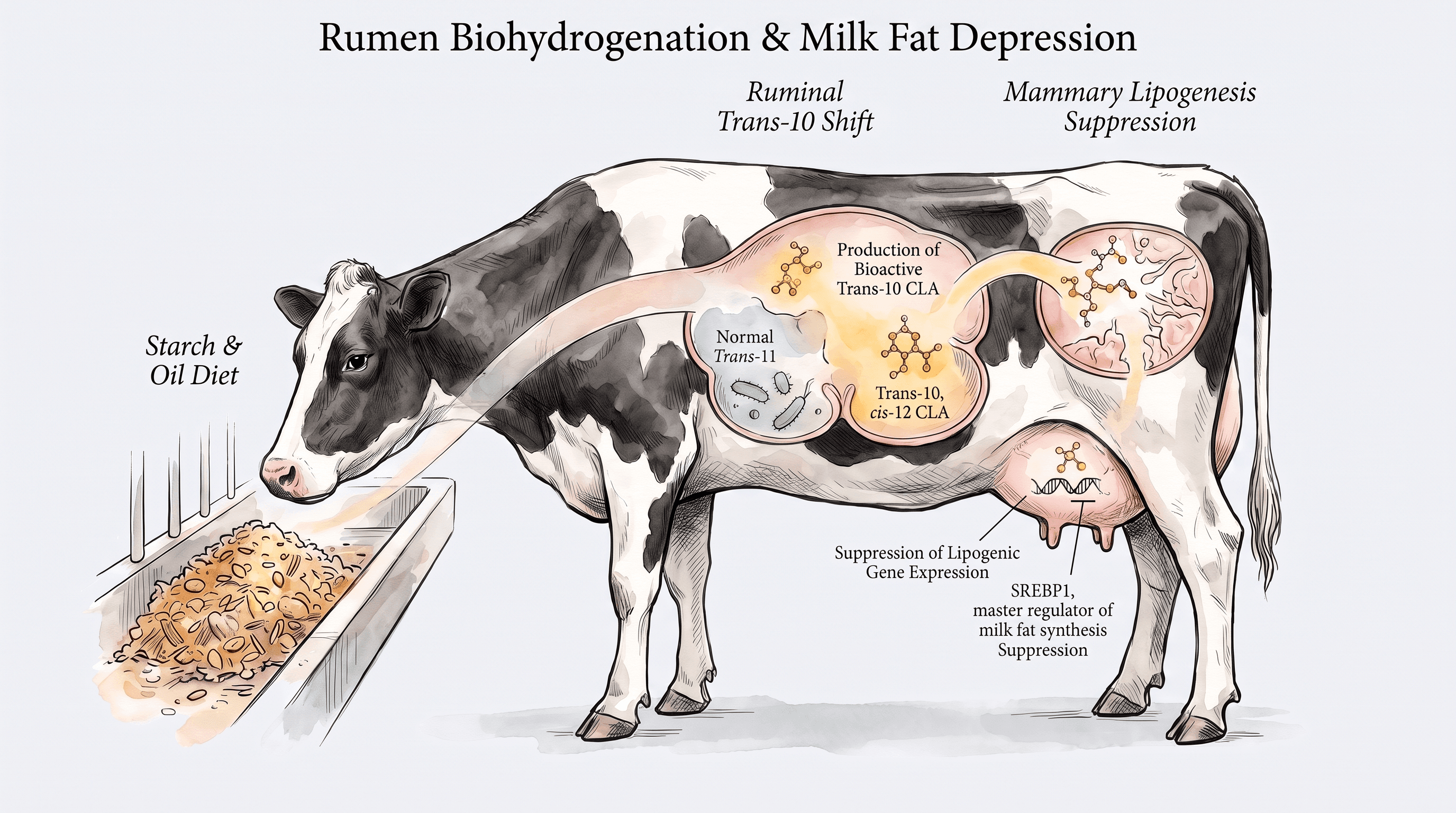
The tank fat test slips a few tenths. The ration looks “hot.” The first instinct is to blame genetics or the parlor. For classic diet-induced milk fat depression, the story usually starts earlier — in the rumen’s fatty-acid traffic.
Dietary unsaturated fats are normally hydrogenated toward pathways that produce trans-11 intermediates. Under high starch load, low effective fiber, and/or high unsaturated oil pressure, the microbial community can shift. Biohydrogenation then favors trans-10 intermediates, including bioactive CLA isomers such as trans-10,cis-12 CLA.
Those molecules leave the rumen, reach the mammary gland, and help suppress lipogenic gene programs that build milk fat. The cow still milks. She just puts less fat in the milk.
In the gland, trans-10,cis-12 CLA lowers SREBP1, a switch that helps run the genes for building milk fat. Research finds little support for a shortage of building blocks as the cause, so this is a signal, not a supply problem. In one infusion trial with four cows, trans-10,cis-12 CLA put straight into the abomasum, the true stomach, for five days cut milk fat yield by about 25% at 3.5 g/day and by about half at 14 g/day. Those are infused doses, not what a ration delivers. In a separate trial, a low-forage, high-oil diet cut fat yield by about 38%, and in a third, fat percentage was lower by day 3 of the diet change and fat yield by day 5. Milk yield held steady in the infusion and time-course trials, so a sliding fat test with steady volume fits this pattern; milk fat as a rumen alarm covers reading it.
In the infusion trial, the short and medium chain fatty acids the udder makes itself fell most at the two higher doses. Trans-10 C18:1 rises with the shift. Infusing about 43 g/day on its own had no effect on milk fat in a three-cow trial, while a mixture supplying about 92 g/day cut milk fat secretion by about 20% in another, so whether it is a cause or only a marker is unsettled. Known CLA isomers do not fully explain the drop, and which microbes drive the shift is still being worked out. The diets that set it up are described above, including fast-arriving starch.
This is not a call for a boutique fatty-acid assay on every herd. It is a systems check: Is physically effective fiber still building a mat and driving cud? Is starch arriving faster than the rumen can buffer? Are free oils or high-PUFA byproducts stacking on top of that starch load?
When peNDF fails and starch/oil rises together, milk fat is often the early dashboard light — related to the same instability that SARA describes from the pH side.
Keep reading
View the networkNext
Count the Unsaturated Fat, Not Just the Fat
Fat on the feed tag is not the count that matters. The unsaturated fat the rumen sees, from every ingredient, can stack with starch and weak fiber.
Knowledge level in this topic: Advanced. Mechanism and stacked risk in this topic — assumes the first-pass frame.Sister note · 3 min
Home plate: Rumen · Starch load & SARA · The microbial shift
- The microbial shiftPopulationPlaced here
- Rumen-Inert Fat Is Energy with a CatchRumen-inert fat can increase dietary energy density, but its value depends on the fatty acids supplied, their digestibility, and how the cow responds.Sister note
- SARA is not grain overloadAcute acidosis is an emergency. SARA is a chronic, almost-normal herd pattern that can quietly cost milk fat and fiber digestion, and it is associated with poorer claw health.Sister note
- Mastitis pathwaysAlmost every intramammary infection walks in through the teat canal. See contagious versus environmental paths before you blame the tank.Bridge → Udder
Mark size is the kind. Color is the atlas area.
- Sheet
- Focus
- Field note
- Rumen
- Udder
Sources
- Invited review: Role of rumen biohydrogenation intermediates and rumen microbes in diet-induced milk fat depression: An update — Dewanckele et al. 2020, Journal of Dairy Science
- Nutritional regulation of milk fat synthesis — Bauman & Griinari 2003, Annual Review of Nutrition
- From Feed to Milk: Understanding Rumen Function — Penn State Extension
- Milk Fat Synthesis in Dairy Cows Is Progressively Reduced by Increasing Supplemental Amounts of trans-10, cis-12 Conjugated Linoleic Acid (CLA) — Baumgard LH, Sangster JK, Bauman DE, J Nutr (2001)
- SREBP1 and Thyroid Hormone Responsive Spot 14 (S14) Are Involved in the Regulation of Bovine Mammary Lipid Synthesis during Diet-Induced Milk Fat Depression and Treatment with CLA — Harvatine KJ, Bauman DE, J Nutr (2006)
- Trans-10 Octadecenoic Acid Does Not Reduce Milk Fat Synthesis in Dairy Cows — Lock AL, Tyburczy C, Dwyer DA, Harvatine KJ, Destaillats F, Mouloungui Z, Candy L, Bauman DE, J Nutr (2007)
- Induction of and recovery from milk fat depression occurs progressively in dairy cows switched between diets that differ in fiber and oil concentration — Rico DE, Harvatine KJ, J Dairy Sci (2013)
- Effect of abomasal infusions of a mixture of octadecenoic acids on milk fat synthesis in lactating cows — Shingfield KJ, Sæbø A, Sæbø PC, Toivonen V, Griinari JM, J Dairy Sci (2009)