Lying Longer Is Not Always Better
About 12 hours of lying a day is a common design goal, but a long lying day can mean comfort or illness, and lying hours are not sleep.
Knowledge level in this topic: Intermediate. Barn-side working knowledge in this topic: checks, pairing, and what to do next.
3 min read · 2026-10-05
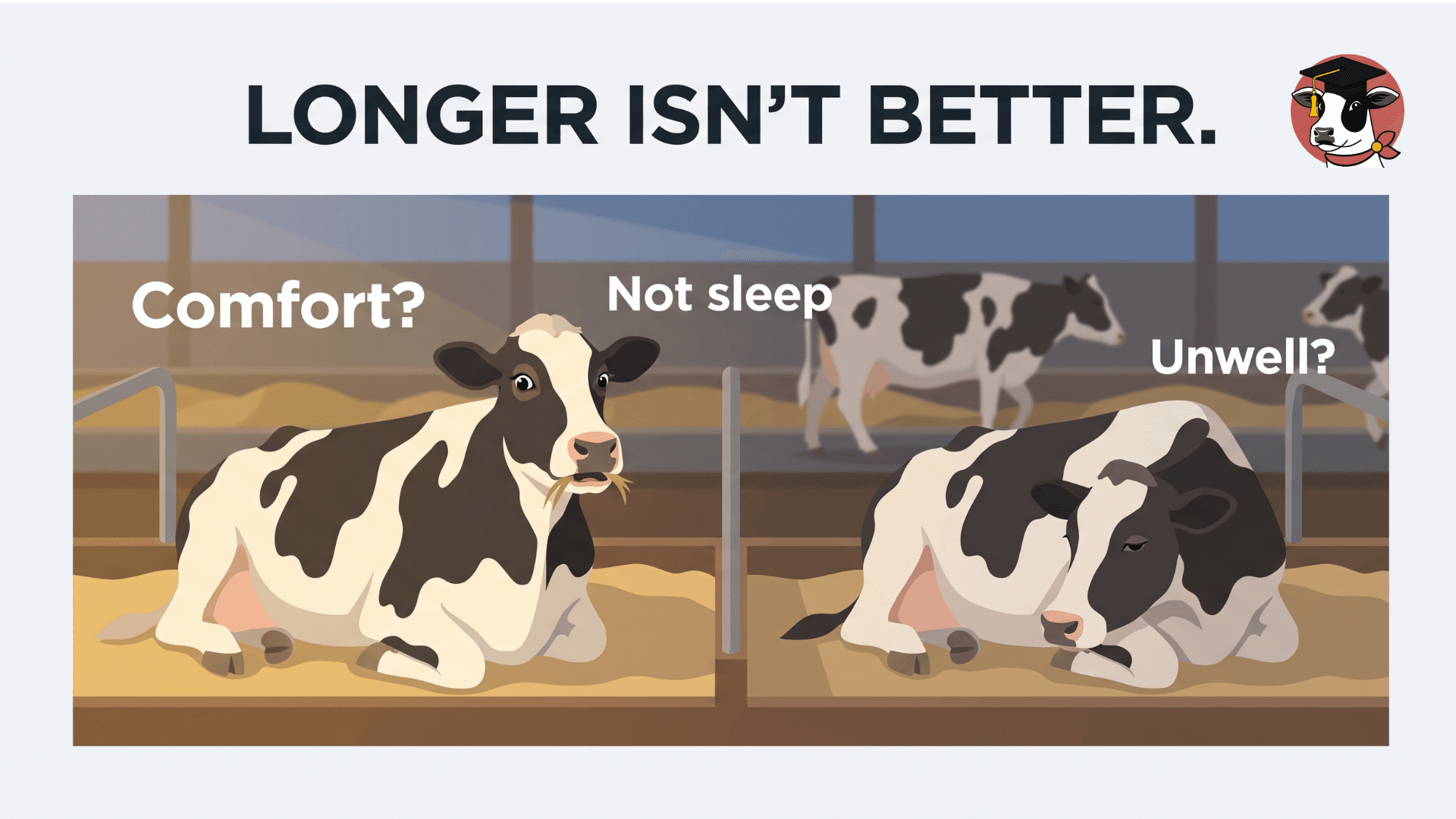
A leg-logger report puts one cow at the top of the pen list. More lying sounds like more comfort, but the number alone cannot tell you whether she is resting well or is unwell.
Lying matters to cows. A Journal of Dairy Science review describes cows as highly motivated to lie down: they make up lost lying after forced standing and will give up other activities, such as feeding, to lie. Housing guidance, including Canada's dairy Code of Practice, uses about 12 hours a day as a common design goal for stalls. In farm surveys of freestall herds, many herd averages sat closer to 10 or 11 hours, and individual cows varied far more than farms did. The same review notes that a valid single welfare threshold is hard to set, so the goal is a herd design aim, not a pass mark for one cow.
Lying, chewing cud and sleeping overlap, but they are different states. A lying cow may be alert, ruminating, drowsing or asleep. Rumination is its own state; a barn walk checks that resting cows should be chewing. Adult cows appear to sleep in many short bouts across the day and night, and a review of sleep methods concludes that resting posture is a poor guide to whether a cow is actually asleep. A leg logger records posture: it shows how long and how often she lay down, not how much she slept. In one small trial, cows kept from lying took longer to regain their usual lying time than cows kept from sleeping.
Higher lying times often go with comfort, but the exceptions matter. Lameness can lengthen lying, while mastitis can shorten it. Other illness can keep a cow down longer, estrus and calving add standing, and heat and rain cut lying. So a long lying day may reflect a comfortable bed, or a cow that finds standing and walking hard. Comfort is one explanation among several.
Short lying still deserves a look. Too few stalls, hard or wet beds, thin bedding, poorly designed stalls and heat are all associated with less lying, and time spent at milking or feeding can limit it. When a group lies less, investigate the time budget rather than chase a number: overstocking steals lying time, hours locked up or held take time from the pen, and in robot herds a climbing fetch list can point to the same squeeze. Hours not spent lying are often spent standing, which adds to the standing dose on claws.
Read lying hours with context: how many bouts she had and how long they lasted, how she lies down and rises (watch for a stall that blocks the rise), how she walks, whether she eats and chews cud, and which group she belongs to. Parity, stage of lactation and health can all shift the picture, and a herd average hides that spread, so split the number by group. Compare a cow with her own recent days rather than with one herd line, and treat a change as a prompt to look, not a verdict.
Check in the barn
What to check: For the cows with the longest and the shortest lying, how do they lie down, rise, walk and chew? Are any lame, fresh, in heat or sick? Are short-lying cows waiting for stalls, held out of the pen, or avoiding a wet or hard bed? Is the device measuring lying only, and over how many days? Leave diagnosis, treatment, welfare and ration decisions to the herd veterinarian and the herd's welfare, behavior and nutrition advisers.
Educational only: not a diagnosis, prescription, or facility design. Defer clinical, welfare and ration decisions to the herd veterinarian and the herd's advisers.
Keep reading
View the networkNext
Build the stall around the rise
Lying time is the budget a stall protects. A stall that blocks the rise charges that time back as standing, collisions, and lesions.
Knowledge level in this topic: Intermediate. Barn-side working knowledge in this topic: checks, pairing, and what to do next.Sister note · 3 min
Home plate: Barn · Stocking & cow flow · Lying time
- Lying timeStallsPlaced here
- Stocking density is a time budgetOverstocking steals lying and eating time. Manage stalls, bunk, and flow, not headcount alone.Sister note
- The Pen Average Hides the Cows That LoseA pen average weights every cow equally, so a small group that is doing badly can disappear inside a number that looks acceptable.Sister note
- Why hoof lesions developClaw-horn disruption is multifactorial: standing time, flooring, lying, transition and the digital cushion, hygiene, and trim. Not one cause.Bridge → Hoof
Mark size is the kind. Color is the atlas area.
- Sheet
- Focus
- Field note
- Hoof
- Barn
Sources
- Invited review: Lying time and the welfare of dairy cows — Journal of Dairy Science (2021)
- Methods used for estimating sleep in dairy cattle — JDS Communications (2024)
- Lying behavior: Assessing within- and between-herd variation in free-stall-housed dairy cows — Journal of Dairy Science (2009)
- Stocking density, milking duration, and lying times of lactating cows on Canadian freestall dairy farms — Journal of Dairy Science (2014)
- Effects of acute lying and sleep deprivation on the behavior of lactating dairy cows — PLOS ONE (2019)
- Code of Practice for the Care and Handling of Dairy Cattle — National Farm Animal Care Council (2023)