
Kernel Processing Unlocks the Starch
Corn silage starch is only worth what the rumen can reach. A whole or merely cracked kernel keeps it locked away, and harvest is the only time the processor can still fix that.
Knowledge level in this topic: Intermediate. Barn-side working knowledge in this topic: checks, pairing, and what to do next.
3 min read · 2026-09-25
In this note
- 9 to 100%
- 50–69%
- 2–3 mm
- 1–3 mm
- 70%
Corn silage is fed partly for its starch, but the rumen can only ferment starch it can reach. Starch behind an unbroken seed coat contributes very little and typically passes through the cow as a whole kernel. So the check belongs at the chopper. This note is about kernels, not stems. Chop length and peNDF are covered in chop length is not peNDF, and harvest dry matter, packing and cover in air at the face spoils the pack.
The pericarp (seed coat) has to be broken before rumen bacteria can get at the starch inside. Beneath it, starch granules sit in a starch–protein matrix, and mechanical processing both breaks the pericarp and disrupts that matrix. Cracking a kernel in two is not enough. The goal is most kernels broken into several pieces, because exposed surface area is what gives microbes access, and feed spends only a short time in the rumen.
Labs report kernel processing as CSPS, the corn silage processing score. The method builds on a 2005 study that sieved dried silage samples and treated starch caught on the 4.75 mm and coarser screens as minimally fragmented. Across the 32 silages in that study, that retained share ranged from 9 to 100% of total starch, with a mean of 52%. CSPS reports the other side: the share of total starch that passes the 4.75 mm screen.
Extension programs use the standard 2005 interpretation bands: above 70% is optimally processed, 50–69% adequately processed, and below 50% inadequately processed. A kernel must be broken to roughly one-twelfth of its original size to pass the 4.75 mm sieve, so a halved kernel still counts as coarse starch in the lab. A lab score comes back after the crop is already in the pile, which is why field checks matter.
Check in the barn
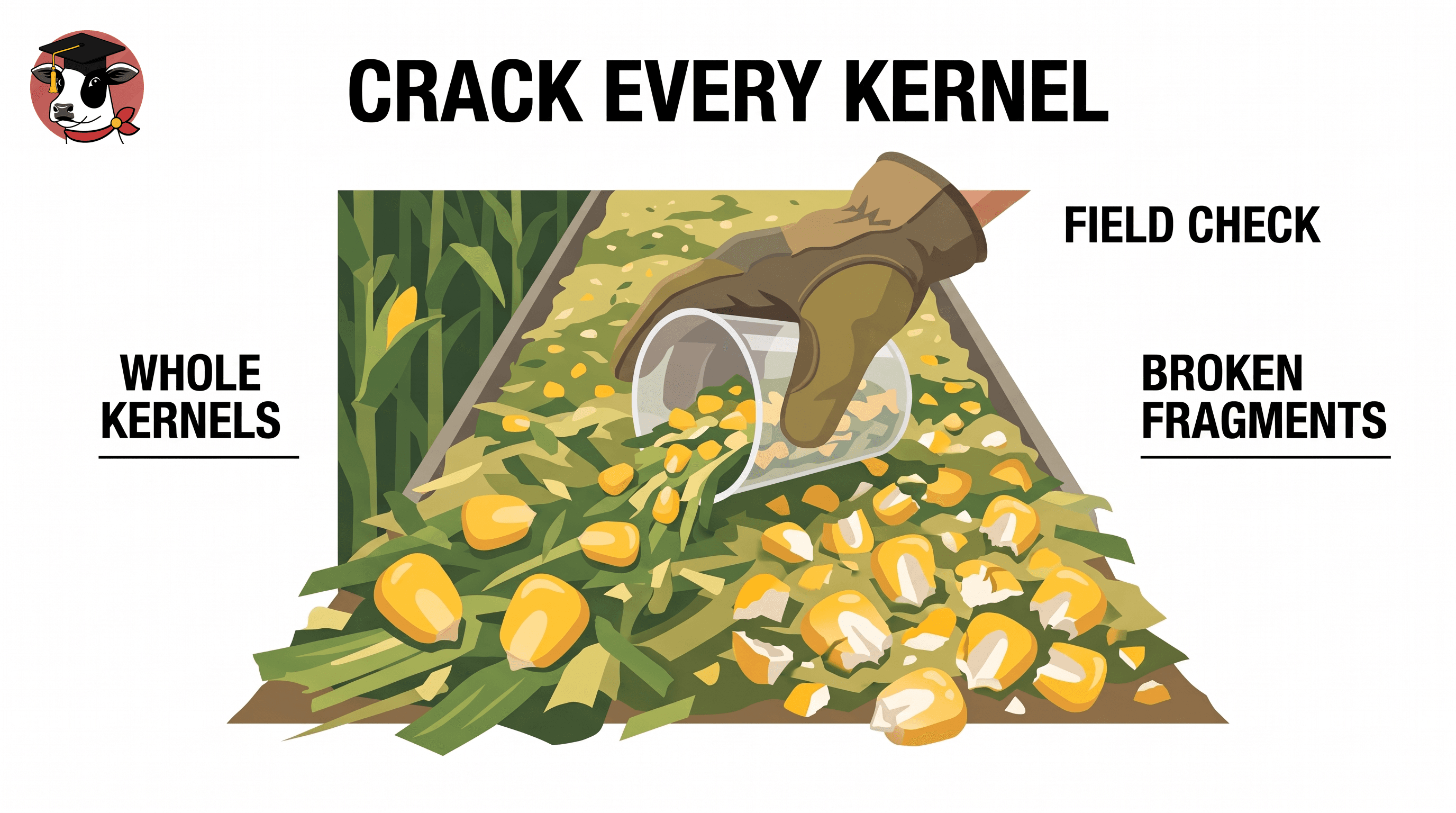
What to check: These are quick, subjective extension methods for adjusting the harvester, not a substitute for a lab score. Cup count. Fill a 32-ounce cup with fresh chop as loads arrive, spread it on a clean surface, and count every kernel that is half-size or larger. The classic goal is fewer than two half or whole kernels per cup, and newer guidance has tightened to zero whole kernels in the cup. Water separation. Fill a dishpan three-quarters full of water, or a 5-gallon bucket half full, and add two or three representative handfuls of chop. Stir for under a minute, skim off the floating stover, pour off the water carefully, and spread the kernels that sank. Many whole kernels means processing is insufficient. Almost no whole kernels but many nicked or cracked ones means barely adequate. Well-processed chop has almost no whole or cracked kernels. Repeat it. Assign someone at the silo to check at a set interval, such as every few hours or every few loads, and spot-check throughout the day. Confirm with the lab. Send CSPS samples so field judgment stays calibrated.
Kernels in manure are a later and weaker signal, covered in what leaves the rumen and read manure before you rewrite the ticket. An intact-looking corn silage kernel can be a shell whose starch has been partly or fully digested, so inspect before judging.
Roll gap. Roll clearance, not theoretical length of cut, is the main processing adjustment, because cut length should be set for the effective fiber the herd needs. Published ranges differ slightly: an older guide gives 2–3 mm (0.08–0.12 in), about the thickness of a dime or nickel, while a later extension guide gives 1–3 mm (0.04–0.12 in). Very small clearances over-process the crop, cut harvester productivity, use more fuel and add equipment wear. Wear and speed differential. Rolls, belts and springs are wear items to track against the manufacturer's schedule. To break kernels harder, there are three adjustments: adjusting the roll speed differential, adding pulley ribs to cut belt slip, and tuning spring tension. Over-tightened springs can make the rolls bounce and break kernels less evenly.
Maturity drift. A setting that worked on the first field may not hold on the last. In one hybrid study, ear dry matter was significantly linked to processing score, while whole-plant dry matter was not. Whole-plant DM alone will not say whether the gap still fits, so re-check whenever the chopper changes fields or the crop advances. Starch digestibility generally rises over months of storage. In one 30-day mini-silo trial, though, the gain appeared only in kernels that had been broken. Better breakage also exposes more starch at once, so it ferments faster. How that rate adds to acid load is covered in SARA is not grain overload and empty bunks are starch events. Educational only—not a diagnosis, prescription, or treatment protocol. Defer clinical and ration decisions to the herd veterinarian and nutritionist.
Keep reading
View the networkNext
Empty bunks are starch events
Cows that wait, then eat fast, can drop rumen pH even when the printed diet never changed.
Knowledge level in this topic: Intermediate. Barn-side working knowledge in this topic: checks, pairing, and what to do next.Sister note · 3 min
Home plate: Rumen · Starch load & SARA · Fast starch
- Fast starchFermentation speedPlaced here
- SARA is not grain overloadAcute acidosis is an emergency. SARA is a chronic, almost-normal herd pattern that can quietly cost milk fat and fiber digestion, and it is associated with poorer claw health.Sister note
- Sole Ulcers, Laminitis, and Diet: Separating Evidence from AssumptionSole ulcers get blamed on “too much grain” more often than the evidence supports — separate diet risk from flooring, standing time, and claw mechanics before rewriting the ration.Same sheet
Mark size is the kind. Color is the atlas area.
- Focus
- Field note
- Rumen
- Hoof
Sources
- Chemical and physical characteristics of corn silages and their effects on in vitro disappearance — Ferreira G, Mertens DR, J Dairy Sci (2005)
- Making sure your kernel processor is doing its job — Shinners KJ, Holmes BJ, Focus on Forage, University of Wisconsin Extension (2013)
- Monitoring kernel processing during harvest — Luck B, Willett R, Drewry J, Ferraretto L, University of Wisconsin–Madison Division of Extension (2019)
- Check your corn silage processing during harvest to ensure optimal nutrition — Seefeldt L, University of Wisconsin–Madison Division of Extension, Dairy
- Corn silage refresher – Part 2: Analyzing and adjusting during harvest — Mangual MJ, Michigan State University Extension (2017)
- Fact sheet 1: Corn silage kernel processing — Lawrence J, Kerwin A, Cornell PRO-DAIRY (2020)
- Fact sheet 2: Effect of corn plant characteristics on corn silage processing scores — Lawrence J, Kerwin A, Cornell PRO-DAIRY (2020)
- Effect of kernel breakage on the fermentation profile, nitrogen fractions, and in vitro starch digestibility of whole-plant corn silage and ensiled corn grain — Saylor BA, Diepersloot EC, Heinzen C, McCary CL, Ferraretto LF, JDS Commun (2021)
- The effects of hybrid, maturity, and length of storage on the composition and nutritive value of corn silage — Der Bedrosian MC, Nestor KE, Kung L Jr, J Dairy Sci (2012)
- Using manure evaluation to enhance dairy cattle nutrition — Heinrichs J, Varga GA, Kononoff P, Penn State Extension