
Flooring, Traction, Wear, and Their Effect on Claw Health
Flooring is a daily mechanical dose — traction and abrasive wear shape claw horn faster than most herds measure, and the wrong surface quietly builds the next ulcer cohort.
3 min read · 2026-09-17
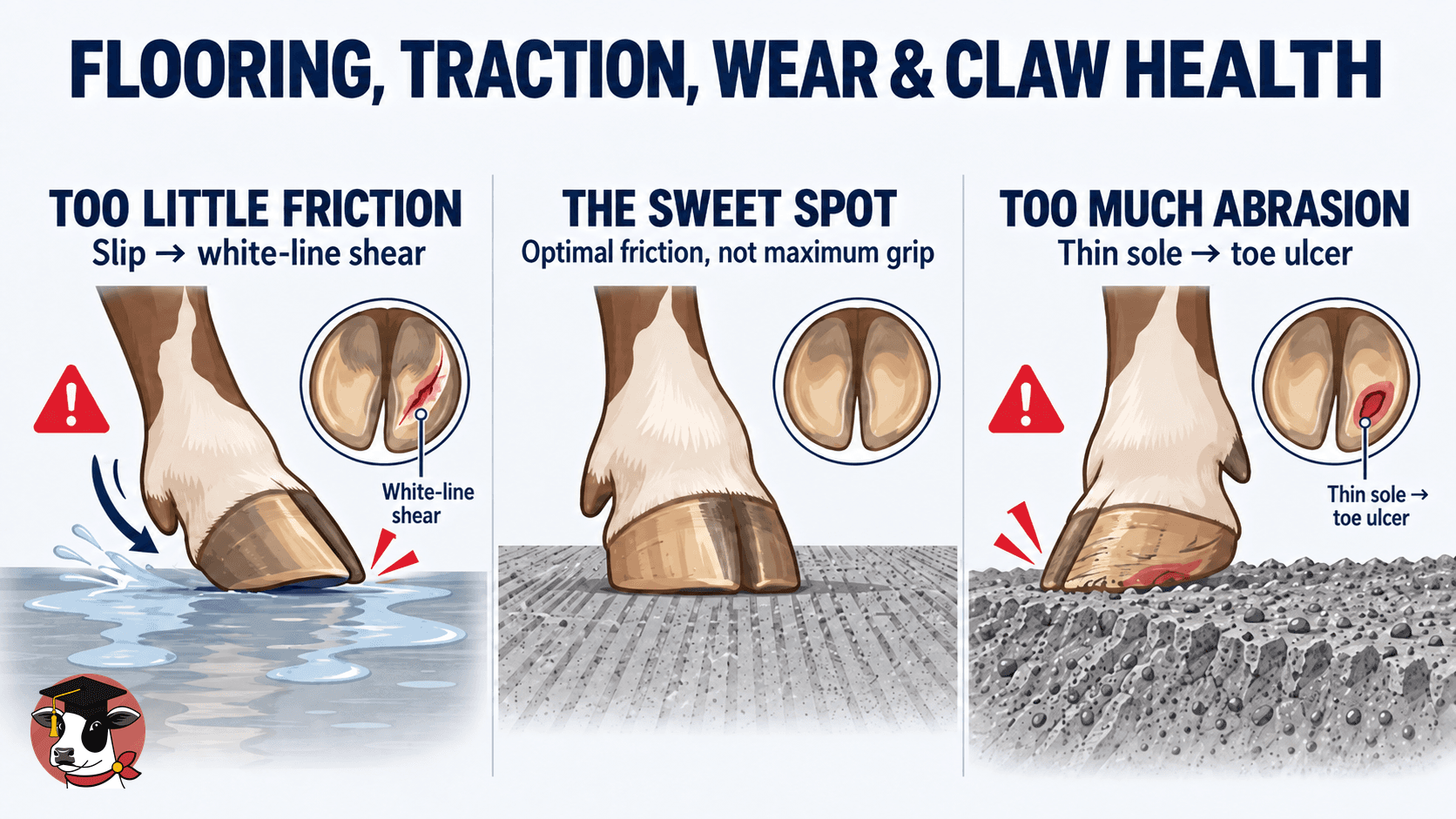
Every step is a friction-and-wear event between claw horn and floor. Slippery surfaces drive micro-slips and white-line shear; overly abrasive ones strip sole faster than the corium can replace it. Maximum grip is not the goal. Leave standing-time budgets to the holding-pen note, cushion biology to the digital-cushion note, and trim cadence to the preventive-trimming note.
Cows need enough floor friction for confident straight walking and more still for turns, starts, and stops. Polished, slurry-filmed concrete often sits near or below that comfort band. When the claw cannot lock briefly at heel strike or push-off, abrupt loading and shear concentrate at the white line — the weak junction between wall and sole. Watch gait: short choppy strides and reluctance to turn are floor confidence problems, not only attitude.
Sole thickness is a balance of horn growth against attrition. New, sharp, or heavily textured concrete — and some mastic asphalt systems — can outpace growth, especially when walking distances are long. Thin soles and toe ulcers are often mechanical endpoints of that imbalance, not a mystery nutrition failure. Softened horn after slurry exposure wears faster still.
Too little traction brings slips and white-line trauma. Too much aggressive texturing or dense diamond grooving everywhere locks pivots and accelerates wear. Parallel grooving sized so each footstep engages an edge — Dairyland Initiative guidance of about 0.5 in deep × 0.75 in wide, ~3.25 in on center, with vertical walls, not V-grooves — belongs on primary alleys. Reserve denser oblique patterns for high-torque turns such as parlor returns and tight crossovers. Rubber alleys raise comfort and cut abrasive wear, and with less attrition, net horn growth often rises—keep functional trimming on schedule and watch claw length if rubber is widespread.
The same concrete that is tolerable in a short barn becomes a thin-sole machine when cows walk hundreds of extra meters to milk. Layout and cow-flow rushing — forced turns on wet floors — multiply shear events. Fix scraper and flush films that turn grooves into lubricated ice.
Check in the barn
What to check: Do wet alleys mirror overhead lights — polished slick — or still show usable texture? Are groove walls vertical with intact edges, or crumbled into V-shapes? Is diamond or oblique patterning limited to turn zones, or carved across whole pens? At trim, are thin soles or toe ulcers clustering after new concrete, long parlor walks, or aggressive re-texturing? How thick is the slurry film when cows actually walk — not right after the scraper? Do cattle shorten stride and hesitate at crossovers when the floor is wet?
Sister notes on this universe cover standing time as the dose, the parlor that added two hours of standing, and hoof blocks when horn has already failed. Educational only — not a diagnosis, prescription, or treatment protocol.
Keep reading
View the networkNext
Standing time is the dose
Prolonged standing load can bruise the corium and surface weeks later as a claw-horn lesion.
Sister note · 3 min
Home plate: Hoof · Why hoof lesions develop · Flooring & wear
- Flooring & wearThe surfacePlaced here
- The new parlor added two hours of standingThroughput rose. Thin soles followed the extra hold time.Sister note
- Digital Cushion Thickness, Body Condition, and Sole Ulcer RiskThin digital cushions after calving leave the sole unprotected — body-condition loss and cushion thickness are tightly linked to sole-ulcer risk; hard floors matter, but they are not the whole story.Same focus
Mark size is the kind. Color is the atlas area.
- Focus
- Field note
- Hoof
Sources
- Frictional forces required for unrestrained locomotion in dairy cattle — van der Tol PPJ, et al., Journal of Dairy Science (2005);88(2):615–624
- Effect of different flooring systems on claw conformation of dairy cows — Telezhenko E, et al., Journal of Dairy Science (2009);92(6):2625–2633
- Effect of rubber flooring on claw health in lactating dairy cows housed in free-stall barns — Vanegas J, et al., Journal of Dairy Science (2006);89(11):4251–4258
- Flooring — The Dairyland Initiative (UW–Madison)
- Considerations in Flooring — Cornell University College of Veterinary Medicine (NYSCHAP)