
Dry period is recovery time
A controlled dry period plus close-up bunk access is mammary recovery time — not an empty parking lot before calving.
Knowledge level in this topic: Intermediate. Barn-side working knowledge in this topic: checks, pairing, and what to do next.
3 min read · 2026-09-09
In this note
- 40–60 days
- 30 inches
The dry pen looks quiet. That quiet is working time. The mammary gland is involuting and rebuilding for the next lactation, and the cow is resetting energy and mineral status for calving. Treat the dry period as recovery infrastructure, not as a holding pattern.
Extension summaries commonly land in a controlled dry period around 40–60 days for most cows. Too short, and mammary recovery and colostrum preparation get squeezed. Too long, and cows often over-condition — then struggle more with intake and metabolic risk after calving.
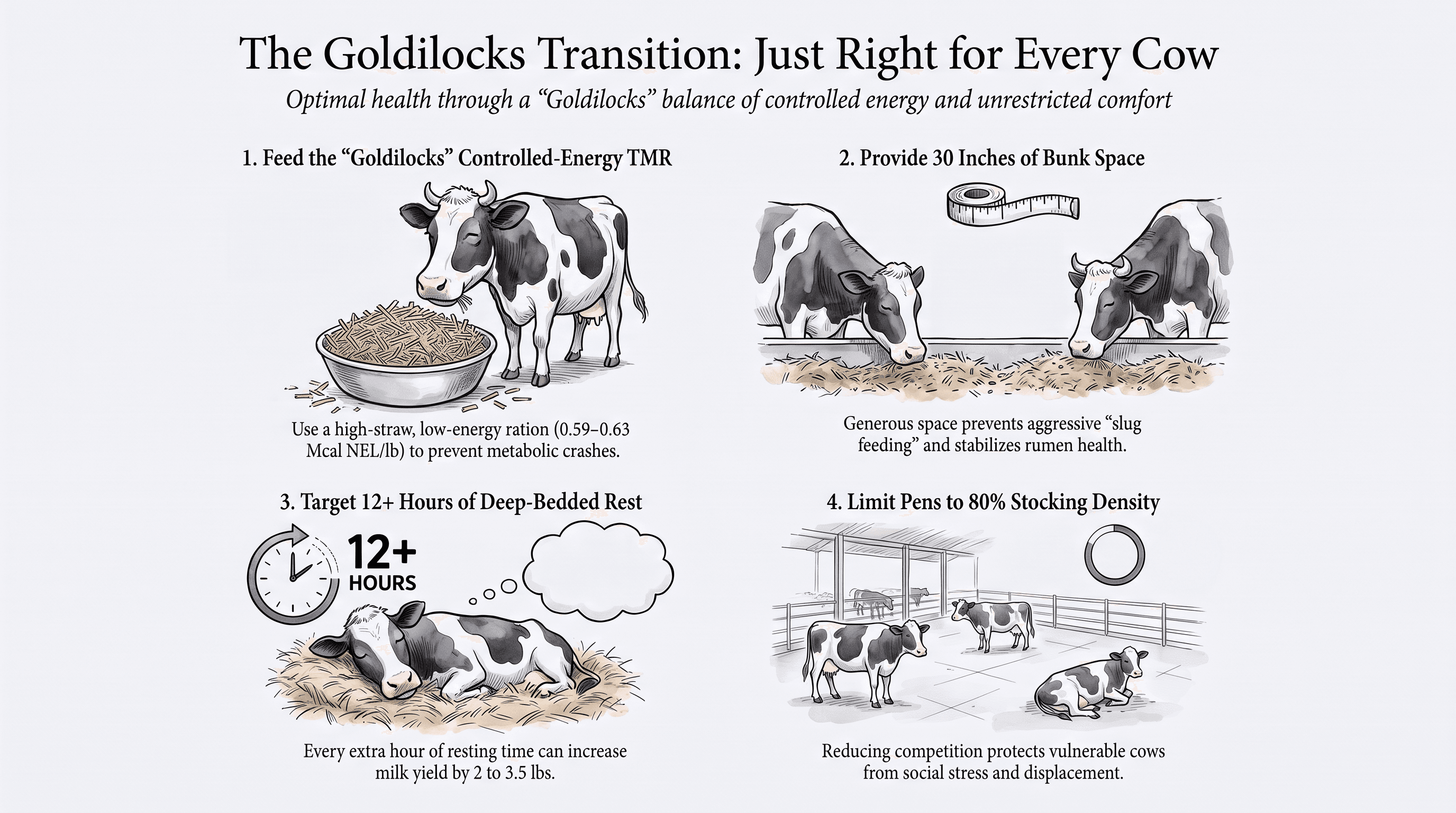
Controlled-energy dry-cow diets (often built with lower-energy forages such as wheat straw in a TMR) aim to keep cows from gaining excess condition while still supporting rumen fill and comfort. Exact formulas belong with the nutritionist and forages on hand; the field idea is density control, not starvation.
In the final weeks before calving, competition at the bunk becomes a transition disease factory. If subordinate cows cannot eat when they want, the same calcium and energy systems you primed on paper never get fed in practice. Aim for generous linear bunk space — roughly 30 inches per cow is a common extension target — and watch sorting, push-ups, and stocking in the close-up pen.
Sister notes on this universe already cover the DCAD sweet spot, when the fresh cow’s energy gap widens, the heifer who never owned a stall at 120% stocking, and why intake comes before the next additive. The dry period is recovery time for the mammary gland and the next lactation. Keep length in a controlled 40–60 day window for most cows, manage energy density so cows do not over-condition, and protect close-up bunk access so the transition diet can actually be eaten. Educational only—not a diagnosis, prescription, or ration formula.
Keep reading
View the networkNext
When the fresh cow’s energy gap widens
After calving, milk demand rises faster than intake — the gap is where ketone risk lives.
Knowledge level in this topic: Intermediate. Barn-side working knowledge in this topic: checks, pairing, and what to do next.Sister note · 3 min
Home plate: Transition · The transition cow · The ±3-week window
- The ±3-week windowThe windowPlaced here
- Intake before the next additiveTransition-cow intake is the first ration to protect: a heating TMR lowers the nutrients she can actually consume.Sister note
- The fresh pen was stocked at 120%Calving went well; in the fresh pen, 96 cows competed for 80 headlocks, and first-lactation cows paid in lost bunk access and intake.Sister note
- Stocking & cow flowStocking is stalls, bunk, lying, lockup, holding, and movement — not one percentage. UW Dairyland: those resources fail separately.Bridge → Barn
Mark size is the kind. Color is the atlas area.
- Sheet
- Focus
- Field note
- Transition
- Barn
Sources
- Total Mixed Rations for Dairy Cows — Penn State Extension
- Body Condition in Transition Cows — Penn State Extension
- Transition Cow Housing — UW Dairyland Initiative