
Digital Cushion Thickness, Body Condition, and Sole Ulcer Risk
Thin digital cushions after calving leave the sole unprotected — body-condition loss and cushion thickness are tightly linked to sole-ulcer risk; hard floors matter, but they are not the whole story.
3 min read · 2026-09-17
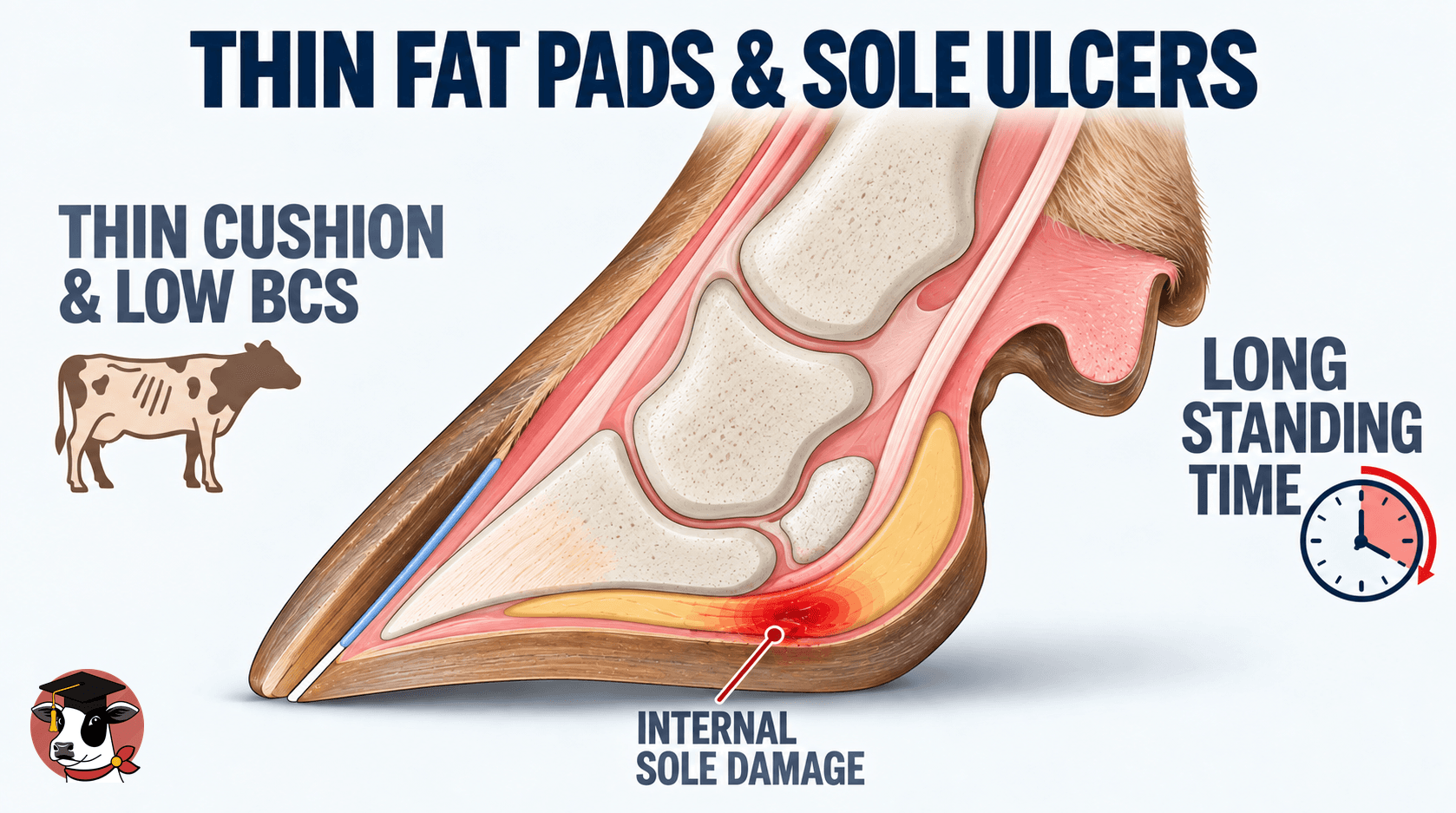
Sole ulcers are claw-horn lesions. Under the flexor tuberosity of the pedal bone sits the digital cushion — adipose and connective tissue that dampens load before it reaches the corium that grows sole. When that pad is thin, the same standing day is a heavier mechanical dose. Hard floors matter, but they are not the whole story; leave traction and wear geometry to the companion flooring note.
The cushion — often measured ultrasonographically with overlying soft tissue as “sole soft tissue” — sits where sole ulcers classically form. Thicker tissue is associated with lower odds of claw-horn disruption and lameness in multiple herds. Thickness also changes with parity and stage of lactation; it is not a fixed factory part.
Body condition and cushion thickness move together: cows with more body fat tend to have thicker cushions, and the periparturient window is when both are under pressure. Ultrasound studies show soft tissues often thinner around calving and into early lactation than in late pregnancy. Absolute thinness is the risk signal farms can act on — do not wait for an open sole ulcer to invent a transition plan. When an ulcer is already present, local swelling can temporarily thicken the measurement — another reason early BCS and standing-time management beat post-hoc ultrasound excuses.
A thinned cushion plus long forced standing — holding pens, overcrowded freestalls, slow parlor returns — concentrates load on the corium. Contusion becomes hemorrhage; continued crush becomes ulcer. Early pull of the first mild limp, and mechanical off-load once a lesion exists, belong to the early-detection and hoof-block notes; here the prevention lever is keeping the pad thicker and the daily standing dose shorter through transition. Leave ration versus “laminitis” debates to the diet companion note.
Check in the barn
What to check: What BCS do dry and close-up cows actually calve at — and how many points are lost by 60 DIM? Who owns lying time and time-away-from-pen audits for fresh cows? Are mild limps in the first 100 DIM pulled to the chute, or only non-weight-bearing cows? Do first-lactation and thin cows get priority freestall and holding-pen management? After a sole ulcer, is there a plan so the next lactation does not start with the same thin-pad and long-standing combination?
Keep reading
View the networkNext
Sole Ulcers, Laminitis, and Diet: Separating Evidence from Assumption
Sole ulcers get blamed on “too much grain” more often than the evidence supports — separate diet risk from flooring, standing time, and claw mechanics before rewriting the ration.
Sister note · 3 min
Home plate: Hoof · Why hoof lesions develop · Transition, body condition & the digital cushion
- Transition, body condition & the digital cushionThe pad thinsPlaced here
- Hoof Blocks and Off-Loading: Taking Pressure Off the Painful ClawA hoof block is mechanical off-load for a painful claw-horn lesion — not a spray substitute. Sound-claw selection, placement, and a timed recheck decide whether it helps or harms.Sister note
- Name horn or skin before you sprayDigital dermatitis and a sole ulcer fail entirely different tissues. One protocol cannot fix both.Sister note
Mark size is the kind. Color is the atlas area.
- Focus
- Field note
- Hoof
Sources
- Lameness in dairy cattle: A debilitating disease or a disease of debilitated cattle? A cross-sectional study of lameness prevalence and thickness of the digital cushion — Bicalho RC, Machado VS, Caixeta LS, Journal of Dairy Science (2009);92(7):3175–3184
- A prospective cohort study of digital cushion and corium thickness. Part 1: Associations with body condition, lesion incidence, and proximity to calving — Newsome RF, et al., Journal of Dairy Science (2017);100(6):4745–4758
- A prospective cohort study of digital cushion and corium thickness. Part 2: Does thinning of the digital cushion and corium lead to lameness and claw horn disruption lesions? — Newsome RF, et al., Journal of Dairy Science (2017);100(6):4759–4771
- Use of data collected at cessation of lactation to predict incidence of sole ulcers and white line disease during the subsequent lactation in dairy cows — Machado VS, Caixeta LS, Bicalho RC, American Journal of Veterinary Research (2011);72(10):1338–1343
- Mobility scoring: How to score your cows (early detection only) — AHDB Knowledge Library