
Compare the feed, not the water
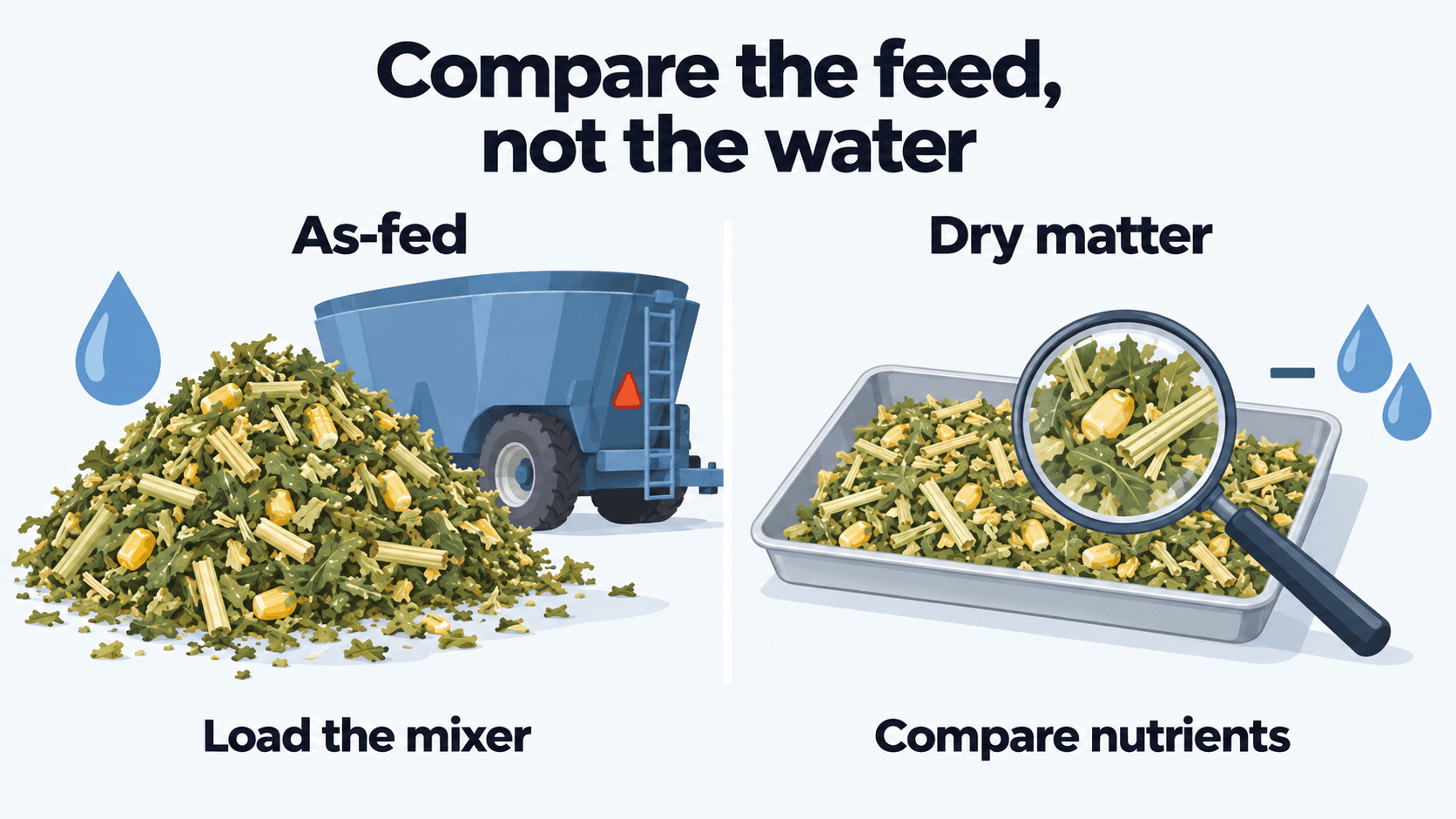
As-fed columns answer loading questions; dry-matter columns answer nutrient-concentration questions.
4 min read · 2026-09-17
In this note
- 30–35%
- 30–40%
Wet corn silage can look poorer in protein, starch, and fiber than dry hay when both are read as-fed. Much of that gap is water. Removing water mathematically puts nutrient concentrations on a comparable basis so you can ask what the dry material actually contains.
Extension forage-report guides keep the jobs separate. Use dry-matter values to compare feeds and to talk with the nutritionist about nutrient concentration. Return to as-fed kilograms when the mixer is loaded. Whole-plant corn silage is commonly harvested around 30–35% dry matter, with fermented silage often landing nearer 30–40% DM — those windows change as-fed weight without rewriting the dry-matter chemistry. Do not treat an as-fed column as a nutrient comparison.
Check in the barn
What to check: Which column did someone quote — as-fed or dry matter? If two forages are being ranked, are they both on DM? If the mixer sheet changed, was that an as-fed load correction or a nutrient rewrite? Say the basis out loud before the number leaves the page.
Sister notes on this universe cover dry-matter-drift-changes-the-load, when moisture moves the load even if the ticket looks unchanged, and a-number-without-a-unit-is-not-a-result. The physically-effective-fiber universe’s water-is-a-fiber-plasticizer note picks up how forage dry matter also changes mixing and the particle box. Educational only — not a diagnosis, prescription, or ration formula.
Keep reading
View the networkNext
Dry-matter drift changes the load
When silage moisture moves and mixer kilograms stay fixed, nutrient delivery moves even if the written ration does not.
Sister note · 4 min
Home plate: Rumen · Reading the feed report · As-fed vs dry matter
- As-fed vs dry matterChoose the columnPlaced here
- A number without a unit is not a resultPercent, ppm, mg/kg, Mcal/lb, and Mcal/kg can turn the same digits into very different decisions.Sister note
- The laboratory cannot fix the sampleA precise analysis of one biased handful is still a poor estimate of the feed the herd is eating.Sister note
- Intake & the energy gapIntakeBridge → Transition
Mark size is the kind. Color is the atlas area.
- Focus
- Field note
- Rumen
- Transition
Sources
- Understanding your forage test results — Oregon State University Extension
- Understanding and Using a Feed Analysis Report — University of Nebraska–Lincoln Extension
- Reading a Forage Analysis Report — University of Kentucky Extension