
Build the stall around the rise
High-producing cows need 12–14 hours lying. A stall that blocks the rise charges that time back as standing, collisions, and lesions.
Knowledge level in this topic: Intermediate. Barn-side working knowledge in this topic: checks, pairing, and what to do next.
3 min read · 2026-09-09
In this note
- 48–54 inches
- 48–50 inches
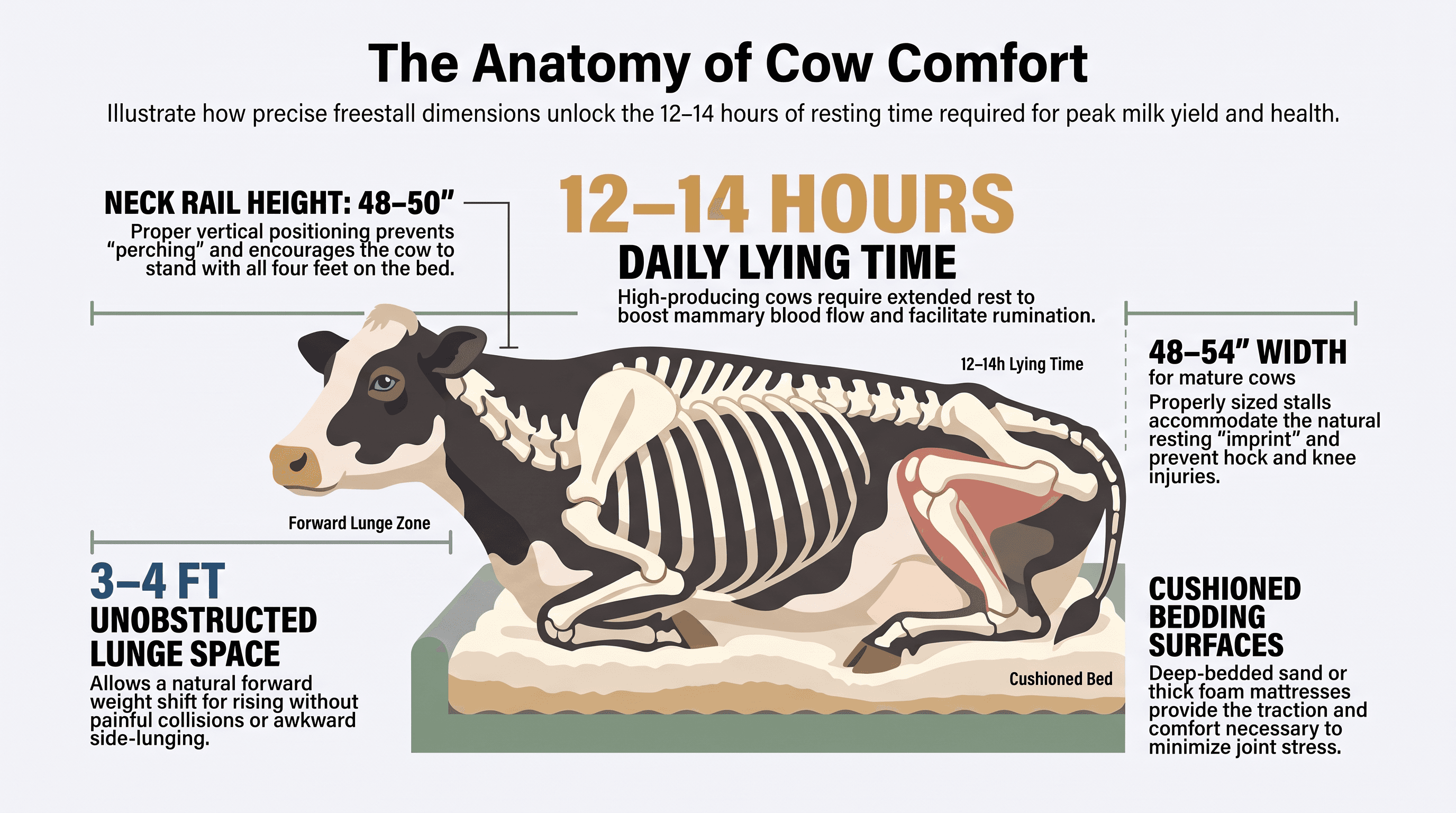
- 12–14 hours
A high-producing cow is designed to spend 12–14 hours a day lying down. That time is not idle: it is rumination, mammary blood flow, and the opposite of the standing "dose" that later shows up as claw-horn lesions. The stall either invites that rest or taxes it.
Cows do not sit up. They lunge forward, shift weight, and swing the hindquarters. If the neck rail is too low, the brisket locator too far back, or the front wall too close, she hesitates, perches (front feet on the bed, hind feet in the alley), or side-lunges into hardware. Those are design errors, not cow faults. Typical mature-cow starting points from extension stall work — not a one-size recipe — include about 48–54 inches of stall width, a neck rail near 48–50 inches, and 3–4 feet of unobstructed forward lunge. Fit the cow in front of you; a first-calf heifer and a mature Holstein do not share the same imprint.
Deep sand or a well-maintained thick mattress gives traction for the rise and cushion for the hocks and knees. A slick, thin, or hollowed bed makes the same geometry feel smaller: she will stand in the alley rather than commit to a stall she cannot trust.
Watch one cow lie down and get up. Count collisions, delayed rises, perching, and cows standing half-in. Soft or wet shoulders, hock lesions, and empty stalls next to a full alley mean the stall is charging time. Tighten dimensions and bedding before adding more stalls on paper — stocking only works if the stall itself is usable.
Design every stall around the cow's natural rise and lie. Hesitation, perching, collisions, or alley-standing are time-and-health penalties — and they steal the same 12–14 hours the hoof and the rumen were counting on. Sister notes on this universe cover stocking density as a time budget; the lameness universe's standing time is the dose note picks up when concrete hours load the corium. Educational only—not a diagnosis, prescription, or barn blueprint.
Keep reading
View the networkNext
Stocking density is a time budget
Overstocking steals lying and eating time. Manage stalls, bunk, and flow, not headcount alone.
Knowledge level in this topic: Intermediate. Barn-side working knowledge in this topic: checks, pairing, and what to do next.Sister note · 3 min
Home plate: Barn · Stocking & cow flow · Lying time
- Lying timeStallsPlaced here
- A rising fetch list is a time-budget failureRobots succeed when cows choose the box and still get 12–14 hours lying. A climbing fetch list means the barn is stealing that time.Sister note
- They closed a crossover to add stallsHeadcount math ignores behavioral biology: walling off a crossover crippled cow flow and penalized subordinate cows.Sister note
- Standing timeThe doseBridge → Hoof
Mark size is the kind. Color is the atlas area.
- Focus
- Field note
- Hoof
- Barn
Sources
- Freestall Dimensions — UW Dairyland Initiative
- Stocking Density — UW Dairyland Initiative