
Ash is not a mineral panel
Ash measures total inorganic residue; it cannot tell whether calcium, potassium, or soil contamination caused the result.
4 min read · 2026-09-17
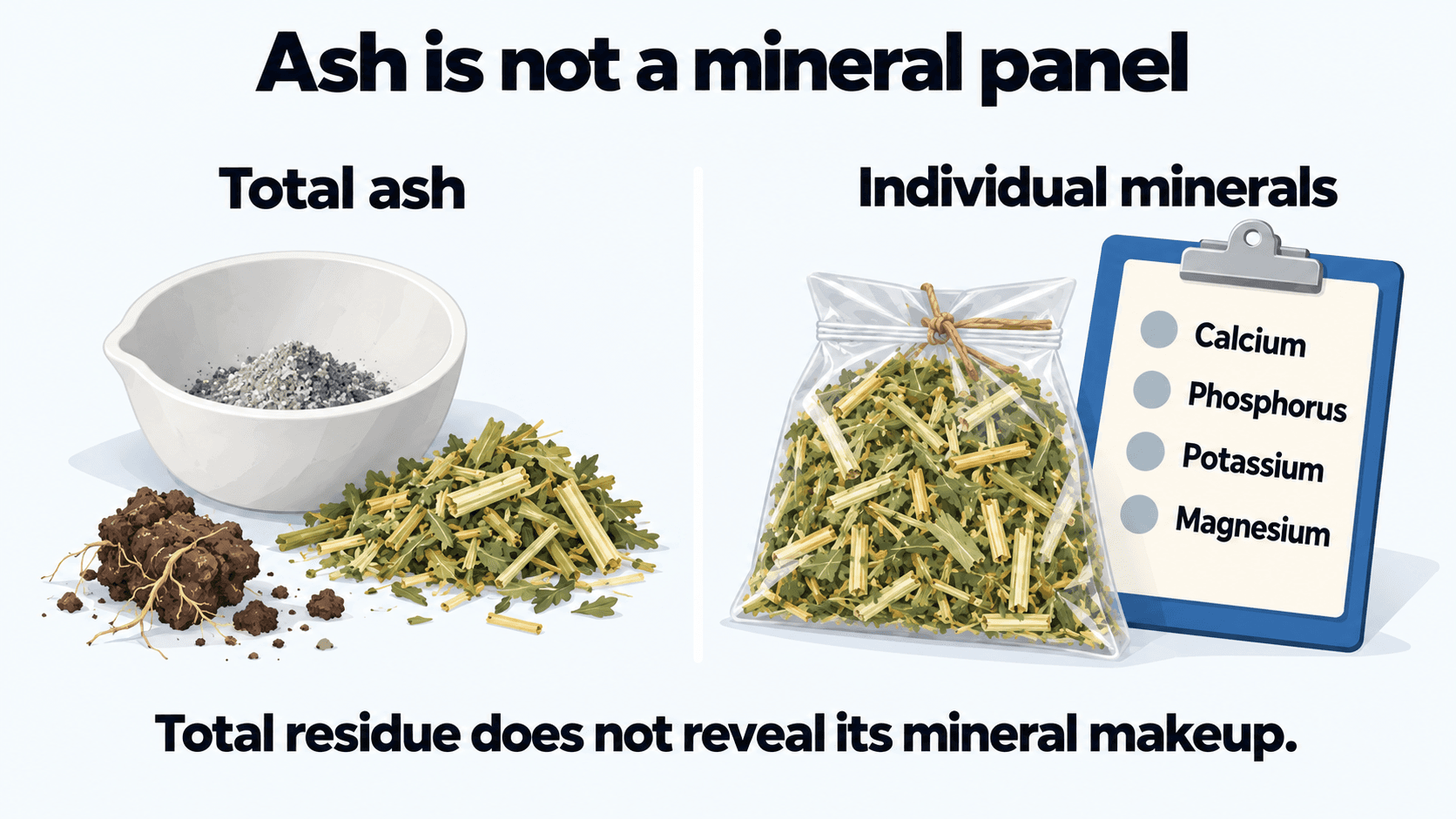
The ash line is the residue after combustion. Essential minerals contribute. So can soil raked in at harvest, sand, or a dirty sample bag. A high value therefore asks a question. It does not name calcium, potassium, phosphorus, or dirt.
Oregon State and Nebraska forage-report guides read ash as a total, then send you to the mineral panel and the field history. A jump relative to your own crop and harvest notes is the alarm — not a license to pull a supplement. Pair ash with individual minerals, harvest conditions, feed appearance, and a representative repeat sample when the change is unexpected. Do not subtract a mineral supplement because ash rose.
Check in the barn
What to check: Did ash move against this farm’s own baseline for that crop? Do calcium, potassium, and the rest of the panel move with it, or is the total unexplained? Was the sample dirty, taken from a muddy face, or cored through weathered bale caps? Repeat the sample before you rewrite minerals.
Sister notes on this universe cover mineral-concentration-is-not-daily-supply and the-water-trough-is-in-the-mineral-program. The-lab-cannot-fix-the-sample is the usual reason a surprising ash line cannot be trusted on the first bag. Educational only — not a diagnosis, prescription, or ration formula.
Keep reading
View the networkNext
The water trough is in the mineral program
Water can supply sulfur, sodium, chloride, iron, and other minerals every time the cow drinks.
Sister note · 4 min
Home plate: Rumen · The feed composition map · Ash & organic matter
- Ash & organic matterSecond splitPlaced here
- Mineral concentration is not daily supplyThe cow receives grams or milligrams per day, not a percentage printed for one ingredient.Sister note
- A number without a unit is not a resultPercent, ppm, mg/kg, Mcal/lb, and Mcal/kg can turn the same digits into very different decisions.Same sheet
Mark size is the kind. Color is the atlas area.
- Focus
- Field note
- Rumen
Sources
- Understanding your forage test results — Oregon State University Extension
- Understanding and Using a Feed Analysis Report — University of Nebraska–Lincoln Extension
- Reading a Forage Analysis Report — University of Kentucky Extension