
Air at the face spoils the pack
Dense packing and oxygen-barrier cover lock fermentation in. A ragged, slow face lets air back in and burns dry matter at the bunk.
3 min read · 2026-09-09
In this note
- ~30–35%
- ~30–40%
- ~4–7%
- 15–16 lb
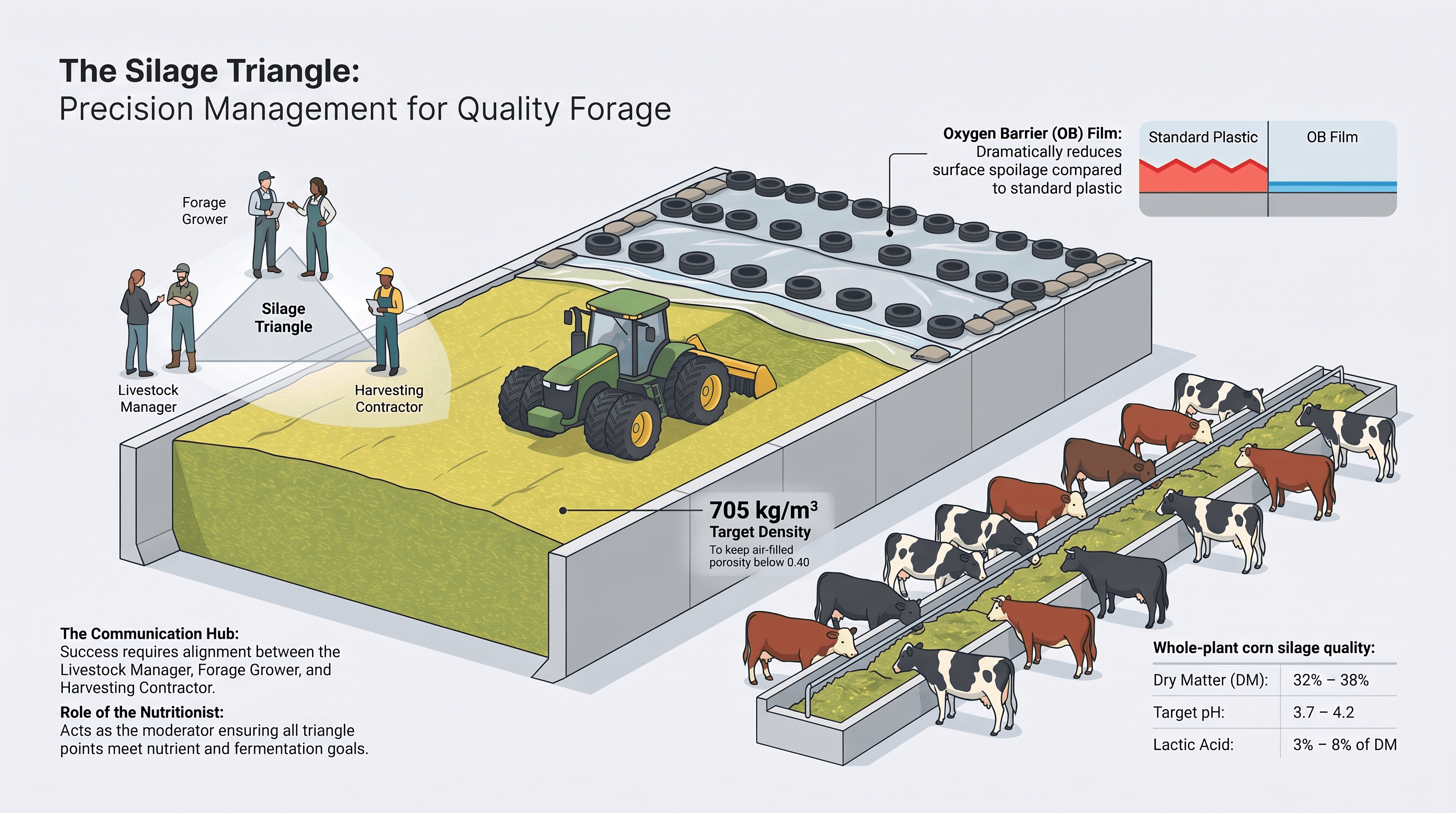
Silage quality is decided long before the TMR mixer. Once forage is chopped, the pack is a race against oxygen: dense packing and a real oxygen-barrier cover lock fermentation in; a ragged, slow-moving face lets air back in and burns dry matter, energy, and bunk life.
Success needs alignment among the forage grower, harvesting contractor, and livestock manager — with the nutritionist moderating toward shared dry-matter, particle-size, and fermentation targets. Misaligned harvest windows or packing rates show up later as heating at the face and selective sorting at the bunk.
Aim for a minimum bulk density near ≥700 kg as-fed (AF)/m³ (about 44 lb AF/ft³) so porosity stays low across normal ensiling dry matters; companion DM-density targets are often ≥15–16 lb DM/ft³. Say AF vs DM out loud — they are not the same number. Whole-plant corn silage is commonly harvested around ~30–35% DM, with fermented silage often landing in a broader ~30–40% DM window; well-preserved corn silage typically shows pH ~3.7–4.2 and lactic acid ~4–7% of DM (Kung & Shaver).
A smooth, progressive face and a removal rate that keeps pace with the herd limit reheating. Spoiled surface layers that reach the bunk depress intake and dilute the fiber and energy the rumen was formulated for — so face discipline is energy and delivery, not just "storage hygiene."
Walk the face: heating, mold seams, and a soft shoulder mean oxygen is winning. Tighten cover edges, raise packing density next fill, and match face advance to daily disappearance before blaming the ration.
Keep reading
View the networkNext
Particle size holds the fiber mat
If the TMR is too fine, the forage raft thins — less trapping, less re-chewing, less bicarbonate-rich saliva.
Sister note · 3 min
Home plate: Rumen · Inside the rumen
- Inside the rumenA dairy cow is a microbial fermentation system. Open the vat: four compartments, a stratified rumen, chewing, acids, and what leaves downstream.Placed here
- Read manure before you rewrite the ticketThe alley is a daily report card on the ration the cow actually ate and fermented — consistency, fiber, and grain tell you before the mixer does.Same sheet
- The sensor is a barn alarm, not a diagnosisRumination and activity collars flag deviations from a cow’s own baseline — useful alarms that still need the cow, bunk, and stall before you act.Same sheet
- Intake & the energy gapIntakeBridge → Transition
Mark size is the kind. Color is the atlas area.
- Sheet
- Focus
- Field note
- Rumen
- Transition
Sources
- Packing Bunkers and Piles to Maximize Forage Preservation — UW–Madison Extension (Holmes & Muck)
- Interpretation and Use of Silage Fermentation Analysis Reports — UW–Madison Extension (Kung & Shaver)
- Silage Management Considerations — LPELC / University extension consortium
- Silage Harvesting, Storing, and Feeding — UF/IFAS Extension (SS-AGR-177)
- Chopping and Storing Quality Corn Silage — Utah State University Extension