
A number without a unit is not a result
Percent, ppm, mg/kg, Mcal/lb, and Mcal/kg can turn the same digits into very different decisions.
4 min read · 2026-09-17
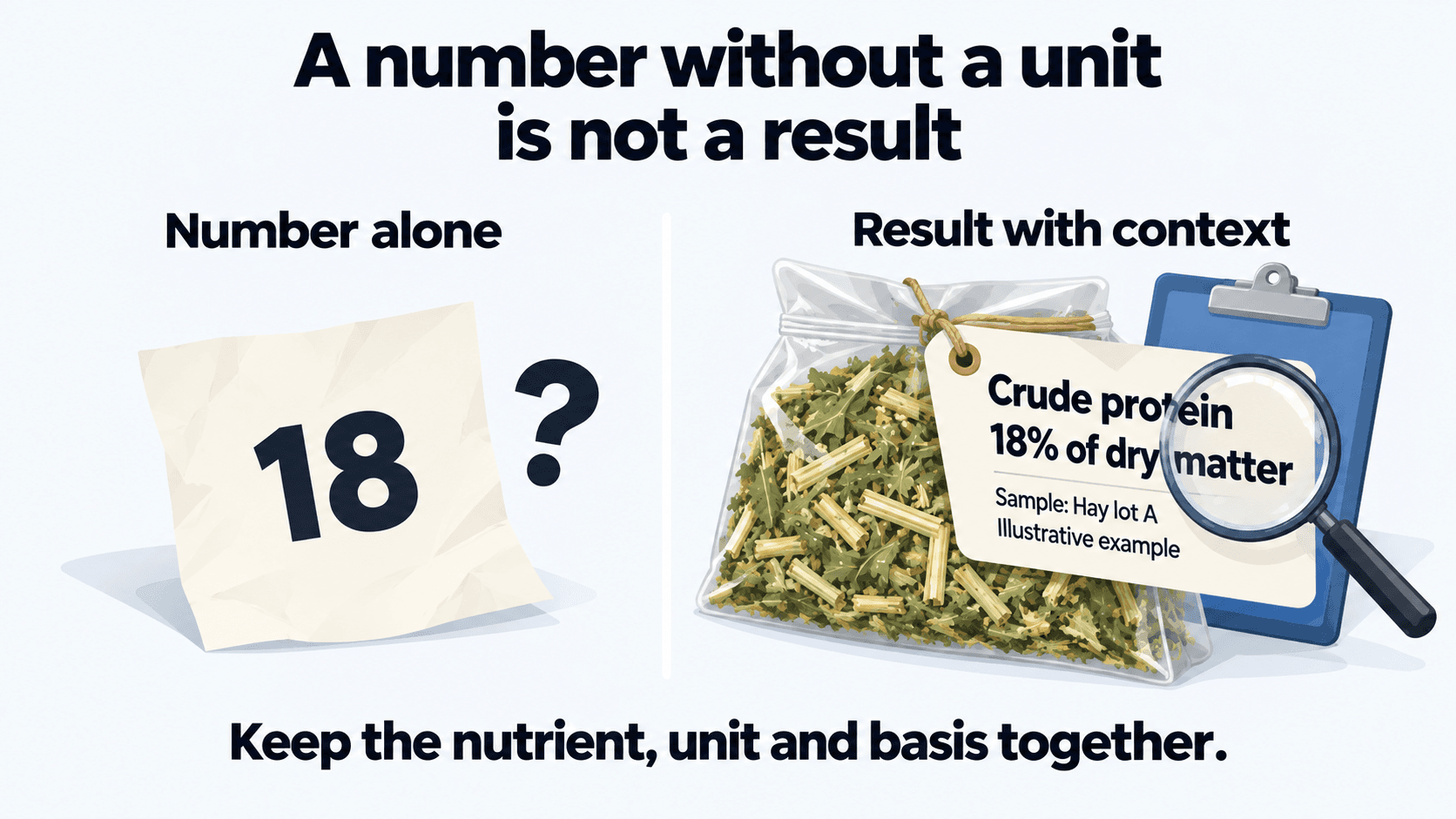
A copied value loses meaning when its basis and unit stay behind. Eighteen is not a result. Eighteen percent crude protein of dry matter on hay lot A is a result. The same digits for selenium, copper, or energy can be a ration-changing error if percent, ppm, mg/kg, Mcal/lb, and Mcal/kg get swapped.
NASEM and extension report guides treat unit and basis as part of the measurement. Trace minerals are where this is most expensive: a percent and a ppm are not interchangeable, and energy per pound is not energy per kilogram. The useful habit is to keep the nutrient name, number, unit, dry-matter or as-fed basis, method, and sample identity together — never paste a bare number into a ration program.
Check in the barn
What to check: Does the number still have its nutrient name? Is the basis DM or as-fed? Is the unit percent, ppm, mg/kg, or Mcal? Did the laboratory method stay with the value? If any piece dropped in the email or the software field, the number is no longer a result.
Sister notes on this universe cover the-lab-cannot-fix-the-sample and compare-dry-matter-not-water. The reading-minerals universe’s mineral-concentration-is-not-daily-supply note is the next conversion: even a correctly labeled concentration still has to become grams per day. Educational only — not a diagnosis, prescription, or ration formula.
Keep reading
View the networkNext
Mineral concentration is not daily supply
The cow receives grams or milligrams per day, not a percentage printed for one ingredient.
Sister note · 4 min
Home plate: Rumen · Reading the feed report · Percent, ppm, and energy units
- Percent, ppm, and energy unitsRead the scalePlaced here
- Compare the feed, not the waterAs-fed columns answer loading questions; dry-matter columns answer nutrient-concentration questions.Sister note
- The laboratory cannot fix the sampleA precise analysis of one biased handful is still a poor estimate of the feed the herd is eating.Sister note
Mark size is the kind. Color is the atlas area.
- Focus
- Field note
- Rumen
Sources
- Understanding and Using a Feed Analysis Report — University of Nebraska–Lincoln Extension
- Forage Laboratory Analytical Procedures — Dairy One Forage Laboratory
- Nutrient Requirements of Dairy Cattle, 8th revised edition — NASEM (2021)